Cammas Anne, Millevoi Stefania
Université Fédérale Toulouse Midi-Pyrénées, Université Toulouse III-Paul Sabatier, Inserm, CRCT, Toulouse, France.
Nucleic Acids Res. 2017 Feb 28;45(4):1584-1595. doi: 10.1093/nar/gkw1280.
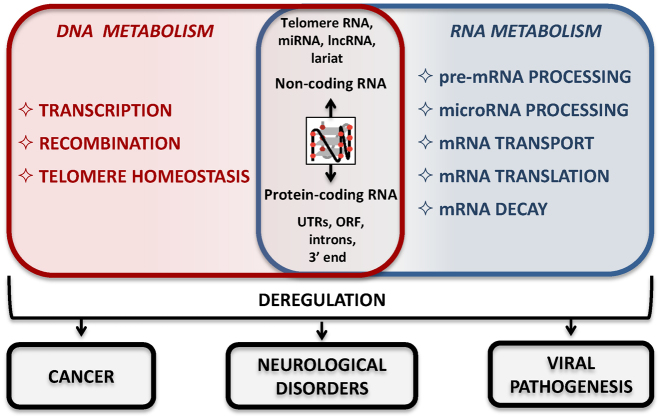
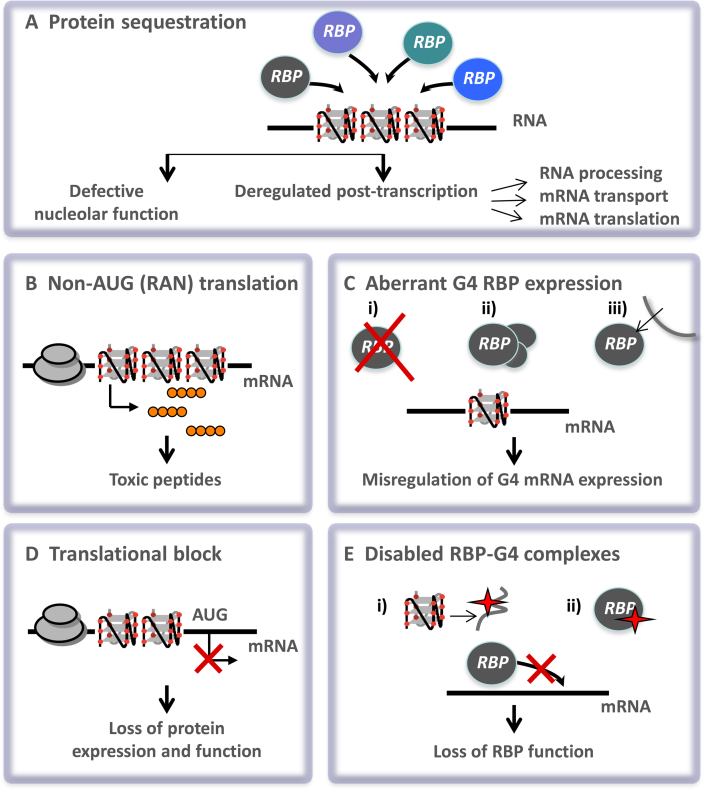
RNA G-quadruplexes (G4s) are formed by G-rich RNA sequences in protein-coding (mRNA) and non-coding (ncRNA) transcripts that fold into a four-stranded conformation. Experimental studies and bioinformatic predictions support the view that these structures are involved in different cellular functions associated to both DNA processes (telomere elongation, recombination and transcription) and RNA post-transcriptional mechanisms (including pre-mRNA processing, mRNA turnover, targeting and translation). An increasing number of different diseases have been associated with the inappropriate regulation of RNA G4s exemplifying the potential importance of these structures on human health. Here, we review the different molecular mechanisms underlying the link between RNA G4s and human diseases by proposing several overlapping models of deregulation emerging from recent research, including (i) sequestration of RNA-binding proteins, (ii) aberrant expression or localization of RNA G4-binding proteins, (iii) repeat associated non-AUG (RAN) translation, (iv) mRNA translational blockade and (v) disabling of protein-RNA G4 complexes. This review also provides a comprehensive survey of the functional RNA G4 and their mechanisms of action. Finally, we highlight future directions for research aimed at improving our understanding on RNA G4-mediated regulatory mechanisms linked to diseases.
RNA G-四链体(G4s)由富含鸟嘌呤的RNA序列形成,这些序列存在于蛋白质编码(mRNA)和非编码(ncRNA)转录本中,并折叠成四链构象。实验研究和生物信息学预测支持这样一种观点,即这些结构参与了与DNA过程(端粒延长、重组和转录)以及RNA转录后机制(包括前体mRNA加工、mRNA周转、靶向和翻译)相关的不同细胞功能。越来越多的不同疾病与RNA G4s的调控异常有关,这例证了这些结构对人类健康的潜在重要性。在这里,我们通过提出近期研究中出现的几种重叠的失调模型,综述了RNA G4s与人类疾病之间联系的不同分子机制,包括:(i)RNA结合蛋白的隔离;(ii)RNA G4结合蛋白的异常表达或定位;(iii)重复相关非AUG(RAN)翻译;(iv)mRNA翻译阻断;以及(v)蛋白质-RNA G4复合物的失活。本综述还全面概述了功能性RNA G4及其作用机制。最后,我们强调了未来研究方向,旨在增进我们对与疾病相关的RNA G4介导的调控机制的理解。