Farr O M, Mantzoros C S
Division of Endocrinology, Department of Medicine, Beth-Israel Deaconess Medical Center/Harvard Medical School, Boston, MAUSA.
Int J Obes (Lond). 2017 Mar;41(3):471-474. doi: 10.1038/ijo.2016.231. Epub 2016 Dec 26.
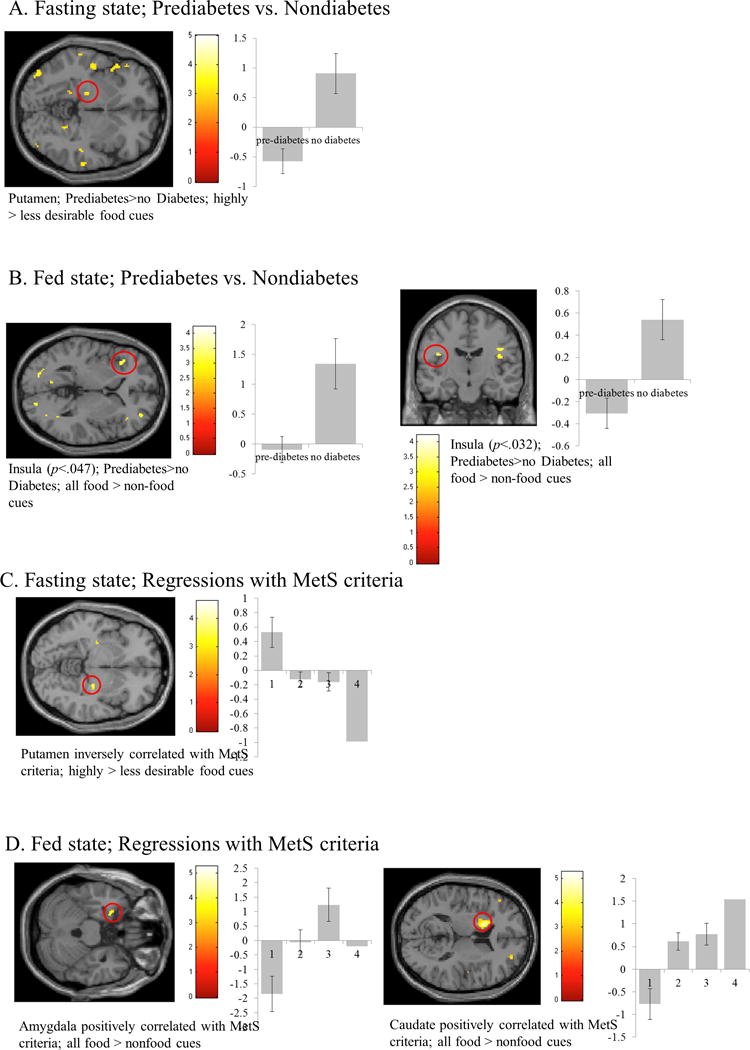
It remains unknown whether obese individuals with more components of the metabolic syndrome and/or prediabetes demonstrate altered activation of brain centers in response to food cues. We examined obese individuals with prediabetes (n=26) vs obese individuals without prediabetes (n=11) using fMRI. We also performed regression analyses on the basis of the number of MetS components per subject. Obese individuals with prediabetes have decreased activation of the reward-related putamen in the fasting state and decreased activation of the salience- and reward-related insula after eating. Obese individuals with more components of MetS demonstrate decreased activation of the putamen while fasting. All these activations remain significant when corrected for BMI, waist circumference (WC), HbA1c and gender. Decreased activation in the reward-related central nervous system areas among the obese is more pronounced in subjects with prediabetes and MetS. Prospective studies are needed to quantify their contributions to the development of prediabetes/MetS and to study whether they may predispose to the exacerbation of obesity and the development of comorbidities over time.
代谢综合征和/或糖尿病前期更多组分的肥胖个体对食物线索的反应是否表现出脑中枢激活改变仍不清楚。我们使用功能磁共振成像(fMRI)检查了患有糖尿病前期的肥胖个体(n = 26)与无糖尿病前期的肥胖个体(n = 11)。我们还根据每个受试者的代谢综合征(MetS)组分数量进行了回归分析。患有糖尿病前期的肥胖个体在禁食状态下与奖励相关的壳核激活降低,进食后与显著性和奖励相关的脑岛激活降低。具有更多MetS组分的肥胖个体在禁食时壳核激活降低。在校正体重指数(BMI)、腰围(WC)、糖化血红蛋白(HbA1c)和性别后,所有这些激活仍具有显著性。肥胖者中与奖励相关的中枢神经系统区域激活降低在患有糖尿病前期和MetS的受试者中更为明显。需要进行前瞻性研究以量化它们对糖尿病前期/MetS发展的影响,并研究随着时间推移它们是否可能易导致肥胖加剧和合并症的发生。