Pednekar Lina, Pathan Ansar A, Paudyal Basudev, Tsolaki Anthony G, Kaur Anuvinder, Abozaid Suhair M, Kouser Lubna, Khan Haseeb A, Peerschke Ellinor I, Shamji Mohamed H, Stenbeck Gudrun, Ghebrehiwet Berhane, Kishore Uday
Biosciences, College of Health and Life Sciences, Brunel University London , London , UK.
Department of Biochemistry, College of Science, King Saud University , Riyadh , Saudi Arabia.
Front Immunol. 2016 Dec 13;7:567. doi: 10.3389/fimmu.2016.00567. eCollection 2016.
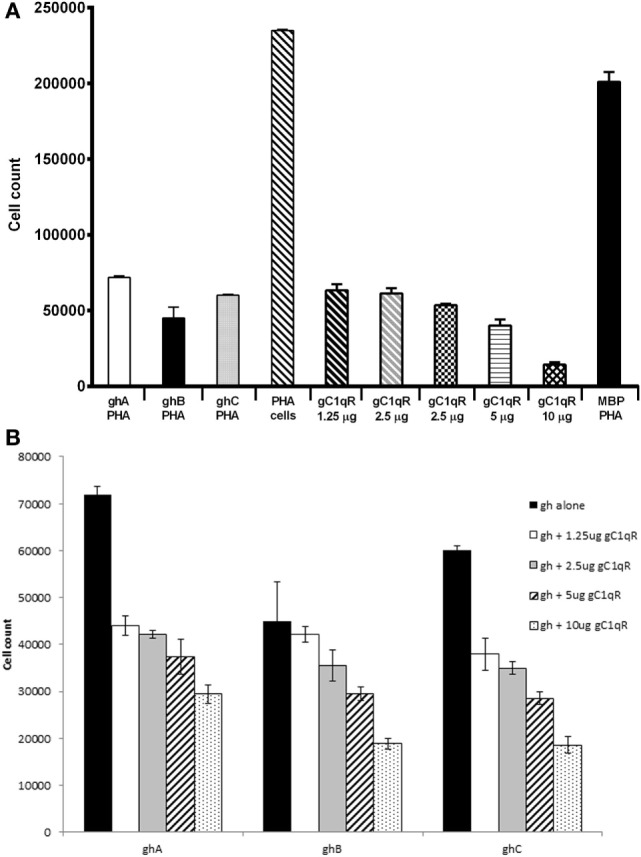
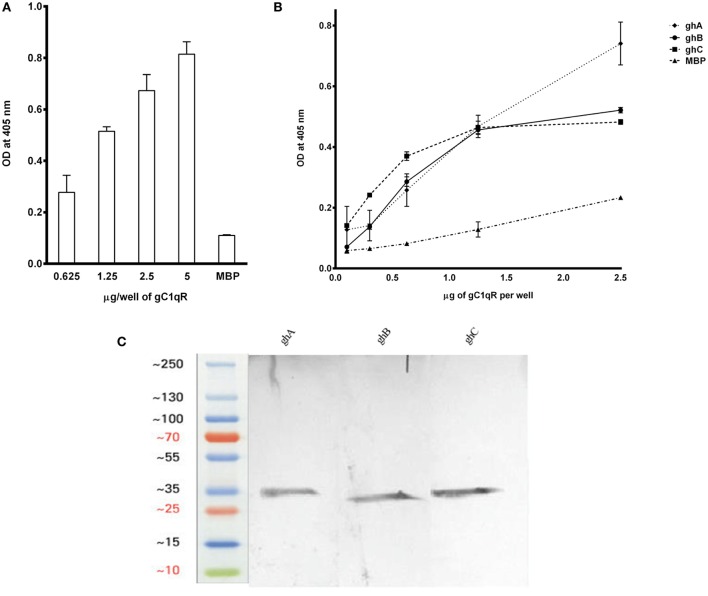
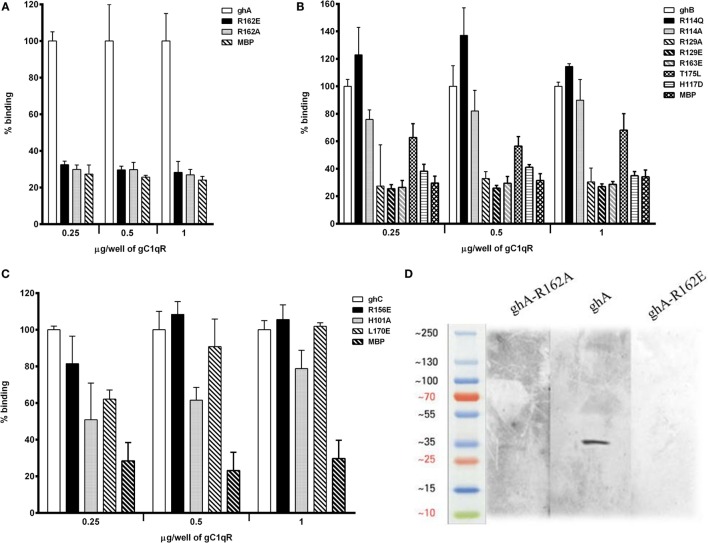
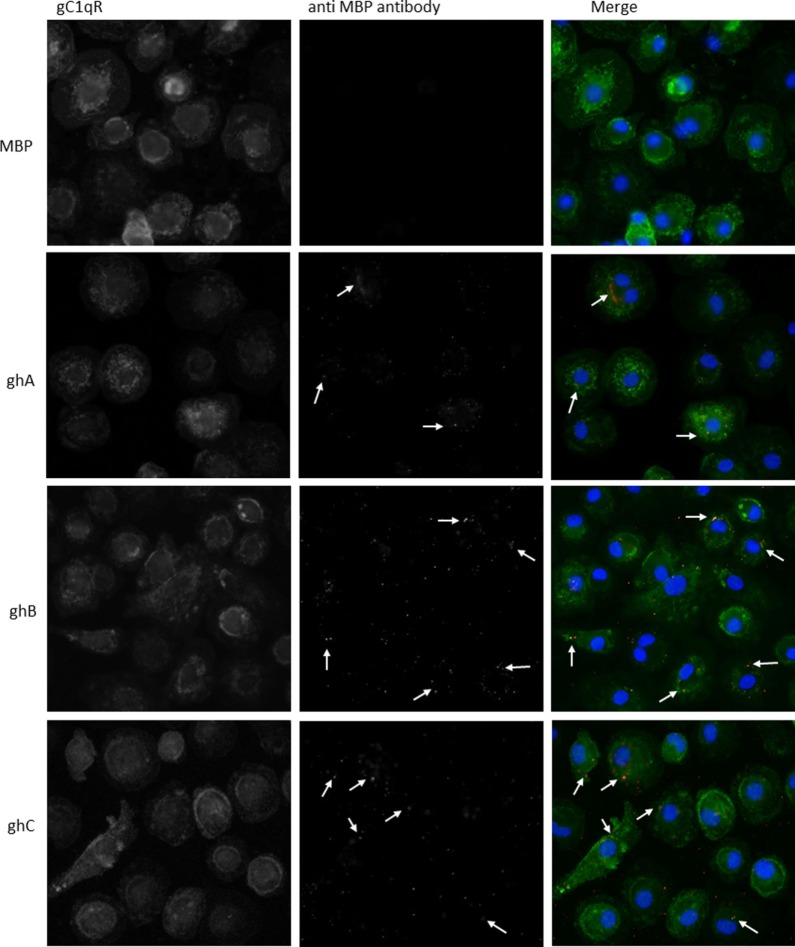
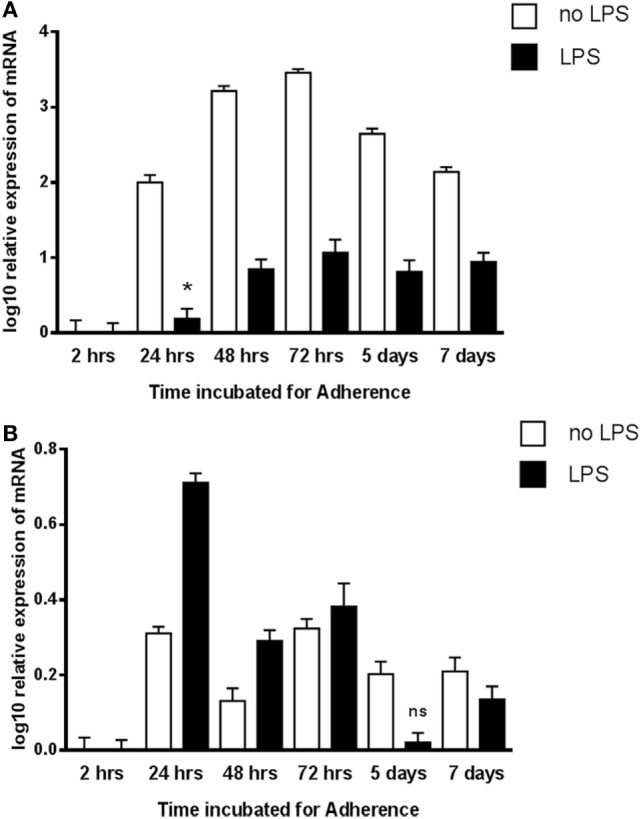
The heterotrimeric globular head (gC1q) domain of human C1q is made up of the C-terminal ends of the three individual chains, ghA, ghB, and ghC. A candidate receptor for the gC1q domain is a multi-functional pattern recognition protein, gC1qR. Since understanding of gC1qR and gC1q interaction could provide an insight into the pleiotropic functions of gC1qR, this study was undertaken to identify the gC1qR-binding site on the gC1q domain, using the recombinant ghA, ghB, and ghC modules and their substitution mutants. Our results show that ghA, ghB, and ghC modules can interact with gC1qR independently, thus reinforcing the notion of modularity within the gC1q domain of human C1q. Mutational analysis revealed that while Arg162 in the ghA module is central to interaction between gC1qR and C1q, a single amino acid substitution (arginine to glutamate) in residue 114 of the ghB module resulted in enhanced binding. Expression of gC1qR and C1q in adherent monocytes with or without pro-inflammatory stimuli was also analyzed by qPCR; it showed an autocrine/paracrine basis of C1q and gC1qR interaction. Microscopic studies revealed that C1q and gC1qR are colocalized on PBMCs. Cell proliferation assays indicated that ghA, ghB, and ghC modules were able to attenuate phytohemagglutinin-stimulated proliferation of PBMCs. Addition of gC1qR had an additive effect on the anti-proliferative effect of globular head modules. In summary, our results identify residues involved in C1q-gC1qR interaction and explain, to a certain level, their involvement on the immune cell surface, which is relevant for C1q-induced functions including inflammation, infection, and immunity.
人C1q的异源三聚体球状头部(gC1q)结构域由三条独立链(ghA、ghB和ghC)的C末端组成。gC1q结构域的一个候选受体是多功能模式识别蛋白gC1qR。由于了解gC1qR与gC1q的相互作用有助于深入了解gC1qR的多效性功能,因此本研究采用重组ghA、ghB和ghC模块及其替代突变体,以鉴定gC1q结构域上的gC1qR结合位点。我们的结果表明,ghA、ghB和ghC模块可独立与gC1qR相互作用,从而强化了人C1q的gC1q结构域内模块化的概念。突变分析显示,虽然ghA模块中的Arg162对于gC1qR与C1q之间的相互作用至关重要,但ghB模块第114位残基的单个氨基酸取代(精氨酸替换为谷氨酸)导致结合增强。还通过qPCR分析了有或无促炎刺激的贴壁单核细胞中gC1qR和C1q的表达;结果显示C1q与gC1qR的相互作用存在自分泌/旁分泌基础。显微镜研究表明,C1q和gC1qR共定位于外周血单核细胞(PBMC)上。细胞增殖试验表明,ghA、ghB和ghC模块能够减弱植物血凝素刺激的PBMC增殖。添加gC1qR对球状头部模块的抗增殖作用有累加效应。总之,我们的结果确定了参与C1q - gC1qR相互作用的残基,并在一定程度上解释了它们在免疫细胞表面的作用,这与C1q诱导的包括炎症、感染和免疫在内的功能相关。