
补体蛋白C1q与DC-SIGN及其球状结构域相互作用,因此可能干扰HIV-1传播。
Complement Protein C1q Interacts with DC-SIGN Its Globular Domain and Thus May Interfere with HIV-1 Transmission.
作者信息
Pednekar Lina, Pandit Hrishikesh, Paudyal Basudev, Kaur Anuvinder, Al-Mozaini Maha Ahmed, Kouser Lubna, Ghebrehiwet Berhane, Mitchell Daniel A, Madan Taruna, Kishore Uday
机构信息
Biosciences, College of Health and Life Sciences, Brunel University London , Uxbridge , UK.
Department of Innate Immunity, National Institute for Research in Reproductive Health (ICMR) , Mumbai , India.
出版信息
Front Immunol. 2016 Dec 22;7:600. doi: 10.3389/fimmu.2016.00600. eCollection 2016.
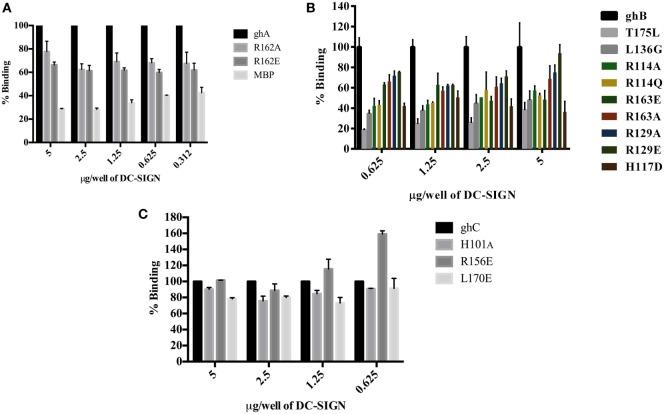
Dendritic cells (DCs) are the most potent antigen-presenting cells capable of priming naïve T-cells. Its C-type lectin receptor, DC-SIGN, regulates a wide range of immune functions. Along with its role in HIV-1 pathogenesis through complement opsonization of the virus, DC-SIGN has recently emerged as an adaptor for complement protein C1q on the surface of immature DCs a trimeric complex involving gC1qR, a receptor for the globular domain of C1q. Here, we have examined the nature of interaction between C1q and DC-SIGN in terms of domain localization, and implications of C1q-DC-SIGN-gC1qR complex formation on HIV-1 transmission. We first expressed and purified recombinant extracellular domains of DC-SIGN and its homologue DC-SIGNR as tetramers comprising of the entire extra cellular domain including the α-helical neck region and monomers comprising of the carbohydrate recognition domain only. Direct binding studies revealed that both DC-SIGN and DC-SIGNR were able to bind independently to the recombinant globular head modules ghA, ghB, and ghC, with ghB being the preferential binder. C1q appeared to interact with DC-SIGN or DC-SIGNR in a manner similar to IgG. Mutational analysis using single amino acid substitutions within the globular head modules showed that Tyr and Lys were critical for the C1q-DC-SIGN/DC-SIGNR interaction. Competitive studies revealed that gC1qR and ghB shared overlapping binding sites on DC-SIGN, implying that HIV-1 transmission by DCs could be modulated due to the interplay of gC1qR-C1q with DC-SIGN. Since C1q, gC1qR, and DC-SIGN can individually bind HIV-1, we examined how C1q and gC1qR modulated HIV-1-DC-SIGN interaction in an infection assay. Here, we report, for the first time, that C1q suppressed DC-SIGN-mediated transfer of HIV-1 to activated pooled peripheral blood mononuclear cells, although the globular head modules did not. The protective effect of C1q was negated by the addition of gC1qR. In fact, gC1qR enhanced DC-SIGN-mediated HIV-1 transfer, suggesting its role in HIV-1 pathogenesis. Our results highlight the consequences of multiple innate immune pattern recognition molecules forming a complex that can modify their functions in a way, which may be advantageous for the pathogen.
树突状细胞(DCs)是最强大的能够激活初始T细胞的抗原呈递细胞。其C型凝集素受体DC-SIGN可调节多种免疫功能。除了通过对病毒进行补体调理作用在HIV-1发病机制中发挥作用外,DC-SIGN最近还作为未成熟DC表面补体蛋白C1q的衔接蛋白出现——这是一种涉及gC1qR(C1q球状结构域的受体)的三聚体复合物。在此,我们从结构域定位方面研究了C1q与DC-SIGN之间相互作用的性质,以及C1q-DC-SIGN-gC1qR复合物形成对HIV-1传播的影响。我们首先表达并纯化了DC-SIGN及其同源物DC-SIGNR的重组细胞外结构域作为四聚体,其由包括α螺旋颈部区域的整个细胞外结构域组成,以及仅由碳水化合物识别结构域组成的单体。直接结合研究表明,DC-SIGN和DC-SIGNR都能够独立结合重组球状头部模块ghA、ghB和ghC,其中ghB是优先结合物。C1q似乎以类似于IgG的方式与DC-SIGN或DC-SIGNR相互作用。使用球状头部模块内的单个氨基酸取代进行的突变分析表明,酪氨酸(Tyr)和赖氨酸(Lys)对于C1q-DC-SIGN/DC-SIGNR相互作用至关重要。竞争性研究表明,gC1qR和ghB在DC-SIGN上共享重叠的结合位点,这意味着由于gC1qR-C1q与DC-SIGN之间的相互作用,DCs介导的HIV-1传播可能会受到调节。由于C1q、gC1qR和DC-SIGN都可以单独结合HIV-1,我们在感染试验中研究了C1q和gC1qR如何调节HIV-1-DC-SIGN相互作用。在此,我们首次报道,C1q抑制DC-SIGN介导的HIV-1向活化的汇集外周血单个核细胞的转移,尽管球状头部模块没有这种作用。添加gC1qR会抵消C1q的保护作用。事实上,gC1qR增强了DC-SIGN介导的HIV-1转移,表明其在HIV-1发病机制中的作用。我们的结果突出了多种天然免疫模式识别分子形成复合物的后果,该复合物可以以某种方式改变它们的功能,这可能对病原体有利。




 Zotero 插件