Constantinescu Dario, Memmah Mohamed-Mahmoud, Vercambre Gilles, Génard Michel, Baldazzi Valentina, Causse Mathilde, Albert Elise, Brunel Béatrice, Valsesia Pierre, Bertin Nadia
Plantes et Systèmes de Culture Horticoles, Institut National de la Recherche Agronomique - Centre PACA Avignon, France.
Unité Génétique et Amélioration des Fruits et Légumes, Institut National de la Recherche Agronomique - Centre PACA Montfavet, France.
Front Plant Sci. 2016 Dec 9;7:1841. doi: 10.3389/fpls.2016.01841. eCollection 2016.
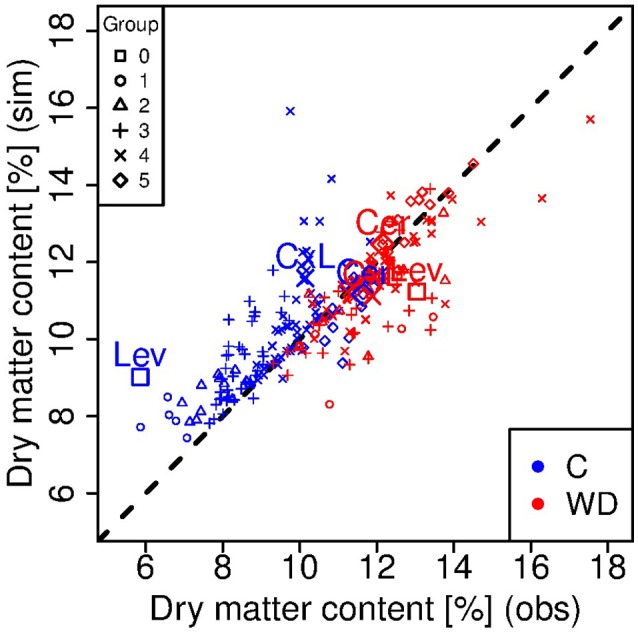
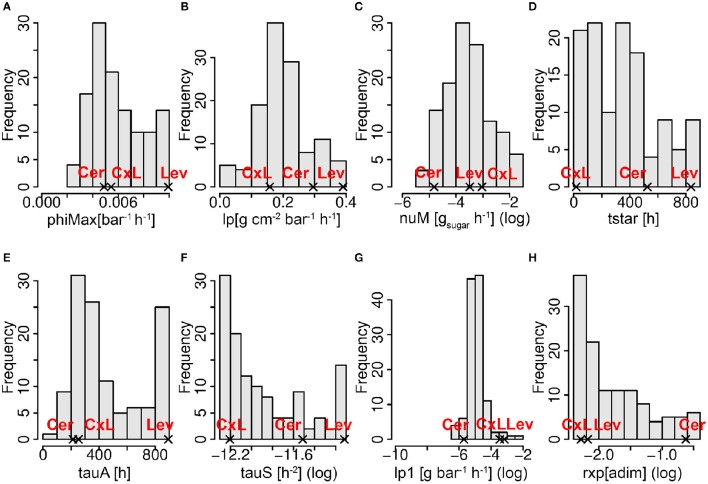
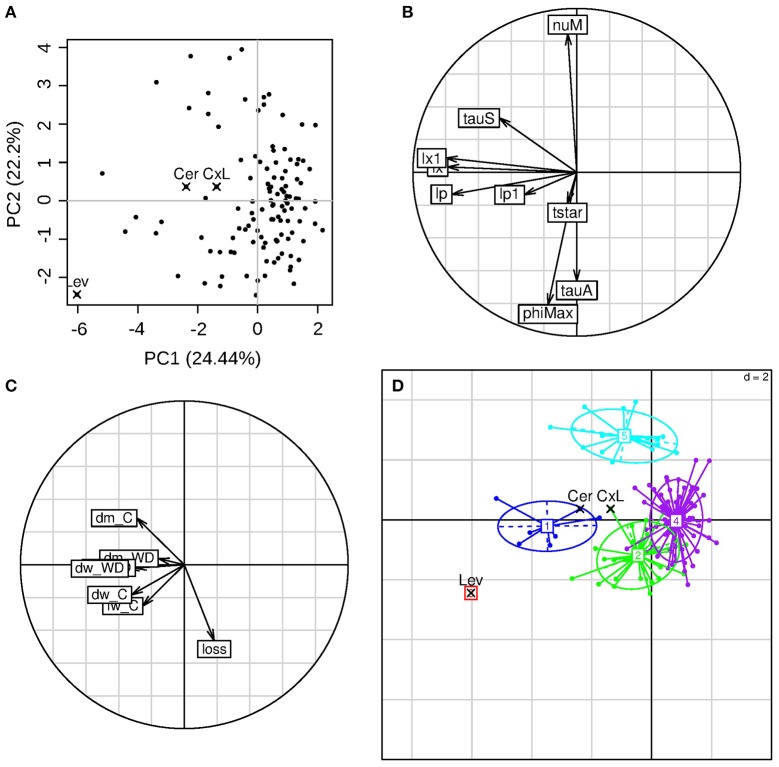
Drought stress is a major abiotic stress threatening plant and crop productivity. In case of fleshy fruits, understanding mechanisms governing water and carbon accumulations and identifying genes, QTLs and phenotypes, that will enable trade-offs between fruit growth and quality under Water Deficit (WD) condition is a crucial challenge for breeders and growers. In the present work, 117 recombinant inbred lines of a population of were phenotyped under control and WD conditions. Plant water status, fruit growth and composition were measured and data were used to calibrate a process-based model describing water and carbon fluxes in a growing fruit as a function of plant and environment. Eight genotype-dependent model parameters were estimated using a multiobjective evolutionary algorithm in order to minimize the prediction errors of fruit dry and fresh mass throughout fruit development. WD increased the fruit dry matter content (up to 85%) and decreased its fresh weight (up to 60%), big fruit size genotypes being the most sensitive. The mean normalized root mean squared errors of the predictions ranged between 16-18% in the population. Variability in model genotypic parameters allowed us to explore diverse genetic strategies in response to WD. An interesting group of genotypes could be discriminated in which (i) the low loss of fresh mass under WD was associated with high active uptake of sugars and low value of the maximum cell wall extensibility, and (ii) the high dry matter content in control treatment (C) was associated with a slow decrease of mass flow. Using 501 SNP markers genotyped across the genome, a QTL analysis of model parameters allowed to detect three main QTLs related to xylem and phloem conductivities, on chromosomes 2, 4, and 8. The model was then applied to design ideotypes with high dry matter content in C condition and low fresh mass loss in WD condition. The ideotypes outperformed the RILs especially for large and medium fruit-size genotypes, by combining high pedicel conductance and high active uptake of sugars. Interestingly, five small fruit-size RILs were close to the selected ideotypes, and likely bear interesting traits and alleles for adaptation to WD.
干旱胁迫是威胁植物和作物生产力的主要非生物胁迫。对于肉质果实而言,了解控制水分和碳积累的机制,并鉴定能够在水分亏缺(WD)条件下实现果实生长与品质之间权衡的基因、数量性状位点(QTL)和表型,是育种者和种植者面临的关键挑战。在本研究中,对一个群体的117个重组自交系在对照和WD条件下进行了表型分析。测量了植物水分状况、果实生长和组成,并将数据用于校准一个基于过程的模型,该模型描述了生长中果实的水分和碳通量作为植物和环境的函数。使用多目标进化算法估计了八个基因型依赖的模型参数,以尽量减少整个果实发育过程中果实干重和鲜重的预测误差。WD增加了果实干物质含量(高达85%)并降低了其鲜重(高达60%),大果实大小的基因型最为敏感。该群体中预测的平均归一化均方根误差在16 - 18%之间。模型基因型参数的变异性使我们能够探索应对WD的多种遗传策略。可以区分出一组有趣的基因型,其中(i)WD条件下鲜重损失低与糖的高主动吸收和最大细胞壁伸展性的低值相关,(ii)对照处理(C)中高干物质含量与质量流的缓慢下降相关。利用全基因组分型的501个单核苷酸多态性(SNP)标记,对模型参数进行QTL分析,检测到与木质部和韧皮部传导率相关的三个主要QTL,分别位于第2、4和8号染色体上。然后将该模型应用于设计在C条件下具有高干物质含量且在WD条件下鲜重损失低的理想型。这些理想型表现优于重组自交系,尤其是对于大中型果实大小的基因型,通过结合高果梗传导率和高糖主动吸收。有趣的是,五个小果实大小的重组自交系接近所选理想型,可能具有适应WD的有趣性状和等位基因。