Gordy James T, Luo Kun, Zhang Hong, Biragyn Arya, Markham Richard B
The Department of Molecular Microbiology and Immunology, Johns Hopkins Bloomberg School of Public Health, 615 N. Wolfe Street, Baltimore, MD 21205 USA.
Immunoregulation Section, Laboratory of Molecular Biology and Immunology, National Institute on Aging, National Institutes of Health, 251 Bayview, Blvd, Suite 100, Baltimore, MD 21224 USA.
J Immunother Cancer. 2016 Dec 20;4:96. doi: 10.1186/s40425-016-0189-y. eCollection 2016.
Although therapeutic cancer vaccines have been mostly disappointing in the clinic, the advent of novel immunotherapies and the future promise of neoantigen-based therapies have created the need for new vaccine modalities that can easily adapt to current and future developments in cancer immunotherapy. One such novel platform is a DNA vaccine fusing the chemokine Macrophage Inflammatory Protein-3α (MIP-3α) to an antigen, here melanoma antigen gp100. Previous published work has indicated that MIP-3α targets nascent peptides to immature dendritic cells, leading to processing by class I and II MHC pathways. This platform has shown enhanced efficacy in prophylactic melanoma and therapeutic lymphoma model systems.
The B16F10 melanoma syngeneic mouse model system was utilized, with a standard therapeutic protocol: challenge with lethal dose of B16F10 cells (5 × 10) on day 0 and then vaccinate by intramuscular electroporation with 50 μg plasmid on days three, 10, and 17. Efficacy was assessed by analysis of tumor burden, tumor growth, and mouse survival, using the statistical tests ANOVA, mixed effects regression, and log-rank, respectively. Immunogenicity was assessed by ELISA and flow cytometric methods, including intracellular cytokine staining to assess vaccine-specific T-cell responses, all tested by ANOVA.
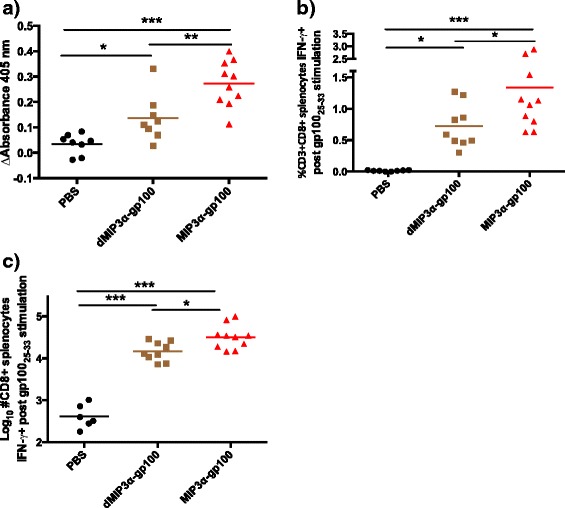
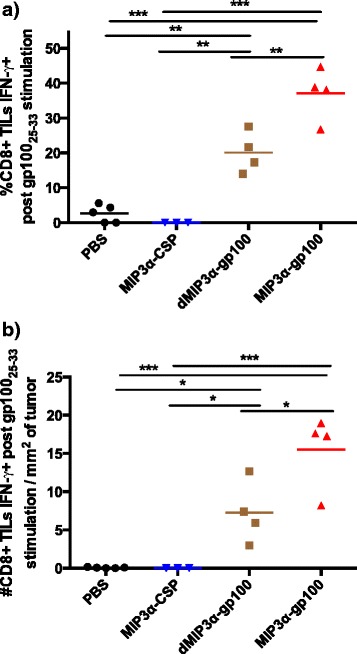
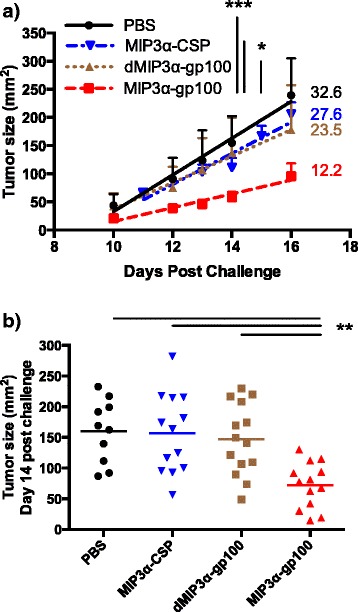
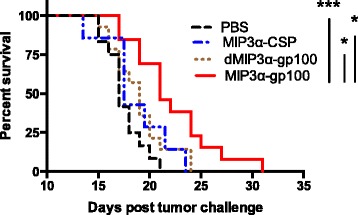
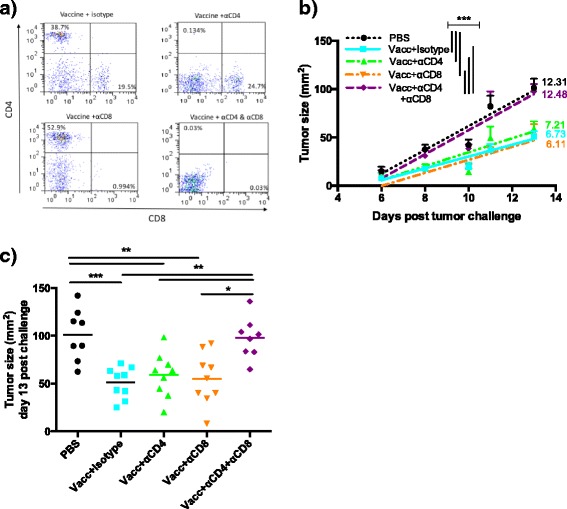
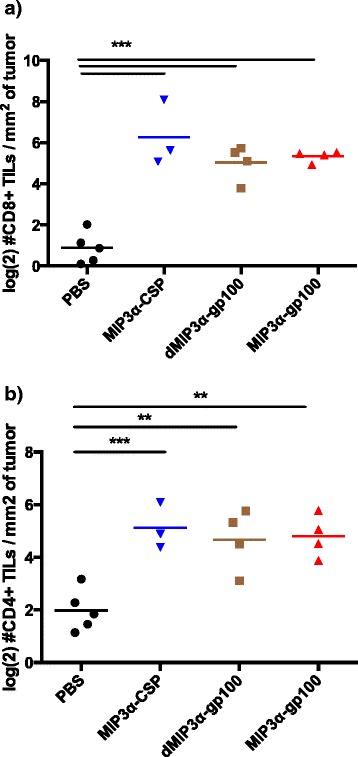
We demonstrate that the addition of MIP3α to gp100 significantly enhances systemic anti-gp100 immunological parameters. Further, chemokine-fusion vaccine therapy significantly reduces tumor burden, slows tumor growth, and enhances mouse overall survival compared to antigen-only, irrelevant-antigen, and mock vaccines, with efficacy mediated by both CD4+ and CD8+ effector T cells. Antigen-only, irrelevant-antigen, and chemokine-fusion vaccines elicit significantly higher and similar CD4+ and CD8+ tumor-infiltrating lymphocyte (TIL) levels compared to mock vaccine. However, vaccine-specific CD8+ TILs are significantly higher in the chemokine-fusion vaccine group, indicating that the critical step induced by the fusion vaccine construct is the enhancement of vaccine-specific T-cell effectors.
The current study shows that fusion of MIP3α to melanoma antigen gp100 enhances the immunogenicity and efficacy of a DNA vaccine in a therapeutic B16F10 mouse melanoma model. This study analyzes an adaptable and easily produced MIP3α-antigen modular vaccine platform that could lend itself to a variety of functionalities, including combination treatments and neoantigen vaccination in the pursuit of personalized cancer therapy.
尽管治疗性癌症疫苗在临床上大多令人失望,但新型免疫疗法的出现以及基于新抗原的疗法的未来前景,使得人们需要新的疫苗模式,以便能够轻松适应癌症免疫疗法当前和未来的发展。一种这样的新型平台是将趋化因子巨噬细胞炎性蛋白-3α(MIP-3α)与抗原(此处为黑色素瘤抗原gp100)融合的DNA疫苗。先前发表的研究表明,MIP-3α将新生肽靶向未成熟树突状细胞,导致通过I类和II类MHC途径进行加工。该平台在预防性黑色素瘤和治疗性淋巴瘤模型系统中显示出增强的疗效。
利用B16F10黑色素瘤同基因小鼠模型系统,采用标准治疗方案:在第0天用致死剂量的B16F10细胞(5×10)进行攻击,然后在第3、10和17天通过肌肉电穿孔接种50μg质粒进行疫苗接种。分别使用方差分析(ANOVA)、混合效应回归和对数秩检验,通过分析肿瘤负荷(tumor burden)、肿瘤生长和小鼠存活情况来评估疗效。通过酶联免疫吸附测定(ELISA)和流式细胞术方法评估免疫原性,包括细胞内细胞因子染色以评估疫苗特异性T细胞反应,所有这些均通过方差分析进行测试。
我们证明,将MIP3α添加到gp100中可显著增强全身抗gp100免疫参数。此外,与仅含抗原的疫苗、无关抗原疫苗和模拟疫苗相比,趋化因子融合疫苗疗法显著降低肿瘤负荷,减缓肿瘤生长,并提高小鼠总体存活率,其疗效由CD4 +和CD8 +效应T细胞介导。与模拟疫苗相比,仅含抗原的疫苗、无关抗原疫苗和趋化因子融合疫苗引发的CD4 +和CD8 +肿瘤浸润淋巴细胞(TIL)水平显著更高且相似。然而,趋化因子融合疫苗组中疫苗特异性CD8 + TILs显著更高,这表明融合疫苗构建体诱导的关键步骤是增强疫苗特异性T细胞效应器。
当前研究表明,在治疗性B16F10小鼠黑色素瘤模型中,将MIP3α与黑色素瘤抗原gp100融合可增强DNA疫苗的免疫原性和疗效。本研究分析了一种适应性强且易于生产的MIP3α - 抗原模块化疫苗平台,该平台可用于多种功能,包括联合治疗和新抗原疫苗接种,以追求个性化癌症治疗。