Pennicooke Brenton, Moriguchi Yu, Hussain Ibrahim, Bonssar Lawrence, Härtl Roger
Department of Neurosurgery, New York-Presbyterian/Weill Cornell Medical Center.
Department of Neurosurgery, NewYork-Presbyterian/Weill Cornell Medical Center.
Cureus. 2016 Nov 22;8(11):e892. doi: 10.7759/cureus.892.
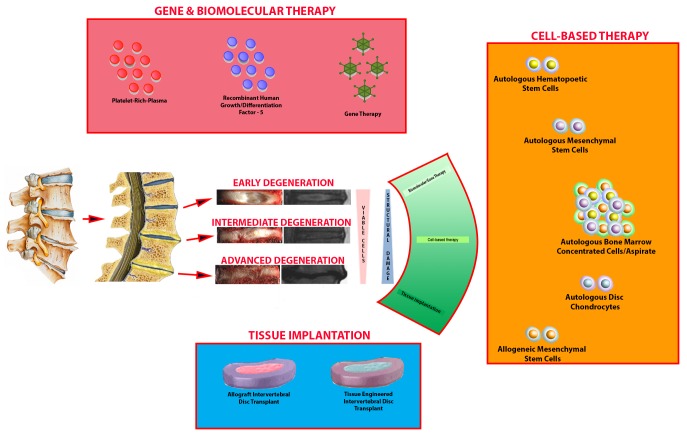
Biologic-based treatment strategies for musculoskeletal diseases have gained traction over the past 20 years as alternatives to invasive, costly, and complicated surgical interventions. Spinal degenerative disc disease (DDD) is among the anatomic areas being investigated among this group, notably due to its high incidence and functional debilitation. In this review, we report the literature encompassing the use of biologic-based therapies for DDD. Articles published between January 1995 and November 2015 were reviewed, with a subset meeting the primary and secondary inclusion criteria of clinical trial results that could be sub-classified into bimolecular, cell-based, or gene therapies, as well as studies investigating the utility of allogeneic and tissue-engineered intervertebral discs. Ongoing clinical trials that have not yet published results are also mentioned to present the current state of the field. This exciting area has demonstrated positive and encouraging results across multiple strategies; thus, future bimolecular and regenerative techniques and understanding will likely lead to an increase in the number of human clinical trials assessing these therapies.
在过去20年里,基于生物制剂的肌肉骨骼疾病治疗策略作为侵入性、昂贵且复杂的手术干预的替代方法而受到关注。脊柱退行性椎间盘疾病(DDD)是该类研究的解剖学领域之一,特别是因为其高发病率和功能衰退。在本综述中,我们报告了有关基于生物制剂的疗法用于DDD的文献。对1995年1月至2015年11月发表的文章进行了综述,其中一部分符合临床试验结果的主要和次要纳入标准,这些结果可分为双分子疗法、基于细胞的疗法或基因疗法,以及研究同种异体和组织工程化椎间盘效用的研究。还提到了尚未发表结果的正在进行的临床试验,以展示该领域的现状。这个令人兴奋的领域在多种策略上都取得了积极且令人鼓舞的结果;因此,未来的双分子和再生技术及认识可能会导致评估这些疗法的人体临床试验数量增加。