Wang Ai-Jun, Kawser Ahmed, Xu Yong-Hang, Ye Xiang, Rani Seema, Chen Ke-Liang
Third Institute of Oceanography, State Oceanic Administration, Xiamen, 361005 China.
Department of Oceanography, University of Dhaka, Dhaka, 1000 Bangladesh.
Springerplus. 2016 Dec 6;5(1):2079. doi: 10.1186/s40064-016-3749-1. eCollection 2016.
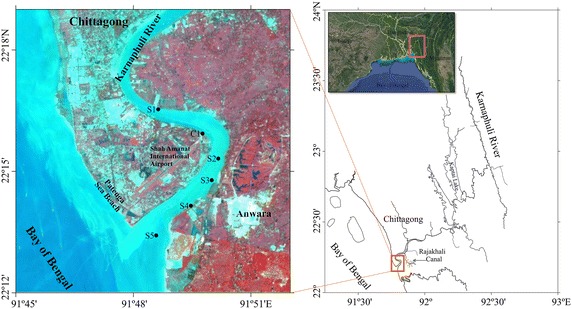
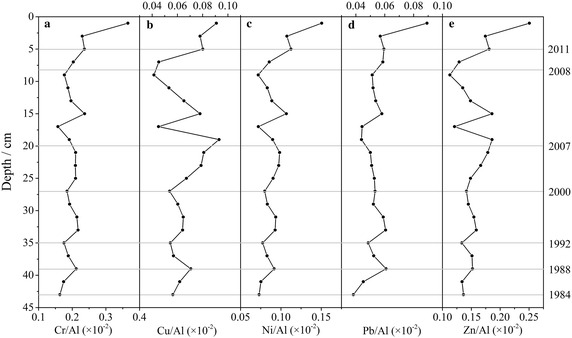
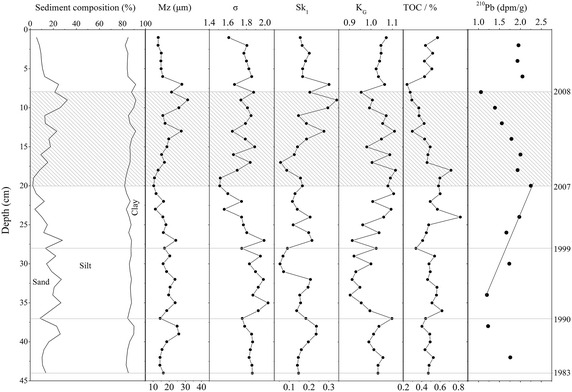
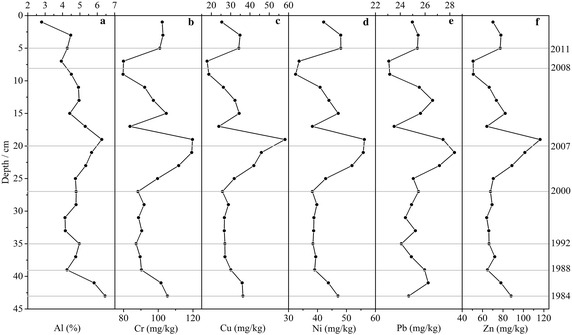
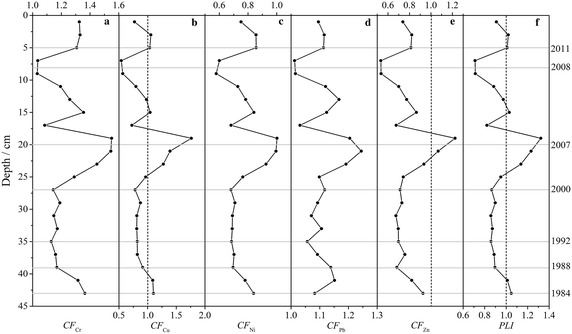
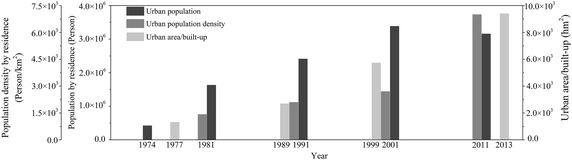
Heavy metal contamination of aquatic environment has attracted global attention owing to its abundance, persistence, and environmental toxicity, especially in developing countries like Bangladesh. Five heavy metals, namely chromium (Cr), copper (Cu), nickel (Ni), lead (Pb) and zinc (Zn) were investigated in surface and core sediments of the Karnaphuli River (KR) estuary in Chittagong, Bangladesh, in order to reveal the heavy metal contamination history in estuarine sediments and its response to catastrophic events and human activities. The surface sediment was predominantly composed of silt and sand, and the surface sediment was contaminated with Cr and Pb. Based on the Pb chronology, the sedimentation rate in the inter-tidal zone of KR estuary was 1.02 cm/a before 2007, and 1.14 cm/a after 2008. The core sediment collected from 8 to 20 cm below the surface mainly originated from terrestrial materials induced by catastrophic events such as cyclone, heavy rainfall and landslides in 2007 and 2008. The values of contamination factor () showed that the sediment became moderately contaminated with Cr and Pb in the last 30 years. The variation and accumulation of heavy metals in core sediment before 2000 was mainly related to natural variations in sediment sources; however, in subsequent years, the anthropogenic inputs of heavy metals have increased due to rapid physical growth of urban and industrial areas in the Chittagong city. In general, the accumulation pattern of heavy metals after normalization to Aluminum in sediments of KR estuary indicated an accelerated rate of urbanization and industrialization in the last 30 years, and also suggested the influence of natural catastrophic event on estuarine environment.
由于重金属在水生环境中的含量丰富、具有持久性且具有环境毒性,因此引起了全球关注,在孟加拉国等发展中国家尤其如此。对孟加拉国吉大港卡尔纳普利河(KR)河口的表层和岩芯沉积物中的五种重金属,即铬(Cr)、铜(Cu)、镍(Ni)、铅(Pb)和锌(Zn)进行了调查,以揭示河口沉积物中的重金属污染历史及其对灾难性事件和人类活动的响应。表层沉积物主要由粉砂和砂组成,表层沉积物受到Cr和Pb的污染。根据铅年代学,2007年之前KR河口潮间带的沉积速率为1.02厘米/年,2008年之后为1.14厘米/年。从地表以下8至20厘米处采集的岩芯沉积物主要来源于2007年和2008年气旋、暴雨和山体滑坡等灾难性事件引发的陆地物质。污染因子()值表明,在过去30年中,沉积物受到Cr和Pb的中度污染。2000年之前岩芯沉积物中重金属的变化和积累主要与沉积物来源的自然变化有关;然而,在随后的几年里,由于吉大港城市和工业区的快速发展,重金属的人为输入有所增加。总体而言,KR河口沉积物中重金属经铝归一化后的积累模式表明,过去30年城市化和工业化进程加快,也表明了自然灾难性事件对河口环境的影响。