Ashraf Sania, Nizame Fosiul A, Islam Mahfuza, Dutta Notan C, Yeasmin Dalia, Akhter Sadika, Abedin Jaynal, Winch Peter J, Ram Pavani K, Unicomb Leanne, Leontsini Elli, Luby Stephen P
Department of International Health, Johns Hopkins Bloomberg School of Public Health, Baltimore, Maryland.
Enteric and Respiratory Disease Program, Environmental Intervention Unit, Infectious Disease Division, International Centre for Diarrheal Disease Research, Bangladesh (icddr,b), Dhaka, Bangladesh.
Am J Trop Med Hyg. 2017 Feb 8;96(2):421-429. doi: 10.4269/ajtmh.16-0304. Epub 2016 Dec 26.
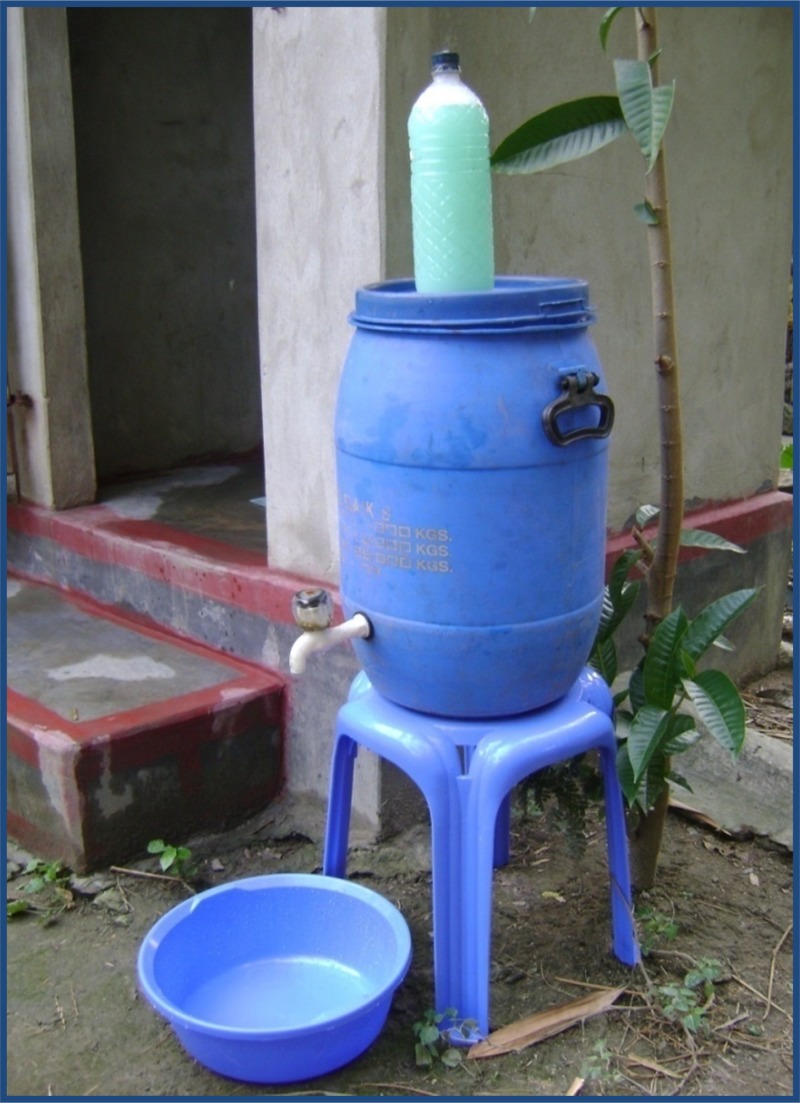
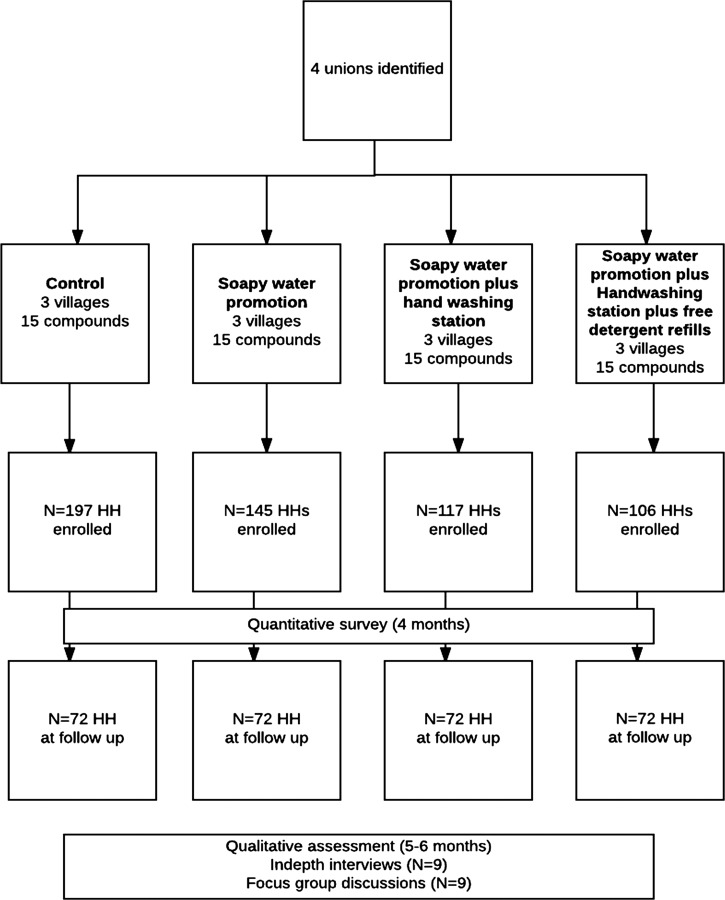
We conducted a nonrandomized trial of strategies to promote soapy water for handwashing in rural Bangladesh and measured uptake. We enrolled households with children < 3 years for three progressively intensive study arms: promotion of soapy water ( = 120), soapy water promotion plus handwashing stations ( = 103), and soapy water promotion, stations plus detergent refills ( = 90); we also enrolled control households ( = 72). Our handwashing stations included tap-fitted buckets and soapy water bottles. Community promoters visited households and held community meetings to demonstrate soapy water preparation and promote handwashing at key times. Field workers measured uptake 4 months later. In-depth interviews and focus group discussions assessed factors associated with uptake. More households had soapy water at the handwashing place in progressively intensive arms: 18% (promotion), 60% (promotion plus station), and 71% (promotion, station with refills). Compared with the promotion-only arm, more households that received stations had soapy water at the primary handwashing station (44%, ≤ 0.001; 71%, < 0.001 with station plus detergent refill). Qualitative findings highlighted several dimensions that affected use: contextual (shared courtyard), psychosocial (perceived value), and technology dimensions (ease of use, convenience). Soapy water may increase habitual handwashing by addressing barriers of cost and availability of handwashing agents near water sources. Further research should inform optimal strategies to scale-up soapy water as a handwashing agent to study health impact.
我们在孟加拉国农村地区开展了一项关于推广使用肥皂水洗手策略的非随机试验,并对其接受程度进行了测量。我们招募了家中有3岁以下儿童的家庭,分为三个逐步强化的研究组:推广使用肥皂水组(n = 120)、推广使用肥皂水加设置洗手站组(n = 103)、推广使用肥皂水、设置洗手站加提供洗涤剂补充装组(n = 90);我们还招募了对照组家庭(n = 72)。我们的洗手站包括配有水龙头的水桶和装有肥皂水的瓶子。社区推广人员走访各户并召开社区会议,演示肥皂水的制备方法,并在关键时间点推广洗手。4个月后,现场工作人员测量了接受程度。深入访谈和焦点小组讨论评估了与接受程度相关的因素。在逐步强化的研究组中,有更多家庭在洗手处备有肥皂水:18%(仅推广组)、60%(推广加洗手站组)和71%(推广、洗手站加补充装组)。与仅推广组相比,设置了洗手站的组中有更多家庭在主要洗手处备有肥皂水(44%,P≤0.001;设置洗手站加洗涤剂补充装组为71%,P<0.001)。定性研究结果突出了几个影响使用的方面:环境方面(共用庭院)、心理社会方面(感知价值)和技术方面(易用性、便利性)。肥皂水可能通过解决靠近水源处洗手剂成本和可得性的障碍来增加习惯性洗手行为。进一步的研究应确定扩大使用肥皂水作为洗手剂的最佳策略,以研究其对健康的影响。