Bureš Vladimír, Čech Pavel, Mikulecká Jaroslava, Ponce Daniela, Kuca Kamil
Faculty of Informatics and Management, University of Hradec Kralove , Hradec Kralove , Czech Republic.
Faculty of Informatics and Management, University of Hradec Kralove, Hradec Kralove, Czech Republic; Biomedical Research Centre, University Hospital Hradec Kralove, Hradec Kralove, Czech Republic.
PeerJ. 2016 Dec 21;4:e2785. doi: 10.7717/peerj.2785. eCollection 2016.
There is a growing number of studies indicating the major consequences of the subjective perception of well-being on mental health and healthcare use. However, most of the cognitive training research focuses more on the preservation of cognitive function than on the implications of the state of well-being. This secondary analysis of data from a randomised controlled trial investigated the effects of individualised television-based cognitive training on self-rated well-being using the WHO-5 index while considering gender and education as influencing factors. The effects of cognitive training were compared with leisure activities that the elderly could be engaged in to pass time.
Cognitively healthy participants aged 60 years or above screened using the Mini-Mental State Examination (MMSE) and Major Depression Inventory (MDI) were randomly allocated to a cognitive training group or to an active control group in a single-blind controlled two-group design and underwent 24 training sessions. Data acquired from the WHO-5 questionnaire administered before and after intervention were statistically analysed using a mixed design model for repeated measures. The effect of individualised cognitive training was compared with leisure activities while the impact of gender and education was explored using estimated marginal means.
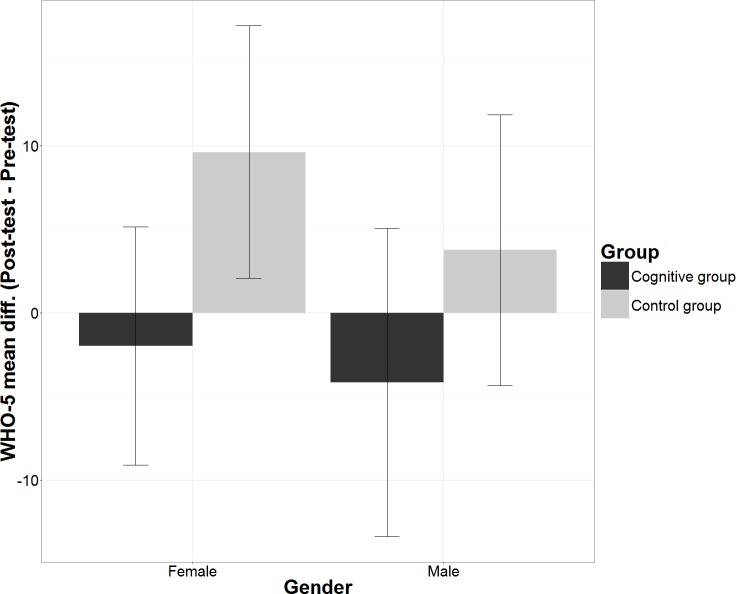
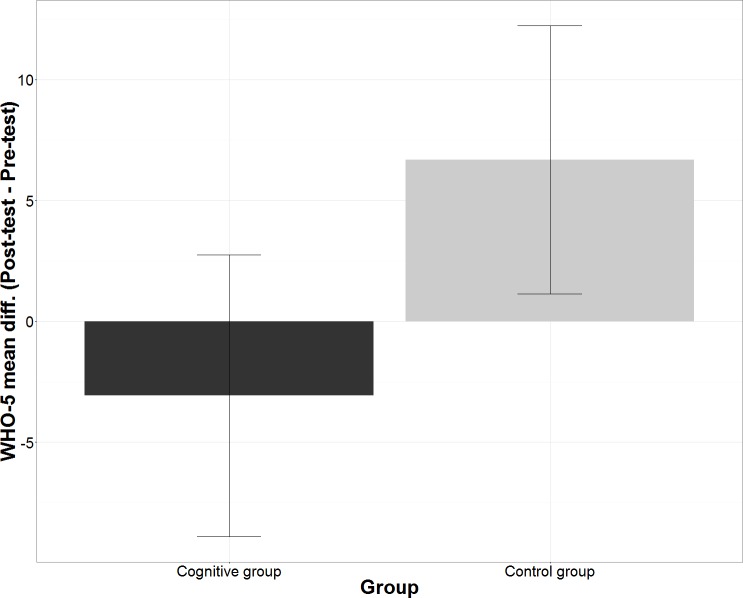
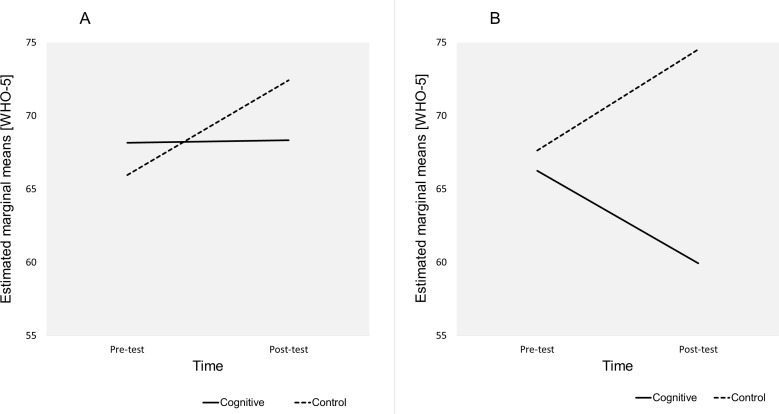
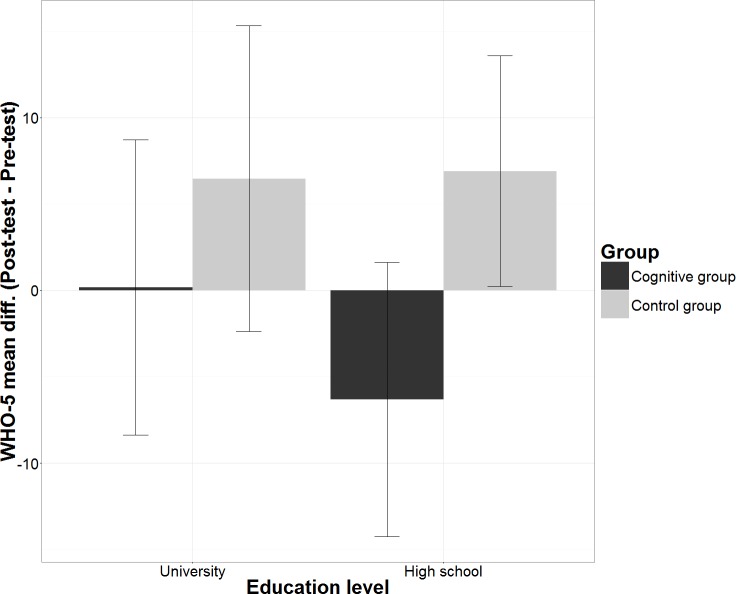
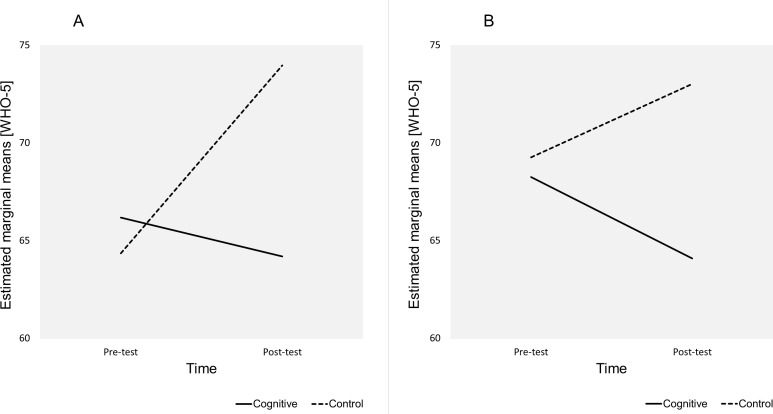
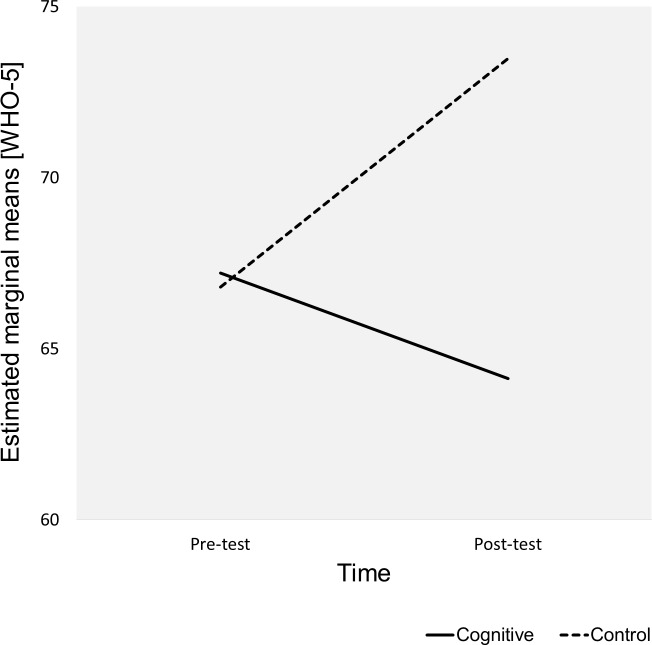
A total of 81 participants aged 67.9 ± 5.59 [60-84] without cognitive impairments and absent of depression symptoms underwent the study. Participants with leisure time activities declared significantly higher scores compared to participants with cognitive training = 73.48 ± 2.88, 95% CI [67.74-79.22] vs = 64.13 ± 3.034, 95% CI [58.09-70.17] WHO-5 score. Gender and education were found to moderate the effect of cognitive training on well-being when compared to leisure activities. Females engaged in leisure activities in the control group reported higher by = 9.77 ± 5.4, 95% CI [-0.99-20.54] WHO-5 scores than females with the cognitive training regimen. Participants with high school education declared leisure activities to increase WHO-5 scores by = 14.59 ± 5.39, 95% CI [3.85-25.34] compared to individualised cognitive training.
The findings revealed that individualised cognitive training was not directly associated with improvements in well-being. Changes in the control group indicated that involvement in leisure time activities, in which participants were partly free to choose from, represented more favourable stimulation to a self-perceived sense of well-being than individualised cognitive training. Results also supported the fact that gender and education moderated the effect of cognitive training on well-being. Females and participants with high school education were found to be negatively impacted in well-being when performance connected with cognitive training was expected.
越来越多的研究表明,主观幸福感对心理健康和医疗保健利用具有重大影响。然而,大多数认知训练研究更多地关注认知功能的保存,而非幸福感状态的影响。这项对随机对照试验数据的二次分析,使用世界卫生组织-5指数(WHO-5指数),在将性别和教育作为影响因素的情况下,研究了基于电视的个性化认知训练对自评幸福感的影响。将认知训练的效果与老年人可以参与的休闲活动进行了比较。
使用简易精神状态检查表(MMSE)和重度抑郁量表(MDI)筛选出60岁及以上认知健康的参与者,采用单盲对照两组设计将其随机分配到认知训练组或积极对照组,并接受24次训练课程。对干预前后通过WHO-5问卷获得的数据,使用重复测量的混合设计模型进行统计分析。将个性化认知训练的效果与休闲活动进行比较,同时使用估计边际均值探讨性别和教育的影响。
共有81名年龄为67.9±5.59岁[60 - 84岁]、无认知障碍且无抑郁症状的参与者进行了该研究。与接受认知训练的参与者相比,参与休闲活动的参与者WHO-5得分显著更高(分别为73.48±2.88,95%置信区间[67.74 - 79.22]和64.13±3.034,95%置信区间[58.09 - 70.17])。与休闲活动相比,发现性别和教育会调节认知训练对幸福感的影响。对照组中参与休闲活动的女性报告的WHO-5得分比接受认知训练方案的女性高(9.77±5.4,95%置信区间[-0.99 - 20.54])。与个性化认知训练相比,高中教育程度的参与者表示休闲活动使WHO-5得分提高(14.59±5.39,95%置信区间[3.85 - 25.34])。
研究结果表明,个性化认知训练与幸福感的改善没有直接关联。对照组的变化表明,参与休闲活动(参与者在一定程度上可自由选择)对自我感知的幸福感而言,比个性化认知训练更具积极刺激作用。结果还支持了性别和教育调节认知训练对幸福感影响这一事实。当预期表现与认知训练相关时,发现女性和高中教育程度的参与者在幸福感方面受到负面影响。