Park Jongsin, Lee Eun Seo, Lee Da Young, Kim Jihyun, Park Se Eun, Park Cheol Young, Lee Won Young, Oh Ki Won, Park Sung Woo, Rhee Eun Jung
Department of Endocrinology and Metabolism, Kangbuk Samsung Hospital, Sungkyunkwan University School of Medicine, Seoul, Korea.
Endocrinol Metab (Seoul). 2016 Dec;31(4):559-566. doi: 10.3803/EnM.2016.31.4.559.
We aimed to assess the risk for coronary artery calcification (CAC) according to groups subdivided by body mass index (BMI) and waist circumference (WC) in apparently healthy Korean adults.
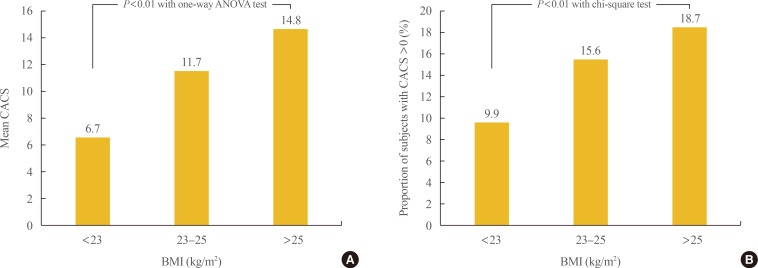
Thirty-three thousand four hundred and thirty-two participants (mean age, 42 years) in a health screening program were divided into three groups according to BMI: <23 kg/m² (normal), 23 to 25 kg/m² (overweight), and >25 kg/m² (obese). In addition, the participants were divided into two groups according to WC. Coronary artery calcium score (CACS) was measured with multi-detector computed tomography in all participants. Presence of CAC was defined as CACS >0.
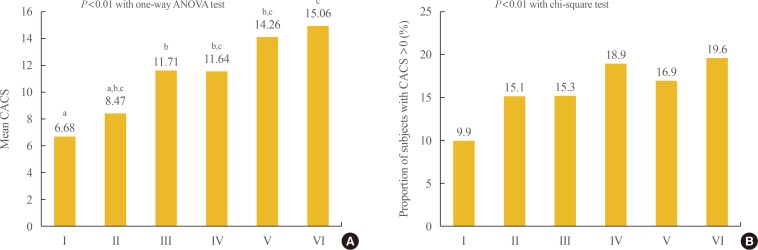
When logistic regression analysis was performed with the presence of CAC as the dependent variable, the risk for CAC increased as BMI increased after adjusting for confounding variables (1.102 [95% confidence interval (CI), 1.000 to 1.216]; 1.284 [95% CI, 1.169 to 1.410]; in the overweight and obese groups vs. the normal weight group). When the participants were divided into six groups according to BMI and WC, the subjects with BMI and WC in the obese range showed the highest risk for CAC (1.321 [95% CI, 1.194 to 1.461]) and those with BMI in the overweight range and WC in the obese range showed the second highest risk for CAC (1.235 [95% CI, 1.194 to 1.461]).
Participants with obesity defined by both BMI and WC showed the highest risk for CAC. Those with BMIs in the overweight range but with WC in the obese range showed the second highest risk for CAC, suggesting that WC as a marker of obesity is more predictive of CAC than BMI.
我们旨在根据体重指数(BMI)和腰围(WC)分组,评估表面健康的韩国成年人发生冠状动脉钙化(CAC)的风险。
一项健康筛查项目中的33432名参与者(平均年龄42岁)根据BMI分为三组:<23kg/m²(正常)、23至25kg/m²(超重)和>25kg/m²(肥胖)。此外,参与者根据WC分为两组。所有参与者均通过多排螺旋计算机断层扫描测量冠状动脉钙化评分(CACS)。CAC的存在定义为CACS>0。
以CAC的存在作为因变量进行逻辑回归分析时,在调整混杂变量后,CAC风险随BMI增加而升高(超重和肥胖组与正常体重组相比,分别为1.102[95%置信区间(CI),1.000至1.216];1.284[95%CI,1.169至1.410])。当根据BMI和WC将参与者分为六组时,BMI和WC均处于肥胖范围的受试者发生CAC的风险最高(1.321[95%CI,1.194至1.461]),BMI处于超重范围且WC处于肥胖范围的受试者发生CAC的风险次之(1.235[95%CI,1.194至1.461])。
由BMI和WC共同定义为肥胖的参与者发生CAC的风险最高。BMI处于超重范围但WC处于肥胖范围的参与者发生CAC的风险次之,这表明WC作为肥胖的一个指标比BMI更能预测CAC。