Roucka Markus, Zimmermann Klaus, Fido Markus, Nechansky Andreas
Vela Labs GmbH, Brunner Str. 69/ Obj. 3, 1230 Vienna, Austria.
JHL Biotech, Zhubei City, Hsinchu County 302, Taiwan.
Microarrays (Basel). 2016 Dec 24;6(1):1. doi: 10.3390/microarrays6010001.
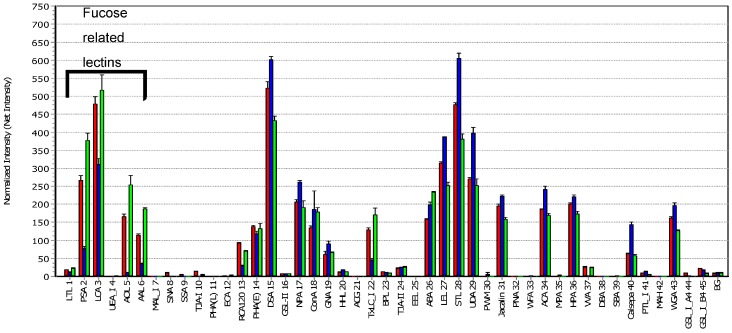
Lectin microarray technology was applied to compare the glycosylation pattern of the monoclonal antibody MB311 expressed in SP2.0 cells to an antibody-dependent cellular cytotoxic effector function (ADCC)-optimized variant (MB314). MB314 was generated by a plant expression system that uses genetically modified moss protoplasts () to generate a de-fucosylated version of MB311. In contrast to MB311, no or very low interactions of MB314 with lectins l-fucose (AOL), agglutinin (PSA), agglutinin (LCA), and lectin (AAL) were observed. These lectins are specific for mono-/biantennary N-glycans containing a core fucose residue. Importantly, this fucose indicative lectin-binding pattern correlated with increased MB314 binding to CD16 (FcγRIII; receptor for the constant region of an antibody)-whose affinity is mediated through core fucosylation-and stronger ADCC. In summary, these results demonstrate that lectin microarrays are useful orthogonal methods during antibody development and for characterization.
凝集素微阵列技术被用于比较在SP2.0细胞中表达的单克隆抗体MB311与抗体依赖性细胞毒性效应功能(ADCC)优化变体(MB314)的糖基化模式。MB314由植物表达系统产生,该系统利用基因改造的苔藓原生质体生成去岩藻糖基化的MB311。与MB311相比,未观察到MB314与凝集素α-L-岩藻糖(AOL)、豌豆凝集素(PSA)、扁豆凝集素(LCA)和刀豆凝集素(AAL)有相互作用或仅有非常低的相互作用。这些凝集素对含有核心岩藻糖残基的单/双天线N-聚糖具有特异性。重要的是,这种岩藻糖指示性凝集素结合模式与MB314与CD16(FcγRIII;抗体恒定区的受体)结合增加相关,其亲和力通过核心岩藻糖基化介导,并且具有更强的ADCC。总之,这些结果表明凝集素微阵列在抗体开发和表征过程中是有用的正交方法。