Okada Yuka, Shirai Kumi, Miyajima Masayasu, Reinach Peter S, Yamanaka Osamu, Sumioka Takayoshi, Kokado Masahide, Tomoyose Katsuo, Saika Shizuya
Ophthalmology, Wakayama Medical University, Wakayama, Japan.
Laboratory Animal Center, Wakayama Medical University, Wakayama, Japan.
PLoS One. 2016 Dec 28;11(12):e0167200. doi: 10.1371/journal.pone.0167200. eCollection 2016.
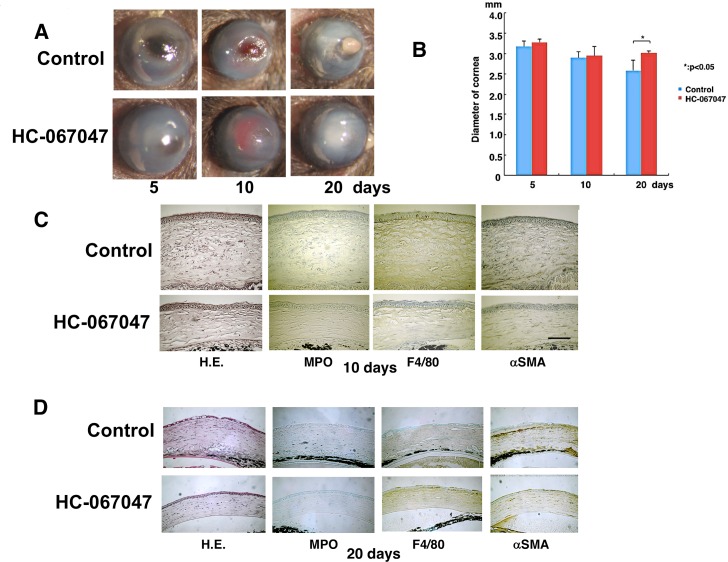
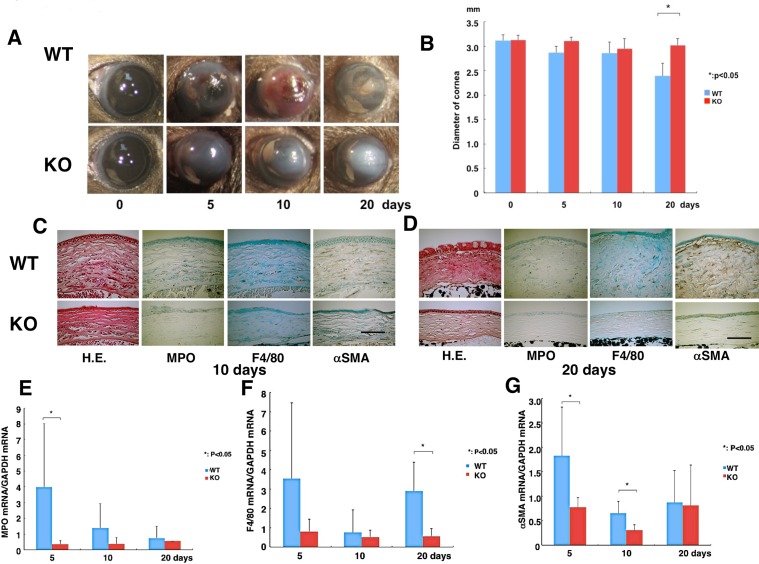
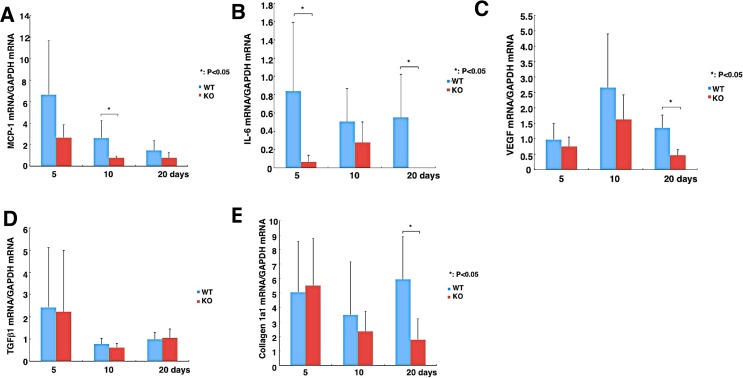
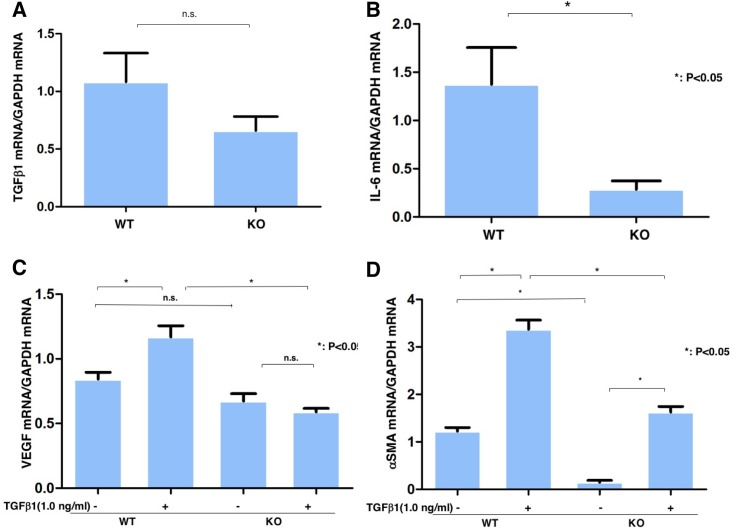
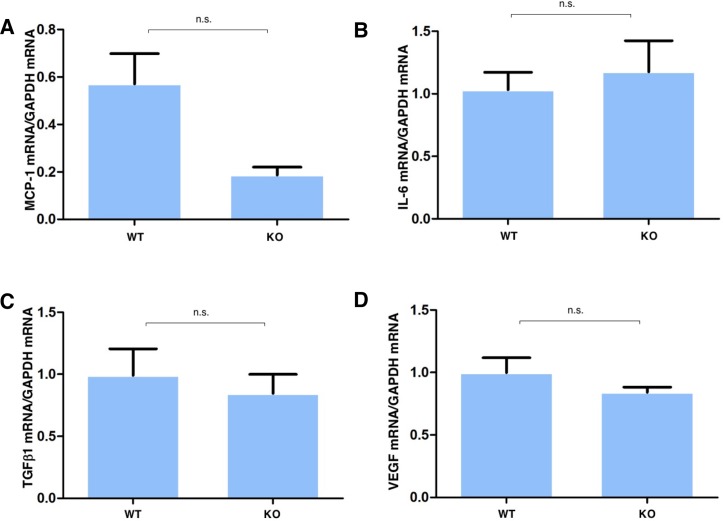
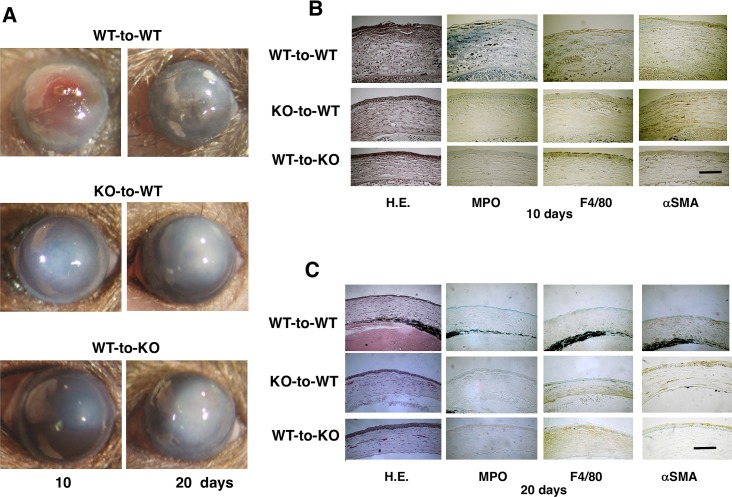
In humans suffering from pulmonary disease and a mouse model, transient receptor potential vanilloid 4 (TRPV4) channel activation contributes to fibrosis. As a corneal alkali burn induces the same response, we determined if such an effect is also attributable to TRPV4 activation in mice. Accordingly, we determined if the alkali burn wound healing responses in wild-type (WT) mice are different than those in their TRPV4-null (KO) counterpart. Stromal opacification due to fibrosis in KO (n = 128) mice was markedly reduced after 20 days relative to that in WT (n = 157) mice. Immunohistochemistry revealed that increases in polymorphonuclear leukocytes and macrophage infiltration declined in KO mice. Semi-quantitative real time RT-PCR of ocular KO fibroblast cultures identified increases in proinflammatory and monocyte chemoattractant protein-1 chemoattractant gene expression after injury. Biomarker gene expression of fibrosis, collagen1a1 and α-smooth muscle actin were attenuated along with macrophage release of interleukin-6 whereas transforming growth factor β, release was unchanged. Tail vein reciprocal bone marrow transplantation between WT and KO chimera mouse models mice showed that reduced scarring and inflammation in KO mice are due to loss of TRPV4 expression on both corneal resident immune cells, fibroblasts and infiltrating polymorphonuclear leukocytes and macrophages. Intraperitoneal TRPV4 receptor antagonist injection of HC-067047 (10 mg/kg, daily) into WT mice reproduced the KO-phenotype. Taken together, alkali-induced TRPV4 activation contributes to inducing fibrosis and inflammation since corneal transparency recovery was markedly improved in KO mice.
在患有肺部疾病的人类和小鼠模型中,瞬时受体电位香草酸受体4(TRPV4)通道激活会导致纤维化。由于角膜碱烧伤会引发相同的反应,我们确定这种效应在小鼠中是否也归因于TRPV4激活。因此,我们确定野生型(WT)小鼠的碱烧伤伤口愈合反应是否与其TRPV4基因敲除(KO)的对应小鼠不同。与WT(n = 157)小鼠相比,KO(n = 128)小鼠在20天后因纤维化导致的基质混浊明显减轻。免疫组织化学显示,KO小鼠中多形核白细胞和巨噬细胞浸润的增加有所下降。对眼部KO成纤维细胞培养物进行半定量实时RT-PCR分析发现,损伤后促炎和单核细胞趋化蛋白-1趋化因子基因表达增加。纤维化的生物标志物基因表达、胶原蛋白1a1和α-平滑肌肌动蛋白随着巨噬细胞白细胞介素-6的释放而减弱,而转化生长因子β的释放则没有变化。WT和KO嵌合小鼠模型之间的尾静脉相互骨髓移植表明,KO小鼠瘢痕形成和炎症减少是由于角膜驻留免疫细胞、成纤维细胞以及浸润的多形核白细胞和巨噬细胞上TRPV4表达缺失所致。向WT小鼠腹腔注射TRPV4受体拮抗剂HC-067047(10 mg/kg,每日)可重现KO表型。综上所述,碱诱导的TRPV4激活会导致纤维化和炎症,因为KO小鼠的角膜透明度恢复明显改善。