Turgeon Nathalie, Michel Kevin, Ha Thi-Lan, Robine Enric, Moineau Sylvain, Duchaine Caroline
Centre de recherche de l'Institut universitaire de cardiologie et de pneumologie de Québec-Université Laval, Québec, Québec, Canada.
Département de biochimie, de microbiologie et de bio-informatique, Faculté des sciences et de génie, Université Laval, Québec, Québec, Canada.
PLoS One. 2016 Dec 28;11(12):e0168815. doi: 10.1371/journal.pone.0168815. eCollection 2016.
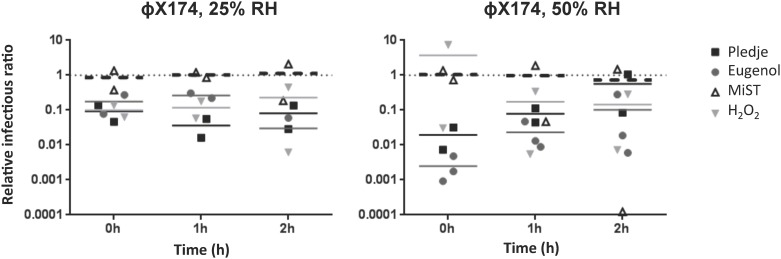
Viral diseases can spread through a variety of routes including aerosols. Yet, limited data are available on the efficacy of aerosolized chemicals to reduce viral loads in the air. Bacteriophages (phages) are often used as surrogates for hazardous viruses in aerosol studies because they are inexpensive, easy to handle, and safe for laboratory workers. Moreover, several of these bacterial viruses display physical characteristics similar to pathogenic human and animal viruses, like morphological size, type of nucleic acids, capsid morphology, and the presence of an envelope. In this study, the efficacy of four chemicals was evaluated on four airborne phages at two different relative humidity levels. Non-tailed bacteriophages MS2 (single-stranded RNA), ϕ6 (double-stranded RNA, enveloped), PR772 (double-stranded DNA), and ϕX174 (single-stranded DNA) were first aerosolized in a 55L rotative environmental chamber at 19°C with 25% and 50% relative humidity. Then, hydrogen peroxide, Eugenol (phenylpropene used in commercial perfumes and flavorings), Mist® (automobile disinfectant containing Triethylene glycol), and Pledge® (multisurface disinfectant containing Isopropanol, n-Alkyl Dimethyl Benzyl Amonium Chlorides, and n-Alkyl Dimethyl Ethylbenzyl Ammonium Chloride) were nebulized with the phages using a separate nebulizer. Aerosols were maintained in suspension during 10 minutes, 1 hour, and 2 hours. Viral aerosols were sampled using an SKC BioSampler and samples were analyzed using qPCR and plaque assays. The resistance levels of the four phages varied depending on the relative humidity (RH) and germicidal products tested. Phage MS2 was the most stable airborne virus under the environmental conditions tested while phage PR772 was the least stable. Pledge® and Eugenol reduced the infectivity of all airborne phages tested. At 25% RH, Pledge® and Eugenol were more effective at reducing infectivity of RNA phages ϕ6 and MS2. At 50% RH, Pledge® was the most effective agent against phage MS2. These findings illustrate that various airborne viruses should be tested to demonstrate the effectiveness of germicidal treatments. This research also provides a set of parameters for testing germicidal products in large-scale settings to reduce the risk of virus transmission.
病毒性疾病可通过多种途径传播,包括气溶胶传播。然而,关于雾化化学品降低空气中病毒载量的效果,现有数据有限。在气溶胶研究中,噬菌体通常被用作危险病毒的替代物,因为它们价格低廉、易于处理,且对实验室工作人员安全。此外,这些细菌病毒中有几种在物理特性上与致病性人类和动物病毒相似,如形态大小、核酸类型、衣壳形态以及包膜的存在情况。在本研究中,评估了四种化学品在两种不同相对湿度水平下对四种空气传播噬菌体的效果。首先,将无尾噬菌体MS2(单链RNA)、ϕ6(双链RNA,有包膜)、PR772(双链DNA)和ϕX174(单链DNA)在一个55升的旋转环境舱中于19°C、相对湿度为25%和50%的条件下雾化。然后,使用一个单独的雾化器将过氧化氢、丁香酚(用于商业香水和调味剂的苯丙烯)、Mist®(含有三甘醇的汽车消毒剂)和Pledge®(含有异丙醇、正烷基二甲基苄基氯化铵和正烷基二甲基乙基苄基氯化铵的多表面消毒剂)与噬菌体一起雾化。气溶胶在10分钟、1小时和2小时内保持悬浮状态。使用SKC生物采样器对病毒气溶胶进行采样,并使用定量聚合酶链反应(qPCR)和噬菌斑测定法对样品进行分析。四种噬菌体的抗性水平因测试的相对湿度(RH)和杀菌产品而异。在测试的环境条件下,噬菌体MS2是最稳定的空气传播病毒,而噬菌体PR772最不稳定。Pledge®和丁香酚降低了所有测试的空气传播噬菌体的感染性。在25%相对湿度下,Pledge®和丁香酚在降低RNA噬菌体ϕ6和MS2的感染性方面更有效。在50%相对湿度下,Pledge®是对抗噬菌体MS2最有效的试剂。这些发现表明,应该对各种空气传播病毒进行测试,以证明杀菌处理的有效性。这项研究还提供了一组参数,用于在大规模环境中测试杀菌产品,以降低病毒传播的风险。