Chen Yanxian, Zhang Jian, Morgan Ian G, He Mingguang
State Key Laboratory of Ophthalmology, Zhongshan Ophthalmic Center, Sun Yat-sen University, Guangzhou, China.
Research School of Biology, Australian National University, Canberra, Australia.
PLoS One. 2016 Dec 28;11(12):e0167642. doi: 10.1371/journal.pone.0167642. eCollection 2016.
To construct reference centile curves of refraction based on population-based data as an age-specific severity scale to evaluate their efficacy as a tool for identifying children at risk of developing high myopia in a longitudinal study.
Data of 4218 children aged 5-15 years from the Guangzhou Refractive Error Study in Children (RESC) study, and 354 first-born twins from the Guangzhou Twin Eye Study (GTES) with annual visit were included in the analysis. Reference centile curves for refraction were constructed using a quantile regression model based on the cycloplegic refraction data from the RESC. The risk of developing high myopia (spherical equivalent ≤ -6 diopters [D]) was evaluated as a diagnostic test using the twin follow-up data.
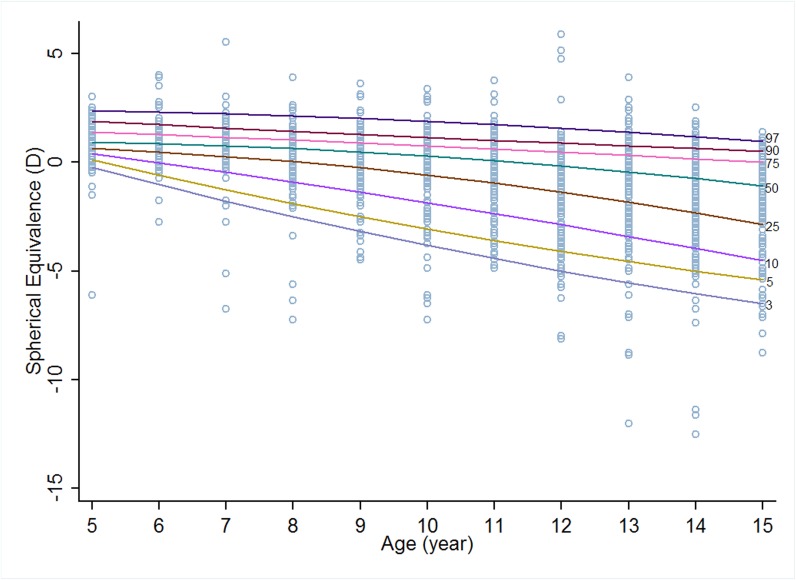
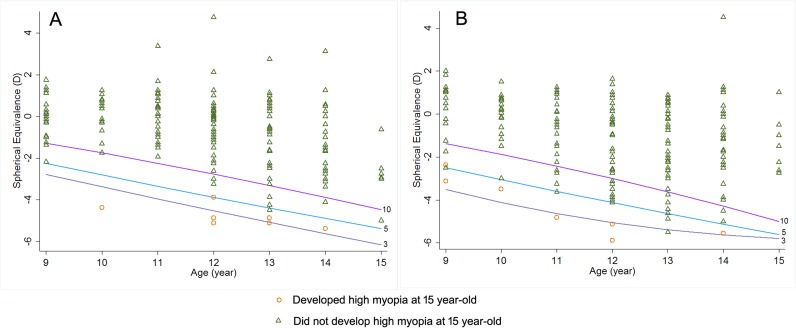
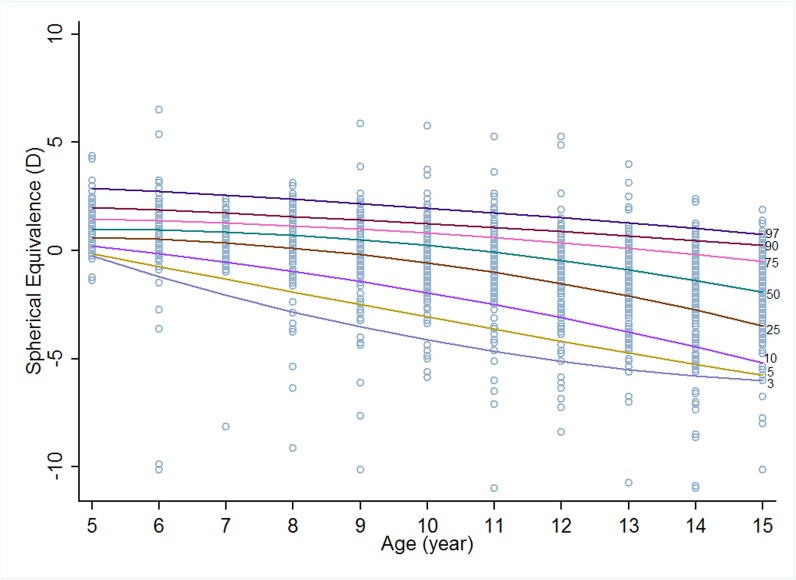
The centile curves suggested that the 3rd, 5th, and 10th percentile decreased from -0.25 D, 0.00 D and 0.25 D in 5 year-olds to -6.00 D, -5.65D and -4.63 D in 15 year-olds in the population-based data from RESC. In the GTES cohort, the 5th centile showed the most effective diagnostic value with a sensitivity of 92.9%, a specificity of 97.9% and a positive predictive value (PPV) of 65.0% in predicting high myopia onset (≤-6.00D) before the age of 15 years. The PPV was highest (87.5%) in 3rd centile but with only 50.0% sensitivity. The Mathew's correlation coefficient of 5th centile in predicting myopia of -6.0D/-5.0D/-4.0D by age of 15 was 0.77/0.51/0.30 respectively.
Reference centile curves provide an age-specific estimation on a severity scale of refractive error in school-aged children. Children located under lower percentiles at young age were more likely to have high myopia at 15 years or probably in adulthood.
基于人群数据构建屈光参考百分位数曲线,作为特定年龄的严重程度量表,以评估其在纵向研究中作为识别有发展为高度近视风险儿童工具的有效性。
分析纳入了来自广州儿童屈光不正研究(RESC)的4218名5至15岁儿童的数据,以及来自广州双胞胎眼研究(GTES)的354对初产双胞胎的数据,这些双胞胎每年接受随访。使用基于RESC的睫状肌麻痹验光数据的分位数回归模型构建屈光参考百分位数曲线。利用双胞胎随访数据,将发展为高度近视(等效球镜度≤-6屈光度[D])的风险作为诊断试验进行评估。
百分位数曲线显示,在RESC的人群数据中,5岁儿童的第3、第5和第10百分位数分别为-0.25 D、0.00 D和0.25 D,到15岁时分别降至-6.00 D、-5.65 D和-4.63 D。在GTES队列中,第5百分位数显示出最有效的诊断价值,在预测15岁前高度近视发病(≤-6.00 D)时,敏感性为92.9%,特异性为97.9%,阳性预测值(PPV)为65.0%。第3百分位数的PPV最高(87.5%),但敏感性仅为50.0%。第5百分位数在预测15岁时近视-6.0 D/-5.0 D/-4.0 D的马修相关系数分别为0.77/0.51/0.30。
参考百分位数曲线提供了学龄儿童屈光不正严重程度量表的特定年龄估计。幼年时处于较低百分位数的儿童在15岁或成年时更有可能患高度近视。