School of Optometry & Vision Sciences, Cardiff University, Maindy Road, Cardiff, CF24 4HQ, UK.
University of Western Australia, Centre for Ophthalmology and Visual Science (incorporating the Lions Eye Institute), Perth, Western Australia, Australia.
EBioMedicine. 2023 May;91:104551. doi: 10.1016/j.ebiom.2023.104551. Epub 2023 Apr 11.
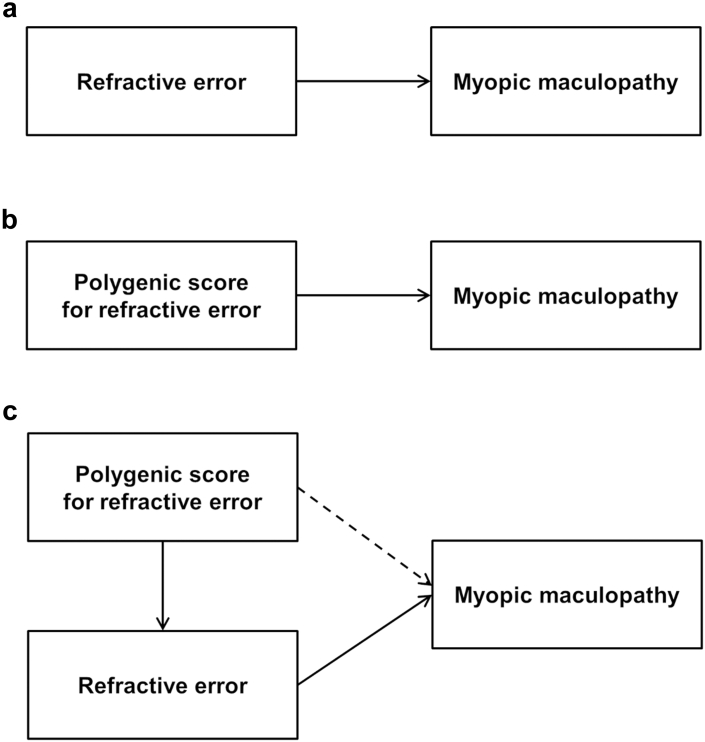
High myopia (HM), defined as a spherical equivalent refractive error (SER) ≤ -6.00 diopters (D), is a leading cause of sight impairment, through myopic macular degeneration (MMD). We aimed to derive an improved polygenic score (PGS) for predicting children at risk of HM and to test if a PGS is predictive of MMD after accounting for SER.
The PGS was derived from genome-wide association studies in participants of UK Biobank, CREAM Consortium, and Genetic Epidemiology Research on Adult Health and Aging. MMD severity was quantified by a deep learning algorithm. Prediction of HM was quantified as the area under the receiver operating curve (AUROC). Prediction of severe MMD was assessed by logistic regression.
In independent samples of European, African, South Asian and East Asian ancestry, the PGS explained 19% (95% confidence interval 17-21%), 2% (1-3%), 8% (7-10%) and 6% (3-9%) of the variation in SER, respectively. The AUROC for HM in these samples was 0.78 (0.75-0.81), 0.58 (0.53-0.64), 0.71 (0.69-0.74) and 0.67 (0.62-0.72), respectively. The PGS was not associated with the risk of MMD after accounting for SER: OR = 1.07 (0.92-1.24).
Performance of the PGS approached the level required for clinical utility in Europeans but not in other ancestries. A PGS for refractive error was not predictive of MMD risk once SER was accounted for.
Supported by the Welsh Government and Fight for Sight (24WG201).
高度近视(HM)定义为等效球镜屈光不正(SER)≤-6.00 屈光度(D),是导致视力损害的主要原因,通过近视性黄斑变性(MMD)。我们旨在为预测 HM 风险的儿童开发改良的多基因评分(PGS),并测试 PGS 在考虑 SER 后是否可预测 MMD。
PGS 是从 UK Biobank、CREAM 联盟和遗传流行病学研究成人健康和衰老参与者的全基因组关联研究中得出的。通过深度学习算法量化 MMD 严重程度。HM 的预测量化为接收器操作特征曲线(AUROC)下的面积。严重 MMD 的预测通过逻辑回归进行评估。
在欧洲、非洲、南亚和东亚血统的独立样本中,PGS 分别解释了 SER 变化的 19%(95%置信区间 17-21%)、2%(1-3%)、8%(7-10%)和 6%(3-9%)。这些样本中 HM 的 AUROC 分别为 0.78(0.75-0.81)、0.58(0.53-0.64)、0.71(0.69-0.74)和 0.67(0.62-0.72)。在考虑 SER 后,PGS 与 MMD 风险无关:OR=1.07(0.92-1.24)。
PGS 在欧洲的临床应用性能接近要求,但在其他血统中则不然。在考虑 SER 后,用于屈光不正的 PGS 不能预测 MMD 风险。
由威尔士政府和“争取视力”(24WG201)资助。