Sandsmark Elise, Hansen Ailin Falkmo, Selnæs Kirsten M, Bertilsson Helena, Bofin Anna M, Wright Alan J, Viset Trond, Richardsen Elin, Drabløs Finn, Bathen Tone F, Tessem May-Britt, Rye Morten B
Department of Circulation and Medical Imaging, Faculty of Medicine, NTNU - Norwegian University of Science and Technology, Trondheim, Norway.
Department of Urology, St. Olavs Hospital, Trondheim University Hospital, Norway.
Oncotarget. 2017 Feb 7;8(6):9572-9586. doi: 10.18632/oncotarget.14161.
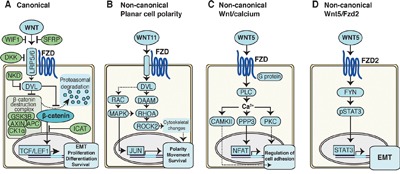
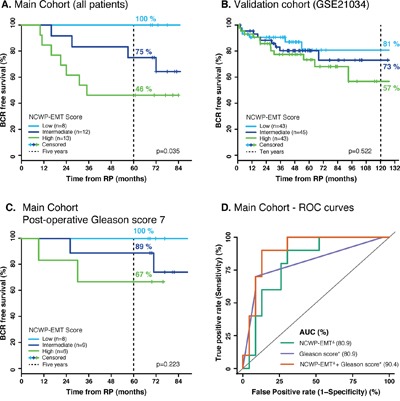
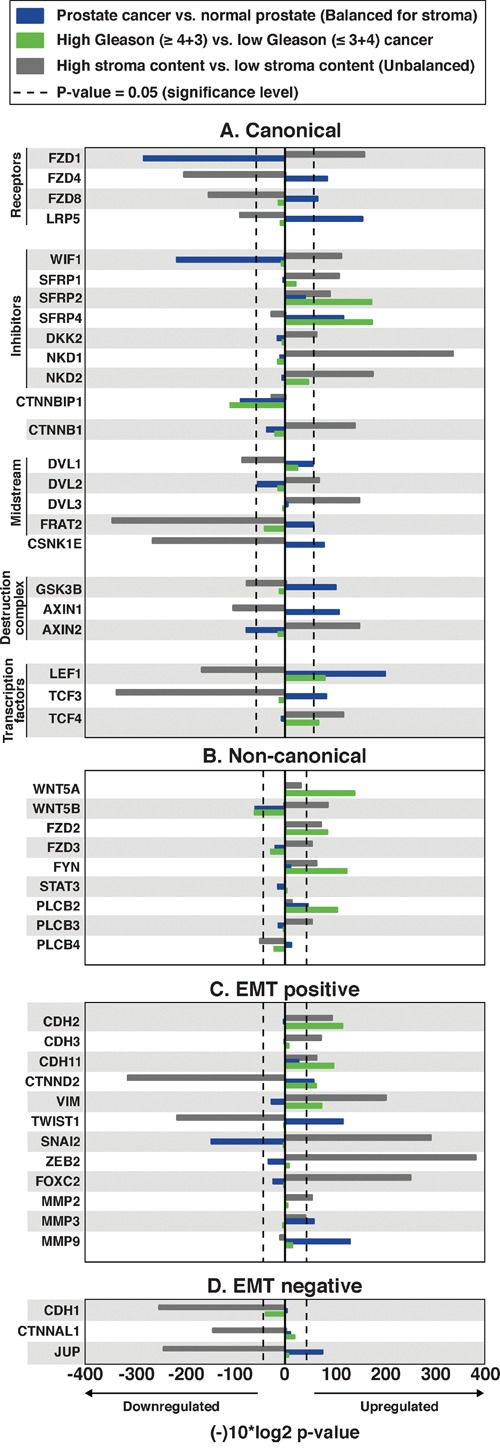
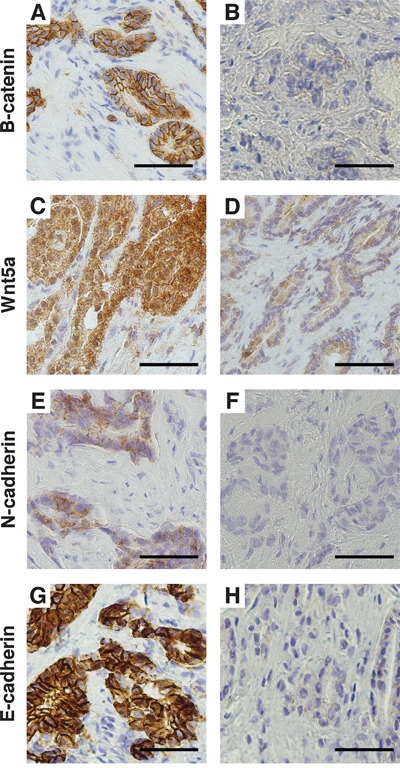
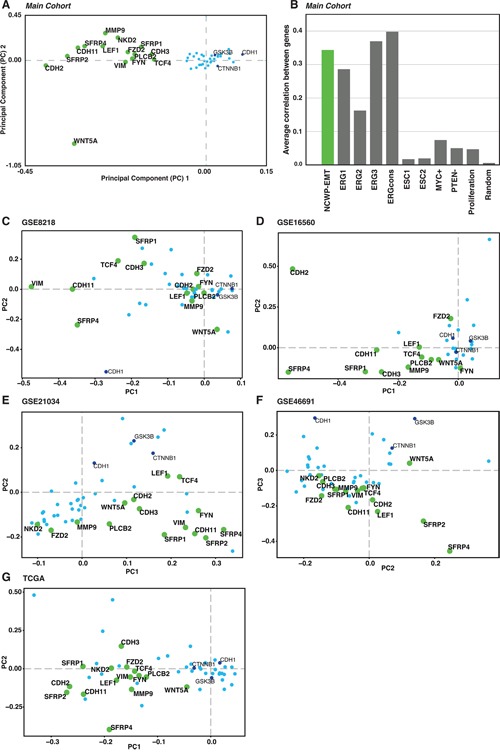
Activation of the Canonical Wnt pathway (CWP) has been linked to advanced and metastatic prostate cancer, whereas the Wnt5a-induced non-canonical Wnt pathway (NCWP) has been associated with both good and poor prognosis. A newly discovered NCWP, Wnt5/Fzd2, has been shown to induce epithelial-to-mesenchymal transition (EMT) in cancers, but has not been investigated in prostate cancer. The aim of this study was to investigate if the CWP and NCWP, in combination with EMT, are associated with metabolic alterations, aggressive disease and biochemical recurrence in prostate cancer. An initial analysis was performed using integrated transcriptomics, ex vivo and in vivo metabolomics, and histopathology of prostatectomy samples (n=129), combined with at least five-year follow-up. This analysis detected increased activation of NCWP through Wnt5a/ Fzd2 as the most common mode of Wnt activation in prostate cancer. This activation was associated with increased expression of EMT markers and higher Gleason score. The transcriptional association between NCWP and EMT was confirmed in five other publicly available patient cohorts (1519 samples in total). A novel gene expression signature of concordant activation of NCWP and EMT (NCWP-EMT) was developed, and this signature was significantly associated with metastasis and shown to be a significant predictor of biochemical recurrence. The NCWP-EMT signature was also associated with decreased concentrations of the metabolites citrate and spermine, which have previously been linked to aggressive prostate cancer. Our results demonstrate the importance of NCWP and EMT in prostate cancer aggressiveness, suggest a novel gene signature for improved risk stratification, and give new molecular insight.
经典Wnt信号通路(CWP)的激活与晚期和转移性前列腺癌相关,而Wnt5a诱导的非经典Wnt信号通路(NCWP)则与预后良好和不良均有关联。一条新发现的NCWP,即Wnt5/Fzd2,已被证明可在癌症中诱导上皮-间质转化(EMT),但尚未在前列腺癌中进行研究。本研究的目的是调查CWP和NCWP与EMT相结合是否与前列腺癌的代谢改变、侵袭性疾病和生化复发有关。最初的分析使用了综合转录组学、体外和体内代谢组学以及前列腺切除样本(n = 129)的组织病理学,并结合了至少五年的随访。该分析检测到通过Wnt/a/Fzd2激活NCWP增加是前列腺癌中Wnt激活的最常见模式。这种激活与EMT标志物表达增加和更高的Gleason评分相关。在其他五个公开可用的患者队列(总共1519个样本)中证实了NCWP与EMT之间的转录关联。开发了一种新的NCWP和EMT协同激活的基因表达特征(NCWP-EMT),该特征与转移显著相关,并被证明是生化复发的重要预测指标。NCWP-EMT特征还与代谢物柠檬酸盐和精胺浓度降低有关,这两种代谢物此前已与侵袭性前列腺癌相关联。我们的结果证明了NCWP和EMT在前列腺癌侵袭性中的重要性,提出了一种用于改善风险分层的新基因特征,并提供了新的分子见解。