Dhasmana D C, Bala Suman, Sharma Rajendra, Sharma Taruna, Kohli Saurabh, Aggarwal Neeraj, Kalra Juhi
Department of Pharmacology, Himalayan Institute of Medical Sciences, Swami Rama Himalayan University, Jolly Grant, Dehradun, Uttarakhand, India.
Indian J Pharmacol. 2016 Oct;48(Suppl 1):S52-S56. doi: 10.4103/0253-7613.193308.
Viva voce examination is an important tool of evaluation in medical examinations marred by high subjectivity. Gross subjectivity in viva voce assessment can be reduced by structuring it.
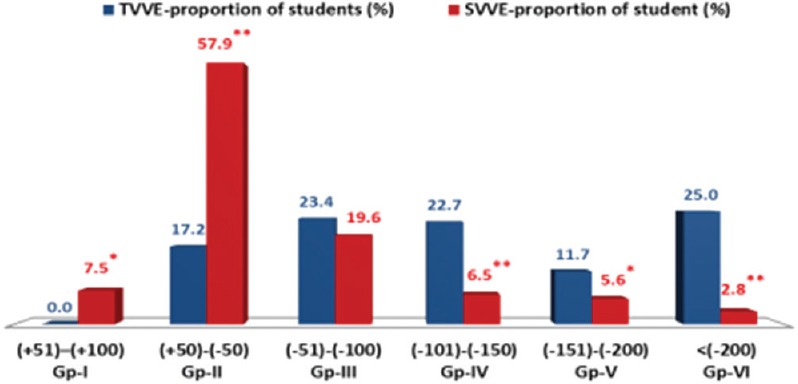
The marks obtained in theory and viva voce (traditional viva voce examination [TVVE]) of I sessional, II MBBS students were compared and a huge disparity was identified. A structured viva voce examination (SVVE) was then proposed and experimented as an objective and standardized alternative. Sets of equitable question cards for SVVE were prepared, each having eight questions with two parts each, arranged successively with increasing difficulty, domains of learning, and appropriate marks. The percentage variation in scoring in viva versus theory marks was calculated for both TVVE and SVVE, and students were grouped as Group I (+100 to +51%); Group II (+50 to -50%); Group III (-51 to -100%); Group IV (-101 to -150%); Group V (-151 to -200%); and Group VI (< -200%) variation, as? inappropriate, appropriate, inappropriate, erroneous, more erroneous and most erroneous respectively. Student's feedback on the SVVE was also obtained.
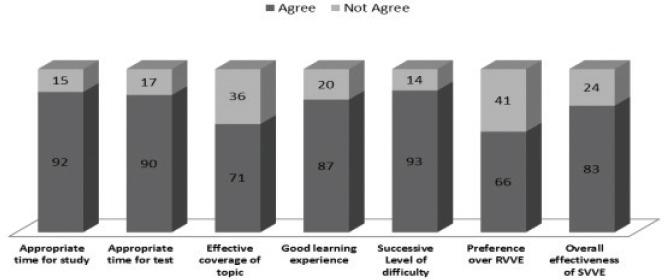
In TVVE ( = 128), the students distributed were:none,17.2%, 23.4%, 22.7%, 11.7% and 25% in Group I, II, III, IV, V, and VI in contrast to SVVE ( = 107) as 7.5%, 57.9%, 19.6%, 6.5%, 5.6%, and 2.8%, respectively. Marked disparity of TVVE was annulled with SVVE. Student's feedback was quite encouraging with 83% overall acceptability and almost 66% preferred SVVE.
SVVE was more realistic as compared to TVVE. Most of the students favored this approach.
口试是医学考试中一项重要的评估工具,但存在高度主观性。通过结构化可以降低口试评估中的总体主观性。
比较了II年级MBBS学生第一学期理论考试和口试(传统口试[TVVE])的成绩,发现存在巨大差异。随后提出并试验了一种结构化口试(SVVE)作为客观、标准化的替代方法。为SVVE准备了公平的问题卡集,每套有八个问题,每个问题分两部分,按照难度递增、学习领域和适当分数依次排列。计算了TVVE和SVVE口试成绩与理论成绩的百分比差异,并将学生分为I组(+100至+51%);II组(+50至-50%);III组(-51至-100%);IV组(-101至-150%);V组(-151至-200%);VI组(<-200%)差异,分别表示为不适当、适当、不适当、错误、更错误和最错误。还获得了学生对口试的反馈。
在TVVE(n = 128)中,I组、II组、III组、IV组、V组和VI组的学生分布分别为0%、17.2%、23.4%、22.7%、11.7%和25%,而在SVVE(n = 107)中分别为7.5%、57.9%、19.6%、6.5%、5.6%和2.8%。TVVE的明显差异通过SVVE得以消除。学生的反馈相当令人鼓舞,总体接受率为83%,近66%的学生更喜欢SVVE。
与TVVE相比,SVVE更符合实际情况。大多数学生喜欢这种方法。