He Mingjing, Zhou Zhuan, Shah Anil A, Zou Haojing, Tao Jin, Chen Qianming, Wan Yong
Department of Cell Biology, University of Pittsburgh School of Medicine, 5117 Centre Avenue, Hillman Cancer Center, HCC2.6c, Pittsburgh, PA 15213 USA ; State Key Laboratory of Oral Diseases, West China Hospital of Stomatology, Sichuan University, Chengdu, 610041 Sichuan People's Republic of China.
Department of Cell Biology, University of Pittsburgh School of Medicine, 5117 Centre Avenue, Hillman Cancer Center, HCC2.6c, Pittsburgh, PA 15213 USA.
Cell Biosci. 2016 Dec 20;6:62. doi: 10.1186/s13578-016-0127-1. eCollection 2016.
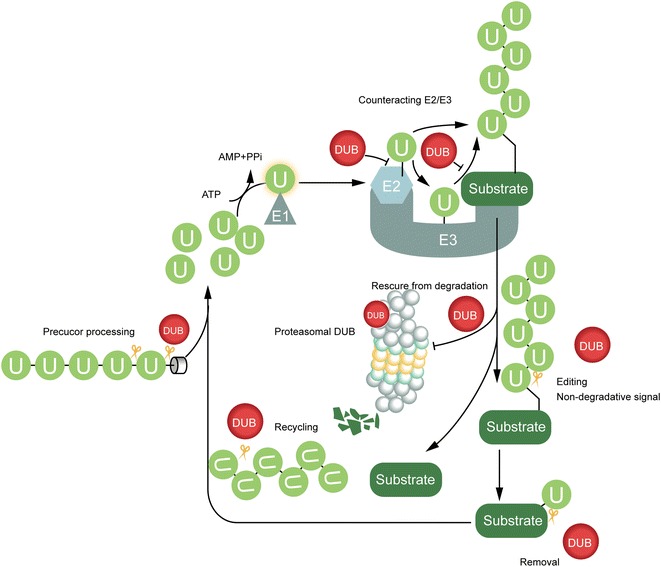
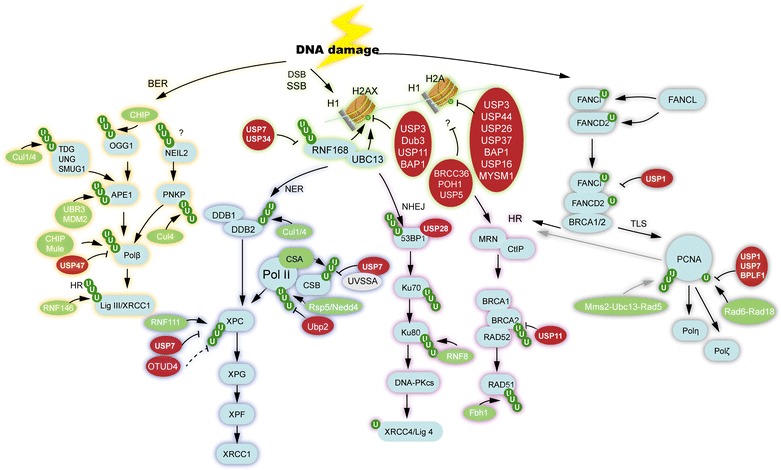
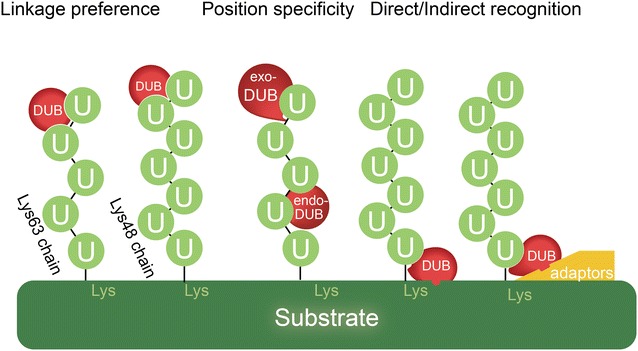
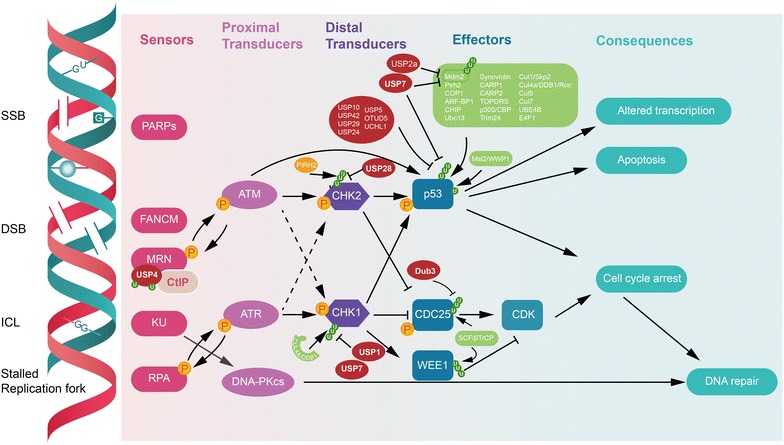
The addition of mono-ubiquitin or poly-ubiquitin chain to signaling proteins in response to DNA damage signal is thought to be a critical event that facilitates the recognition of DNA damage lesion site, the activation of checkpoint function, termination and checkpoint response and the recruitment of DNA repair proteins. Despite the ubiquitin modifiers, removal of ubiquitin from the functional proteins by the deubiquitinating enzymes (DUBs) plays an important role in orchestrating DNA damage response as well as DNA repair processes. Deregulated ubiquitination and deubiquitination could lead to genome instability that in turn causes tumorigenesis. Recent TCGA study has further revealed the connection between mutations in alteration of DUBs and various types of tumors. In addition, emerging drug design based on DUBs provides a new avenue for anti-cancer therapy. In this review, we will summarize the role of deubiquitination and specificity of DUBs, and highlight the recent discoveries of DUBs in the modulation of ubiquitin-mediated DNA damage response and DNA damage repair. We will furthermore discuss the DUBs involved in the tumorigenesis as well as interception of deubiquitination as a novel strategy for anti-cancer therapy.
响应DNA损伤信号时,向信号蛋白添加单泛素或多泛素链被认为是一个关键事件,它有助于识别DNA损伤位点、激活检查点功能、终止和检查点反应以及募集DNA修复蛋白。尽管存在泛素修饰剂,但去泛素化酶(DUBs)从功能蛋白上去除泛素在协调DNA损伤反应以及DNA修复过程中也起着重要作用。泛素化和去泛素化失调可能导致基因组不稳定,进而引发肿瘤发生。最近的TCGA研究进一步揭示了DUBs改变中的突变与各种类型肿瘤之间的联系。此外,基于DUBs的新兴药物设计为抗癌治疗提供了一条新途径。在这篇综述中,我们将总结去泛素化的作用和DUBs的特异性,并强调DUBs在调节泛素介导的DNA损伤反应和DNA损伤修复方面的最新发现。我们还将讨论参与肿瘤发生的DUBs以及作为抗癌治疗新策略的去泛素化阻断。