Harricharan Sherain, Rabellino Daniela, Frewen Paul A, Densmore Maria, Théberge Jean, McKinnon Margaret C, Schore Allan N, Lanius Ruth A
Department of Neuroscience University of Western Ontario London ON Canada.
Department of Psychiatry University of Western Ontario London ON Canada.
Brain Behav. 2016 Sep 20;6(12):e00579. doi: 10.1002/brb3.579. eCollection 2016 Dec.
Posttraumatic stress disorder (PTSD) is associated with hyperarousal and active fight or flight defensive responses. By contrast, the dissociative subtype of PTSD, characterized by depersonalization and derealization symptoms, is frequently accompanied by additional passive or submissive defensive responses associated with autonomic blunting. Here, the periaqueductal gray (PAG) plays a central role in defensive responses, where the dorsolateral (DL-PAG) and ventrolateral PAG (VL-PAG) are thought to mediate active and passive defensive responses, respectively.
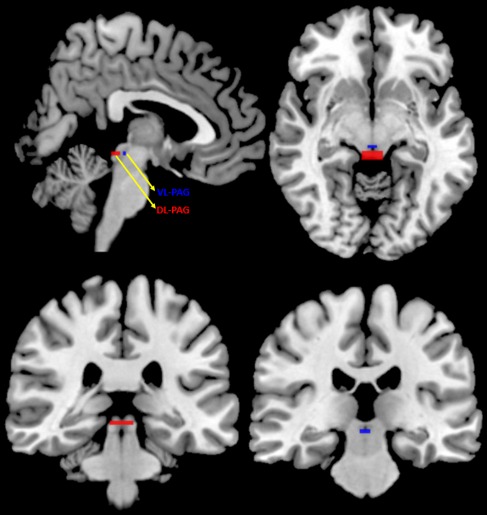
We examined PAG subregion (dorsolateral and ventrolateral) resting-state functional connectivity in three groups: PTSD patients without the dissociative subtype (= 60); PTSD patients with the dissociative subtype (= 37); and healthy controls (= 40) using a seed-based approach via PickAtlas and SPM12.
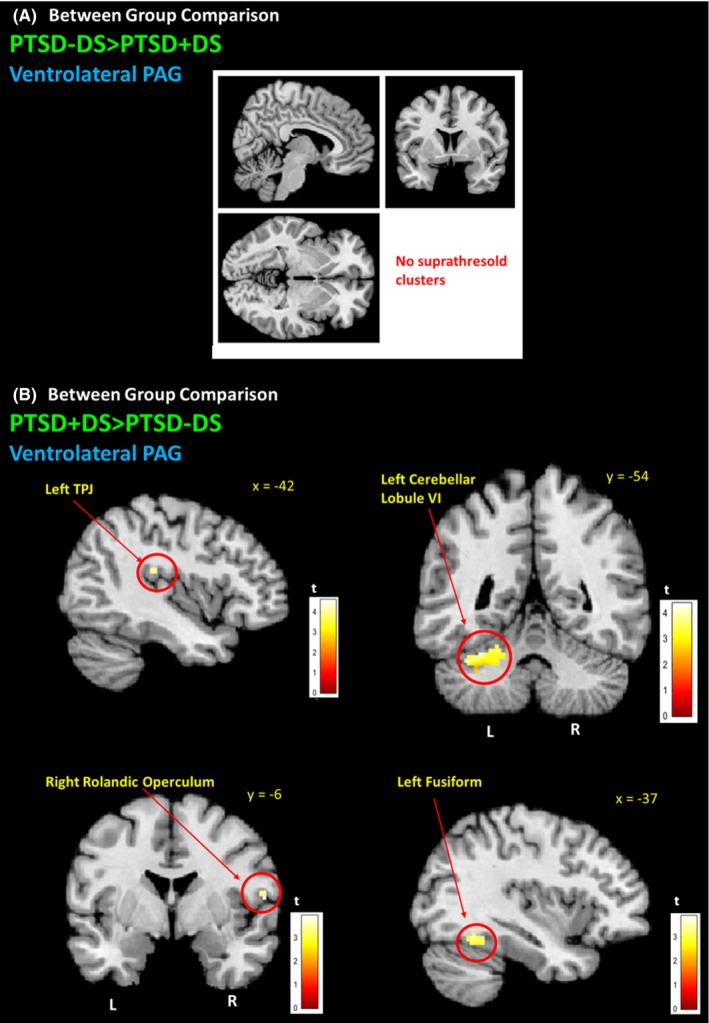
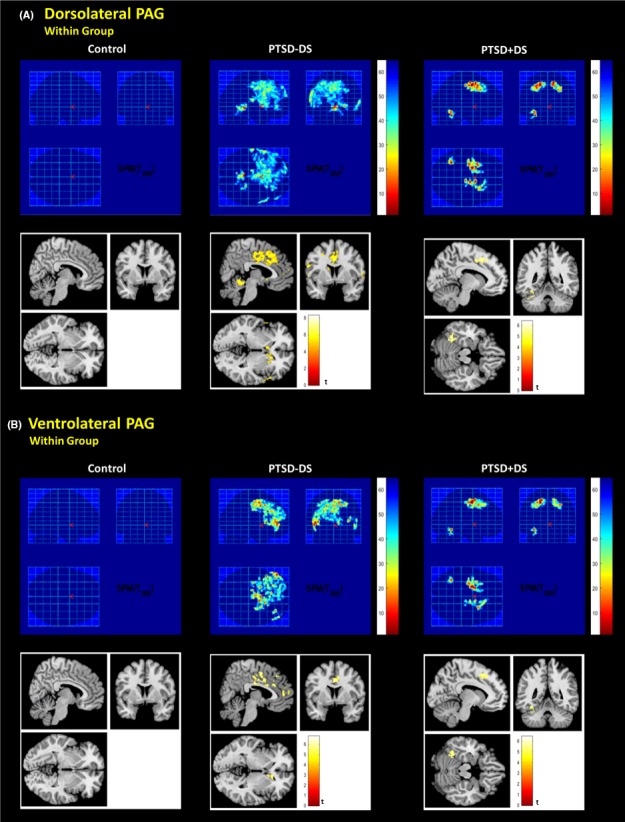
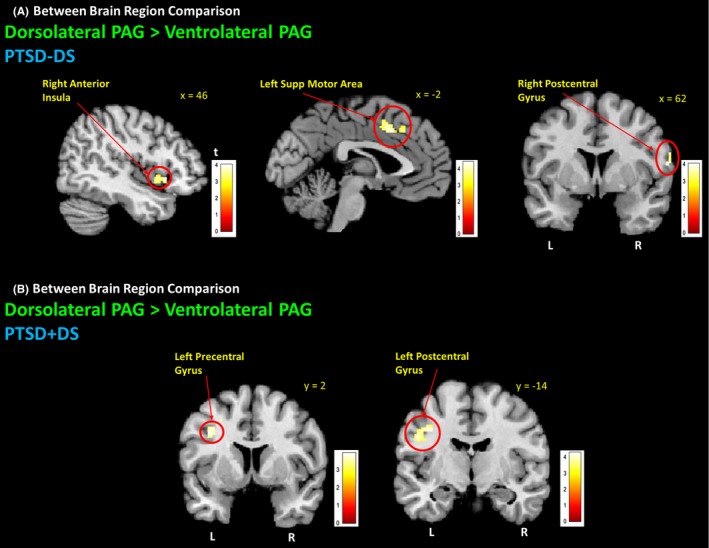
All PTSD patients showed extensive DL- and VL-PAG functional connectivity at rest with areas associated with emotional reactivity and defensive action as compared to controls (= 40). Although all PTSD patients demonstrated DL-PAG functional connectivity with areas associated with initiation of active coping strategies and hyperarousal (e.g., dorsal anterior cingulate; anterior insula), only dissociative PTSD patients exhibited greater VL-PAG functional connectivity with brain regions linked to passive coping strategies and increased levels of depersonalization (e.g., temporoparietal junction; rolandic operculum).
These findings suggest greater defensive posturing in PTSD patients even at rest and demonstrate that those with the dissociative subtype show unique patterns of PAG functional connectivity when compared to those without the subtype. Taken together, these findings represent an important first step toward identifying neural and behavioral targets for therapeutic interventions that address defensive strategies in trauma-related disorders.
创伤后应激障碍(PTSD)与过度觉醒及主动的战斗或逃跑防御反应有关。相比之下,PTSD的解离亚型以人格解体和现实解体症状为特征,常伴有与自主神经迟钝相关的额外被动或顺从防御反应。在此,中脑导水管周围灰质(PAG)在防御反应中起核心作用,其中背外侧(DL-PAG)和腹外侧PAG(VL-PAG)分别被认为介导主动和被动防御反应。
我们通过基于种子点的方法,利用PickAtlas和SPM12,在三组中检查了PAG亚区域(背外侧和腹外侧)的静息态功能连接:无解离亚型的PTSD患者(=60例);有解离亚型的PTSD患者(=37例);以及健康对照者(=40例)。
与对照组(=40例)相比,所有PTSD患者在静息状态下均显示出DL-PAG和VL-PAG与情绪反应和防御行动相关区域的广泛功能连接。尽管所有PTSD患者均表现出DL-PAG与与主动应对策略启动和过度觉醒相关区域(如背侧前扣带回;前岛叶)的功能连接,但只有解离型PTSD患者表现出VL-PAG与与被动应对策略和人格解体水平升高相关脑区(如颞顶联合区;中央沟盖)的功能连接更强。
这些发现表明,即使在静息状态下,PTSD患者也有更强的防御姿态,并且表明与无该亚型的患者相比,解离亚型患者表现出独特的PAG功能连接模式。综上所述,这些发现是朝着识别针对创伤相关障碍中防御策略的治疗干预的神经和行为靶点迈出的重要第一步。