Guedes Ricardo Augusto Paletta, Guedes Vanessa Maria Paletta, Gomes Carlos Eduardo de Mello, Chaoubah Alfredo
Statistics Department and Public Health Department, Federal University of Juiz de Fora Ophthalmology Department, Santa Casa de Misericórdia Hospital Glaucoma Department, Paletta Guedes Ophthalmological Center, Juiz de Fora, MG, Brazil.
Medicine (Baltimore). 2016 Dec;95(52):e5745. doi: 10.1097/MD.0000000000005745.
The aim of this study is to determine the most cost-effective strategy for the treatment of primary open-angle glaucoma (POAG) in Brazil, from the payer's perspective (Brazilian Public Health System) in the setting of the Glaucoma Referral Centers.
Study design was a cost-effectiveness analysis of different treatment strategies for POAG. We developed 3 Markov models (one for each glaucoma stage: early, moderate and advanced), using a hypothetical cohort of POAG patients, from the perspective of the Brazilian Public Health System (SUS) and a horizon of the average life expectancy of the Brazilian population. Different strategies were tested according to disease severity. For early glaucoma, we compared observation, laser and medications. For moderate glaucoma, medications, laser and surgery. For advanced glaucoma, medications and surgery. Main outcome measures were ICER (incremental cost-effectiveness ratio), medical direct costs and QALY (quality-adjusted life year).
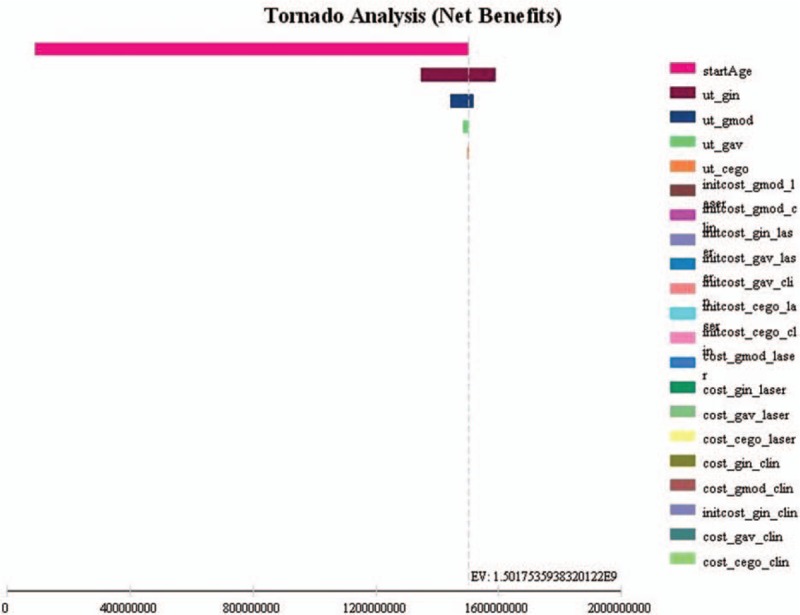
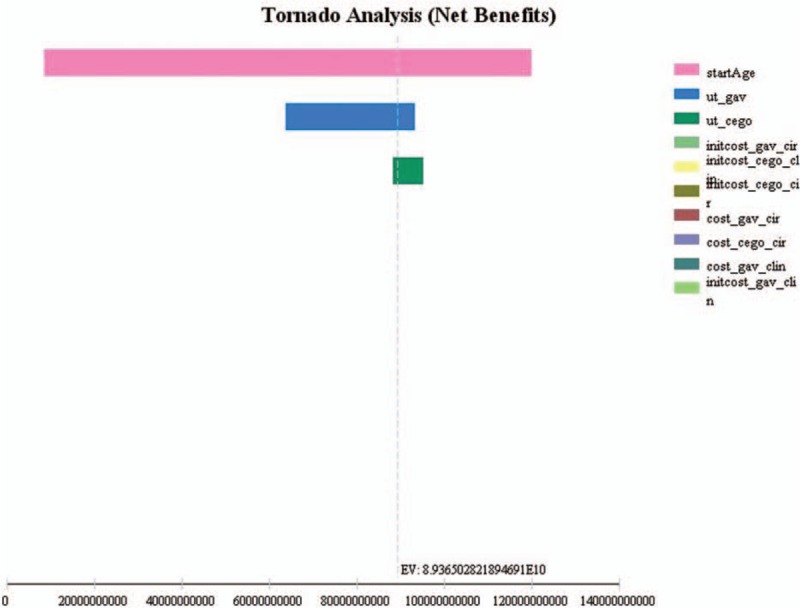
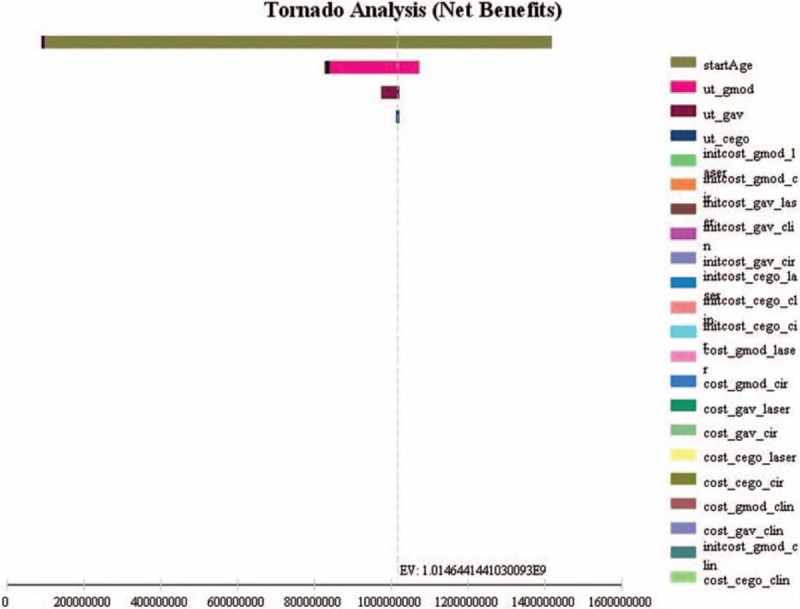
In early glaucoma, both laser and medical treatment were cost-effective (ICERs of initial laser and initial medical treatment over observation only, were R$ 2,811.39/QALY and R$ 3,450.47/QALY). Compared to observation strategy, the two alternatives have provided significant gains in quality of life. In moderate glaucoma population, medical treatment presented the highest costs among treatment strategies. Both laser and surgery were highly cost-effective in this group. For advanced glaucoma, both tested strategies were cost-effective. Starting age had a great impact on results in all studied groups. Initiating glaucoma therapy using laser or surgery were more cost-effective, the younger the patient.
All tested treatment strategies for glaucoma provided real gains in quality of life and were cost-effective. However, according to the disease severity, not all strategies provided the same cost-effectiveness profile. Based on our findings, there should be a preferred strategy for each glaucoma stage, according to a cost-effectiveness ratio ranking.
本研究旨在从青光眼转诊中心的支付方(巴西公共卫生系统)角度,确定巴西治疗原发性开角型青光眼(POAG)最具成本效益的策略。
研究设计为对POAG不同治疗策略的成本效益分析。我们使用一组假设的POAG患者,从巴西公共卫生系统(SUS)角度以及巴西人口平均预期寿命的时间跨度,开发了3个马尔可夫模型(每个青光眼阶段一个:早期、中度和晚期)。根据疾病严重程度测试不同策略。对于早期青光眼,我们比较了观察、激光治疗和药物治疗。对于中度青光眼,比较了药物治疗、激光治疗和手术治疗。对于晚期青光眼,比较了药物治疗和手术治疗。主要结局指标为增量成本效益比(ICER)、医疗直接成本和质量调整生命年(QALY)。
在早期青光眼阶段,激光治疗和药物治疗均具有成本效益(仅观察与初始激光治疗和初始药物治疗相比的ICER分别为每QALY 2811.39雷亚尔和每QALY 3450.47雷亚尔)。与观察策略相比,这两种替代方案均显著提高了生活质量。在中度青光眼患者群体中,药物治疗在治疗策略中成本最高。激光治疗和手术治疗在该组中均具有高成本效益。对于晚期青光眼,两种测试策略均具有成本效益。起始年龄对所有研究组的结果有很大影响。患者越年轻,采用激光或手术开始青光眼治疗越具成本效益。
所有测试的青光眼治疗策略均在生活质量方面带来了实际改善且具有成本效益。然而,根据疾病严重程度,并非所有策略都具有相同的成本效益特征。基于我们的研究结果,根据成本效益比排名,每个青光眼阶段应有首选策略。