Krüsemann Erna J Z, Cremers Johannes W J M, Visser Wouter F, Punter Pieter H, Talhout Reinskje
Centre for Health Protection, National Institute for Public Health and the Environment (RIVM), Antonie van Leeuwenhoeklaan 9, 3721 MA Bilthoven, The Netherlands and.
OP&P Product Research BV, Burgemeester Reigerstraat 89, 3581 KP Utrecht, The Netherlands.
Chem Senses. 2017 Mar 1;42(3):233-238. doi: 10.1093/chemse/bjw123.
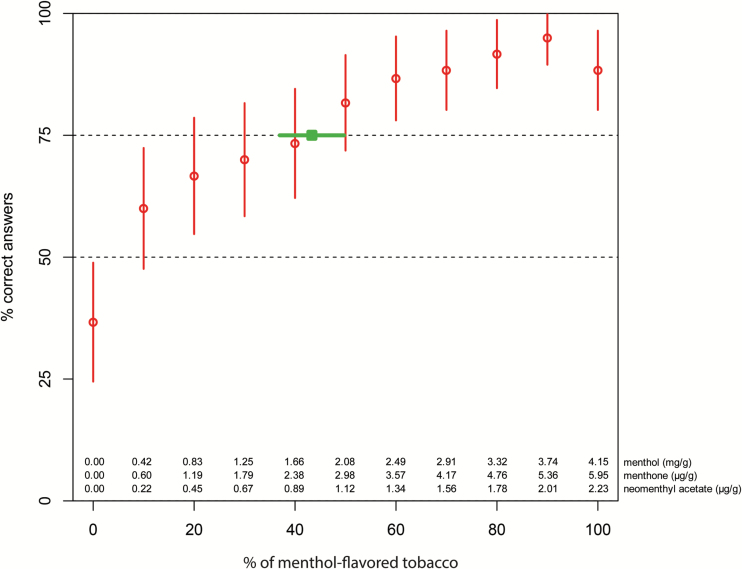
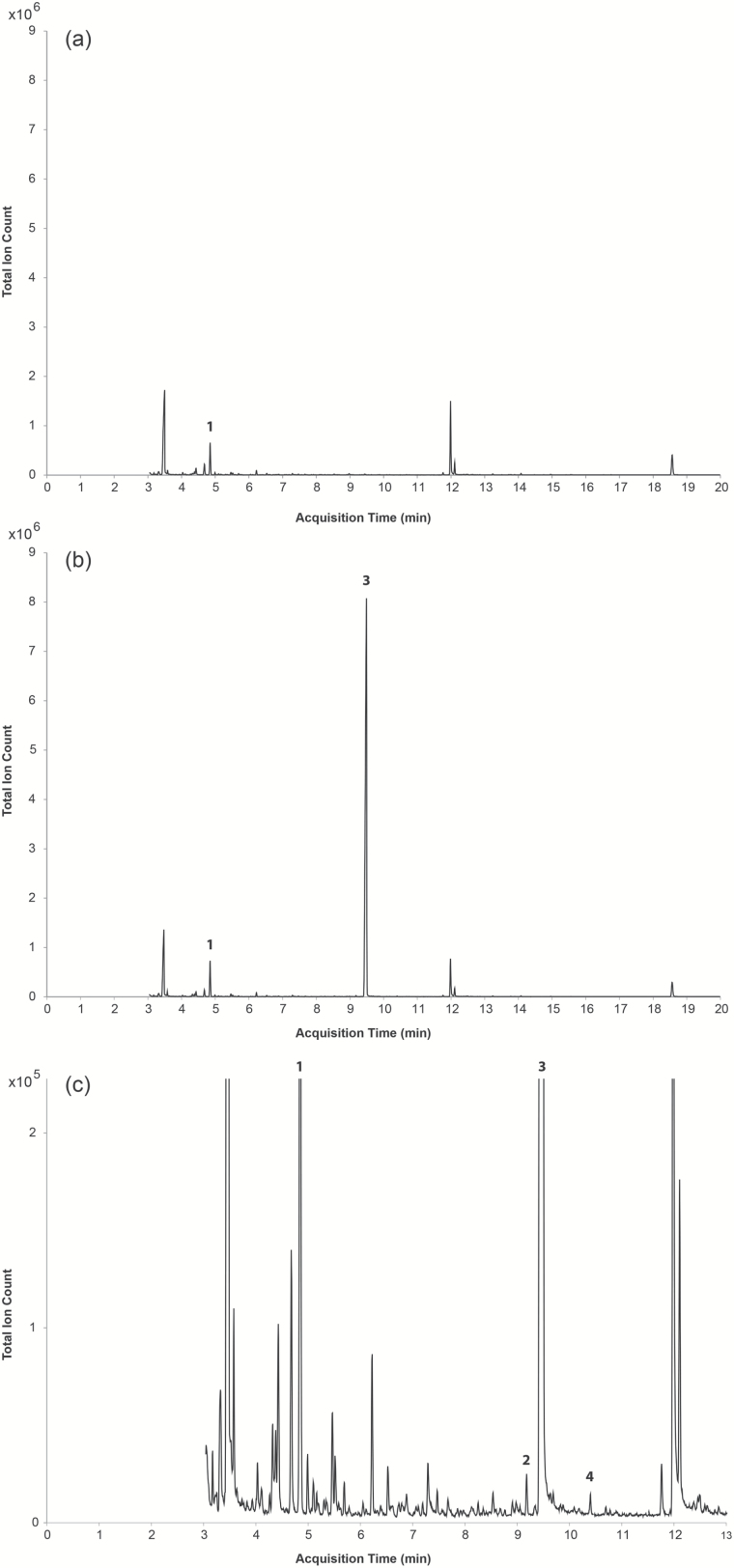
Cigarettes are an often-used consumer product, and flavor is an important determinant of their product appeal. Cigarettes with strong nontobacco flavors are popular among young people, and may facilitate smoking initiation. Discriminating flavors in tobacco is important for regulation purposes, for instance to set upper limits to the levels of important flavor additives. We provide a simple and fast method to determine the human odor difference threshold for flavor additives in a tobacco matrix, using a combination of chemical and sensory analysis. For an example, the human difference threshold for menthol odor, one of the most frequently used tobacco flavors, was determined. A consumer panel consisting of 20 women compared different concentrations of menthol-flavored tobacco to unflavored cigarette tobacco using the 2-alternative forced choice method. Components contributing to menthol odor were quantified using headspace GC-MS. The sensory difference threshold of menthol odor corresponded to a mixture of 43 (37-50)% menthol-flavored tobacco, containing 1.8 (1.6-2.1) mg menthol, 2.7 (2.3-3.1) µg menthone, and 1.0 (0.9-1.2) µg neomenthyl acetate per gram of tobacco. Such a method is important in the context of the European Tobacco Product Directive, and the US Food and Drug Administration Tobacco Control Act, that both prohibit cigarettes and roll-your-own tobacco with a characterizing flavor other than tobacco. Our method can also be adapted for matrices other than tobacco, such as food.
香烟是一种常用的消费品,味道是其产品吸引力的重要决定因素。带有浓郁非烟草味道的香烟在年轻人中很受欢迎,可能会促使人们开始吸烟。区分烟草中的味道对于监管目的很重要,例如设定重要味道添加剂含量的上限。我们提供了一种简单快速的方法,结合化学分析和感官分析来确定烟草基质中味道添加剂的人体气味差异阈值。例如,测定了最常用的烟草味道之一薄荷醇气味的人体差异阈值。一个由20名女性组成的消费者小组使用二项必选法比较了不同浓度的薄荷醇味烟草与无味卷烟烟草。使用顶空气相色谱 - 质谱法定量了构成薄荷醇气味的成分。薄荷醇气味的感官差异阈值相当于43(37 - 50)%的薄荷醇味烟草混合物,每克烟草含有1.8(1.6 - 2.1)毫克薄荷醇、2.7(2.3 - 3.1)微克薄荷酮和1.0(0.9 - 1.2)微克新薄荷基乙酸酯。在欧洲烟草产品指令和美国食品药品监督管理局烟草控制法案的背景下,这样的方法很重要,这两个法案都禁止带有非烟草特征味道的香烟和自卷烟。我们的方法也可适用于烟草以外的其他基质,如食品。