Bologna Zuzana, Teoh Jian-Peng, Bayoumi Ahmed S, Tang Yaoliang, Kim Il-Man
Vascular Biology Center, Medical College of Georgia, Augusta University, GA 30912, USA.
Department of Biochemistry and Molecular Biology, Medical College of Georgia, Augusta University, GA 30912, USA.
Biomol Ther (Seoul). 2017 Jan 1;25(1):12-25. doi: 10.4062/biomolther.2016.165.
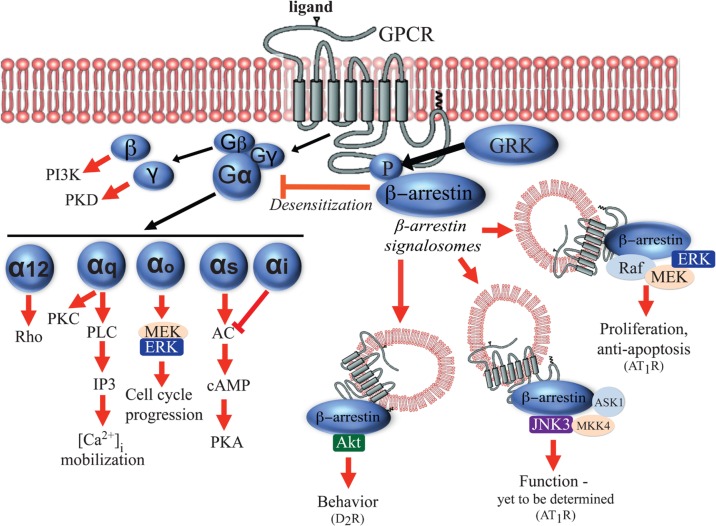
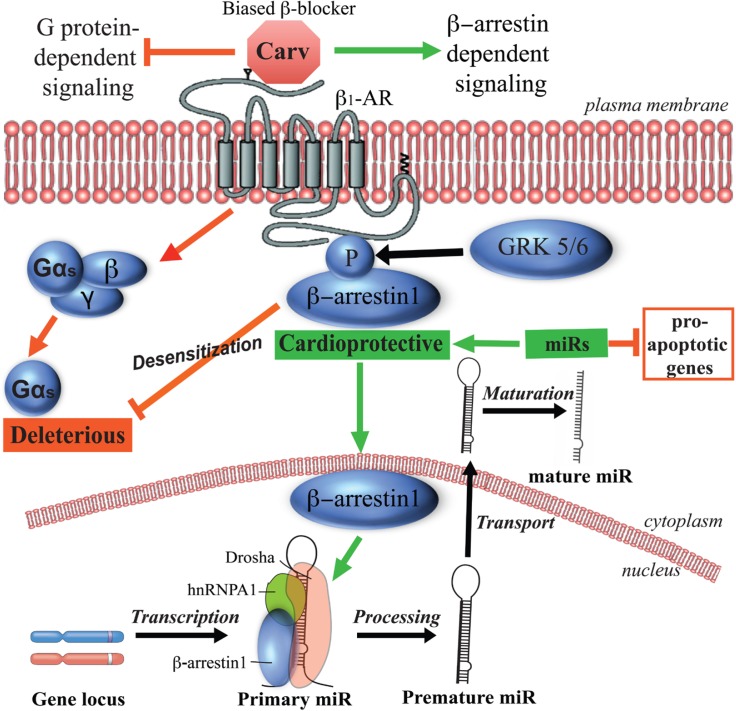
G protein-coupled receptors (GPCRs) are a family of cell-surface proteins that play critical roles in regulating a variety of pathophysiological processes and thus are targeted by almost a third of currently available therapeutics. It was originally thought that GPCRs convert extracellular stimuli into intracellular signals through activating G proteins, whereas β-arrestins have important roles in internalization and desensitization of the receptor. Over the past decade, several novel functional aspects of β-arrestins in regulating GPCR signaling have been discovered. These previously unanticipated roles of β-arrestins to act as signal transducers and mediators of G protein-independent signaling have led to the concept of biased agonism. Biased GPCR ligands are able to engage with their target receptors in a manner that preferentially activates only G protein- or β-arrestin-mediated downstream signaling. This offers the potential for next generation drugs with high selectivity to therapeutically relevant GPCR signaling pathways. In this review, we provide a summary of the recent studies highlighting G protein- or β-arrestin-biased GPCR signaling and the effects of biased ligands on disease pathogenesis and regulation.
G蛋白偶联受体(GPCRs)是一类细胞表面蛋白,在调节多种病理生理过程中发挥关键作用,因此目前约三分之一的可用治疗药物都以其为靶点。最初人们认为GPCRs通过激活G蛋白将细胞外刺激转化为细胞内信号,而β-抑制蛋白在受体的内化和脱敏过程中起重要作用。在过去十年中,人们发现了β-抑制蛋白在调节GPCR信号传导方面的几个新的功能方面。β-抑制蛋白作为信号转导器和G蛋白非依赖性信号传导介质的这些先前未预料到的作用导致了偏向性激动的概念。偏向性GPCR配体能够以仅优先激活G蛋白或β-抑制蛋白介导的下游信号传导的方式与其靶受体结合。这为下一代对治疗相关GPCR信号通路具有高选择性的药物提供了潜力。在这篇综述中,我们总结了最近的研究,突出了G蛋白或β-抑制蛋白偏向性GPCR信号传导以及偏向性配体对疾病发病机制和调节的影响。