van Wijk Rien E, Bauer Silke, Schaub Michael
Swiss Ornithological Institute Sempach Switzerland; Department of Evolutionary Biology and Environmental Studies University of Zürich Zürich Switzerland; Present address: Rien E. van Wijk Calle Zafra 12 2-4 18010 Granada Spain.
Swiss Ornithological Institute Sempach Switzerland.
Ecol Evol. 2016 Nov 11;6(24):8679-8685. doi: 10.1002/ece3.2578. eCollection 2016 Dec.
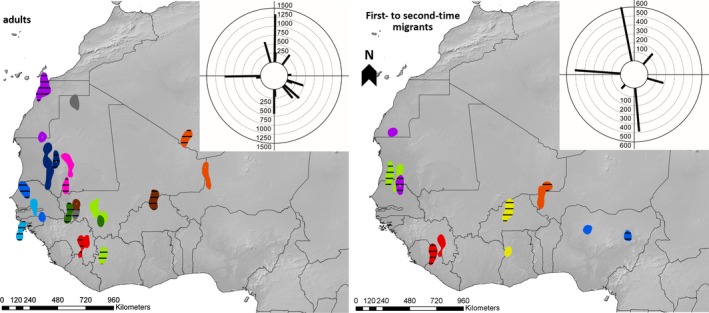
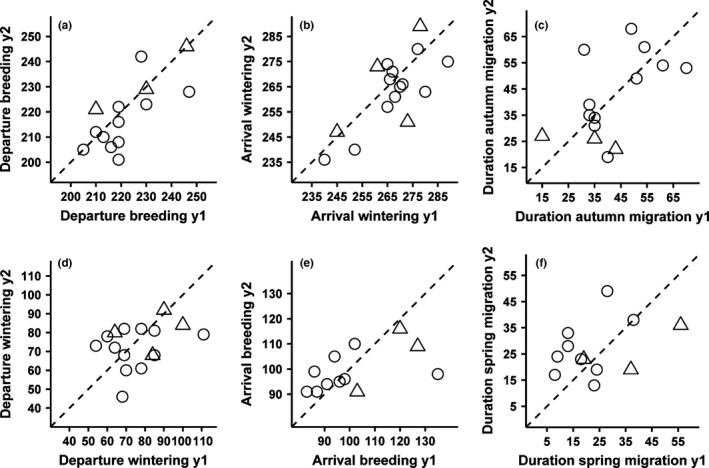
Migratory birds are often faithful to wintering (nonbreeding) sites, and also migration timing is usually remarkably consistent, that is, highly repeatable. Spatiotemporal repeatability can be of advantage for multiple reasons, including familiarity with local resources and predators as well as avoiding the costs of finding a new place, for example, nesting grounds. However, when the environment is variable in space and time, variable site selection and timing might be more rewarding. To date, studies on spatial and temporal repeatability in short-lived long-distance migrants are scarce, most notably of first-time and subsequent migrations. Here, we investigated repeatability in autumn migration directions, wintering sites, and annual migration timing in Hoopoes (), a long-distance migrant, using repeated tracks of adult and first-time migrants. Even though autumn migration directions were mostly the same, individual wintering sites often changed from year to year with distances between wintering sites exceeding 1,000 km. The timing of migration was repeatable within an individual during autumn, but not during spring migration. We suggest that Hoopoes respond to variable environmental conditions such as north-south shifts in rainfall during winter and differing onset of the food availability during spring migration.
候鸟通常会忠实于越冬(非繁殖)地点,而且迁徙时间通常也非常一致,也就是说具有高度的可重复性。时空可重复性具有多种优势,包括熟悉当地资源和捕食者,以及避免寻找新地点(例如筑巢地)的成本。然而,当环境在空间和时间上变化时,可变的地点选择和时间安排可能会更有益。迄今为止,关于短寿命长距离迁徙鸟类的空间和时间可重复性的研究很少,尤其是首次迁徙和后续迁徙。在这里,我们利用成年和首次迁徙鸟类的重复轨迹,研究了戴胜这种长距离迁徙鸟类秋季迁徙方向、越冬地点和年度迁徙时间的可重复性。尽管秋季迁徙方向大多相同,但个体的越冬地点常常逐年变化,越冬地点之间的距离超过1000公里。秋季时,个体内部的迁徙时间是可重复的,但春季迁徙时并非如此。我们认为,戴胜会对可变的环境条件做出反应,例如冬季降雨的南北移动以及春季迁徙期间食物供应开始时间的不同。