Russell Christopher M, Lebastchi Amir H, Borza Tudor, Spratt Daniel E, Morgan Todd M
Department of Urology, University of Michigan , Ann Arbor, MI, USA.
Department of Radiation Oncology, University of Michigan , Ann Arbor, MI, USA.
Bladder Cancer. 2016 Oct 27;2(4):381-394. doi: 10.3233/BLC-160076.
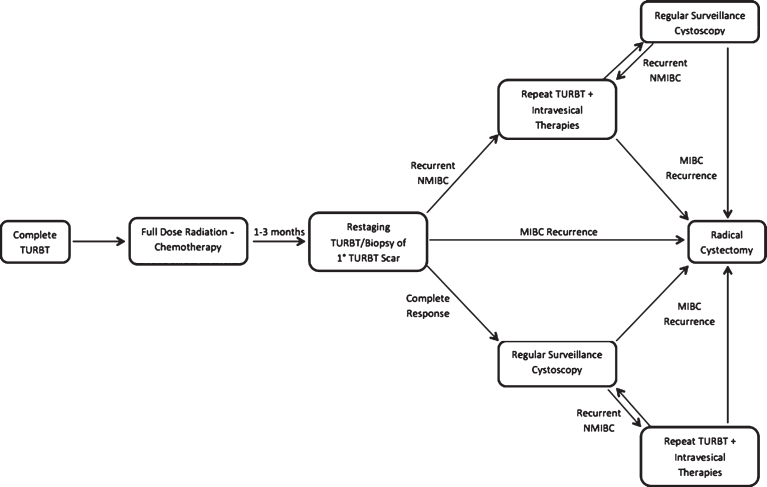
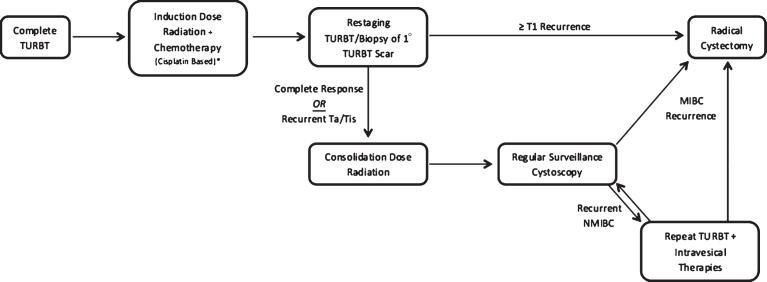
While radical cystectomy (RC) with pelvic lymph node dissection (PLND) represents the accepted gold standard for the treatment of muscle-invasive bladder cancer, this treatment approach is associated with significant morbidity. As such, bladder preservation strategies are often utilized in patients who are either deemed medically unfit due to significant comorbidities or whom decline management with RC and PLND secondary to its associated morbidity. In a select group of patients, meeting strict criteria, bladder preservation approaches may be employed with curative intent. Trimodal therapy, consisting of complete transurethral resection of bladder tumor (TURBT), chemotherapy, and radiation therapy has demonstrated durable oncologic control and long-term survival in a number of studies. The review presented here provides a description of trimodal therapy and the role of TURBT in bladder preservation for patients with muscle-invasive bladder cancer.
虽然根治性膀胱切除术(RC)联合盆腔淋巴结清扫术(PLND)是治疗肌层浸润性膀胱癌公认的金标准,但这种治疗方法会带来显著的并发症。因此,对于因严重合并症而被认为身体状况不佳或因相关并发症而拒绝接受RC和PLND治疗的患者,通常会采用膀胱保留策略。在一组符合严格标准的特定患者中,可以采用具有治愈意图的膀胱保留方法。由膀胱肿瘤完全经尿道切除术(TURBT)、化疗和放疗组成的三联疗法在多项研究中已显示出持久的肿瘤控制和长期生存效果。本文的综述描述了三联疗法以及TURBT在肌层浸润性膀胱癌患者膀胱保留中的作用。