Ghassemi Hadi, Hashemnia Mohammad, Mousavibahar Seyed Habibollah, Mahmoodzadeh Hosseini Hamideh, Mirhosseini Seyed Ali
Applied Microbiology Research Center, Systems Biology and Poisonings Institute, Baqiyatallah University of Medical Sciences, Tehran, Iran.
Department of Clinical Biochemistry, Hamadan University of Medical Sciences, Hamadan, Iran.
Cell J. 2021 Dec;23(7):742-749. doi: 10.22074/cellj.2021.7661. Epub 2021 Dec 29.
Bladder cancer is the 9 leading cause of human urologic malignancy and the 13 cause of death worldwide. Increased collagen cross-linking, expression and consequently stiffness of extracellular matrix (ECM) may be responsible for the mechanotransduction and regulation of transcriptional co-activator with PDZ-binding motif (TAZ) and transforming growth factor β1 (TGF-β1) signaling pathways, resulting in progression of tumorigenesis. The present study aimed to assess whether type 1 collagen expression is associated with TAZ nuclear localization.
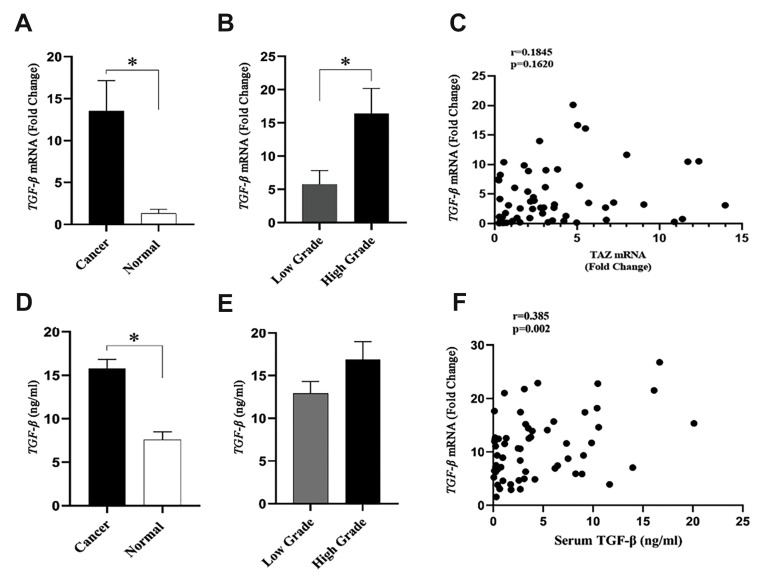
In this case-control study, real-time quantitative reverse transcription polymerase chain reaction (qRT-PCR) and immunohistochemical analysis were performed to evaluate the activation of the TAZ pathway in patients with bladder cancer (n=40) and healthy individuals (n=20). The ELISA method was also conducted to measure the serum concentrations of TGF-β1. Masson's trichrome staining was carried out to histologically evaluate the density of type 1 collagen.
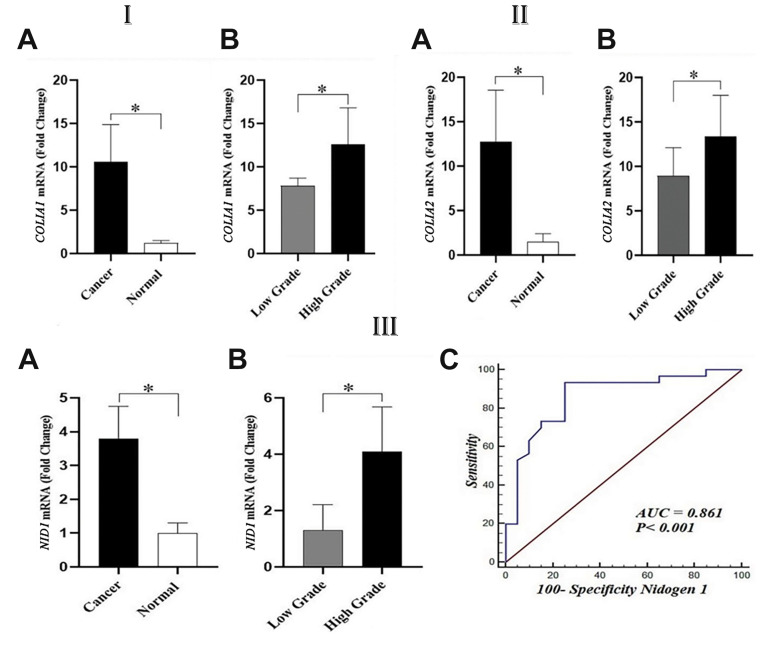
Our findings that the expression levels of and genes were overexpressed in patients with bladder cancer, and their expression levels were positively associated with the grade of bladder cancer. The immunohistochemical analysis demonstrated that the nuclear localization of TAZ was markedly correlated with high-grade bladder cancer. We also found that TAZ nuclear localization was substantially higher in cancerous tissues as compared with normal bladder tissues. Masson's trichrome staining showed that the tissue density of type I collagen was considerably increased in patients with bladder cancer as compared with healthy subjects.
According to our findings, it seems the alterations in the expression of type I collagen and , as well as TAZ nuclear localization influence the progression of bladder cancer. The significance of and expression in tumorigenesis and progression to high-grade bladder cancer was also highlighted. However, a possible relationship between TGF-β1 expression and the Hippo pathway needs further investigations.
膀胱癌是人类泌尿系统恶性肿瘤的第九大常见病因,也是全球第十三大死因。胶原蛋白交联增加、细胞外基质(ECM)表达及由此导致的硬度增加可能是机械转导以及具有PDZ结合基序的转录共激活因子(TAZ)和转化生长因子β1(TGF-β1)信号通路调控的原因,从而导致肿瘤发生进展。本研究旨在评估I型胶原蛋白表达是否与TAZ核定位有关。
在本病例对照研究中,采用实时定量逆转录聚合酶链反应(qRT-PCR)和免疫组织化学分析来评估膀胱癌患者(n = 40)和健康个体(n = 20)中TAZ通路的激活情况。还采用酶联免疫吸附测定(ELISA)法测量血清中TGF-β1的浓度。进行Masson三色染色以组织学评估I型胶原蛋白的密度。
我们的研究结果表明, 和 基因的表达水平在膀胱癌患者中过表达,且其表达水平与膀胱癌分级呈正相关。免疫组织化学分析表明,TAZ的核定位与高级别膀胱癌显著相关。我们还发现,与正常膀胱组织相比,癌组织中TAZ核定位明显更高。Masson三色染色显示,与健康受试者相比,膀胱癌患者的I型胶原蛋白组织密度显著增加。
根据我们的研究结果,似乎I型胶原蛋白和 的表达改变以及TAZ核定位会影响膀胱癌进展。 和 表达在肿瘤发生及进展为高级别膀胱癌中的意义也得到了凸显。然而,TGF-β1表达与Hippo通路之间的可能关系需要进一步研究。