Perlman Michal, Falenchuk Olesya, Fletcher Brooke, McMullen Evelyn, Beyene Joseph, Shah Prakesh S
Applied Psychology and Human Development, University of Toronto/OISE, Toronto, Ontario, Canada.
Department of Gastroenterology, Alberta Children's Hospital, Calgary, Alberta, Canada.
PLoS One. 2016 Dec 30;11(12):e0167660. doi: 10.1371/journal.pone.0167660. eCollection 2016.
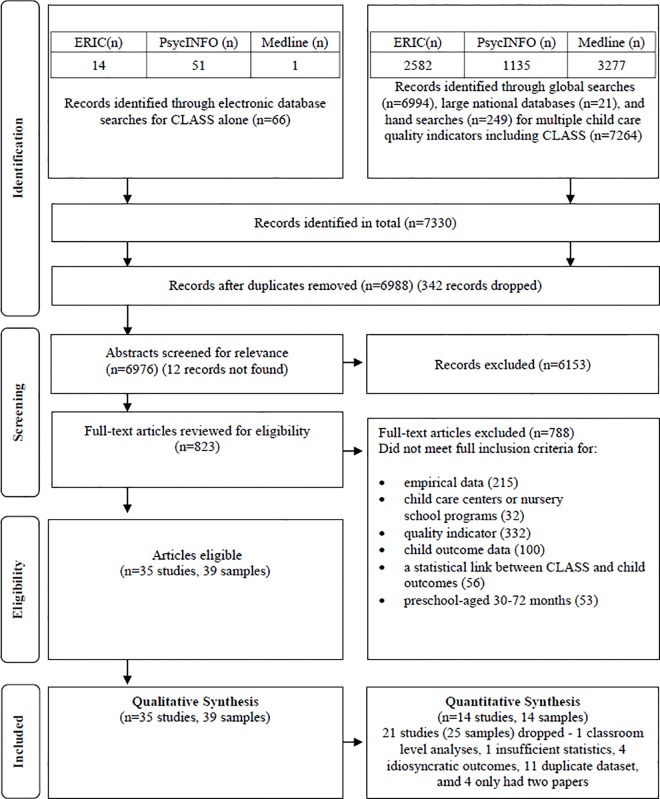
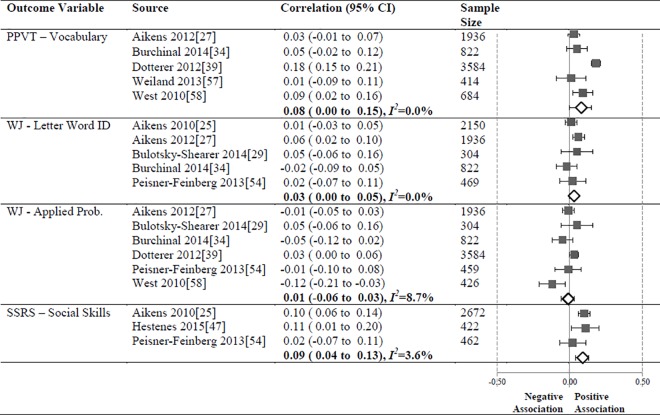
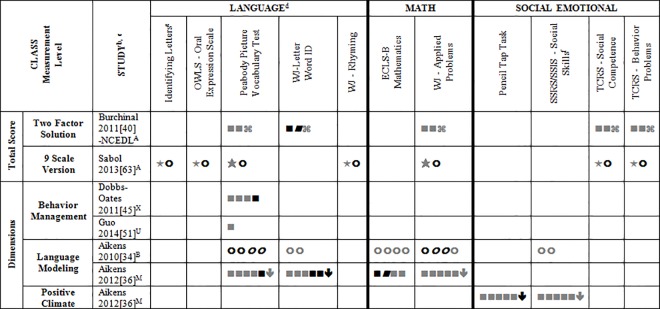
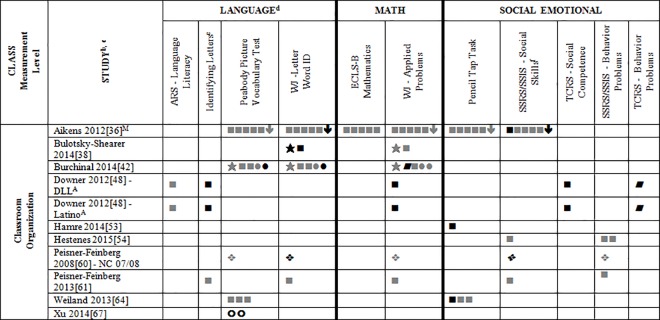
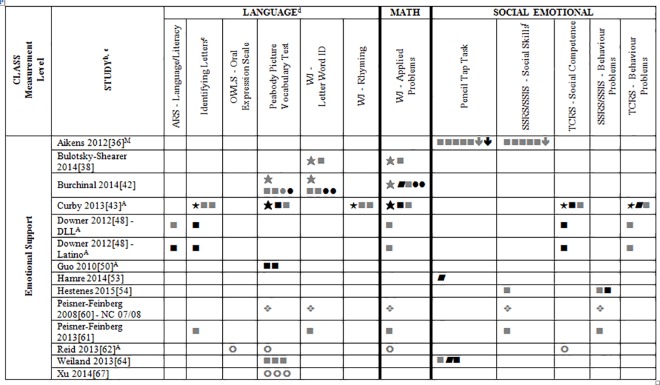
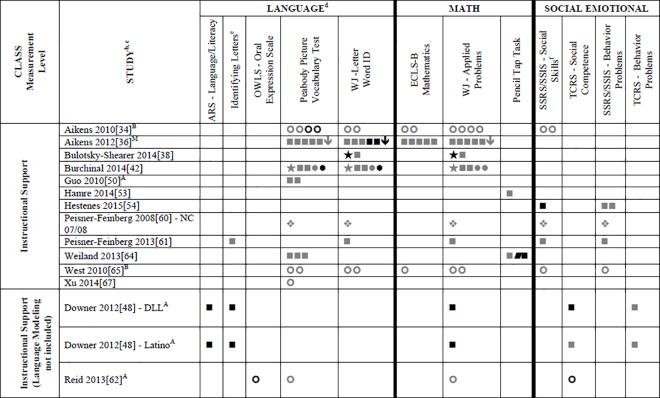
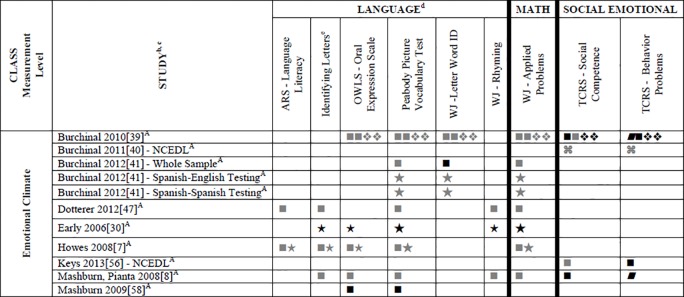
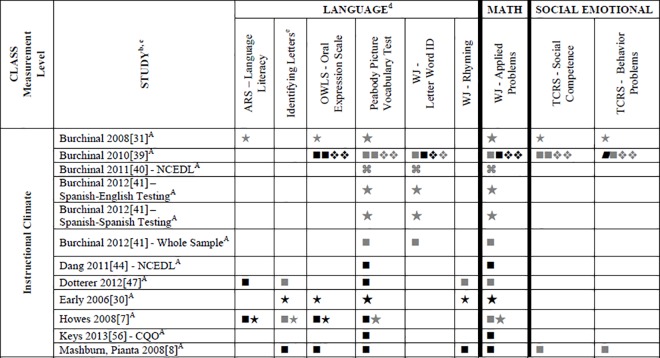
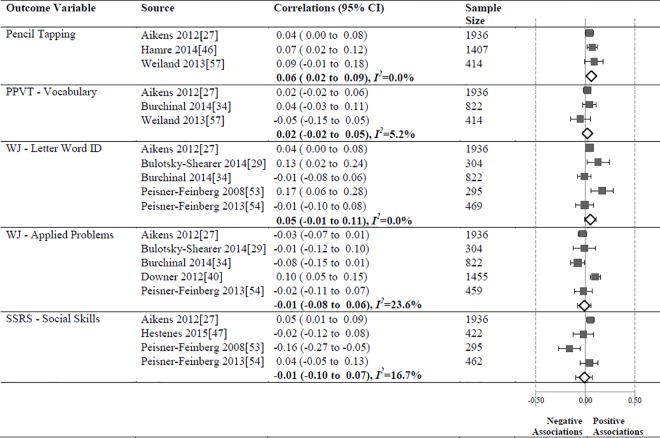
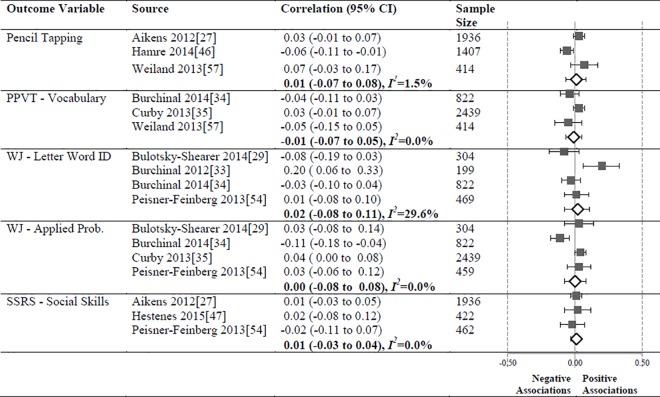
The quality of staff/child interactions as measured by the Classroom Assessment Scoring System (CLASS) in Early Childhood Education and Care (ECEC) programs is thought to be important for children's outcomes. The CLASS is made of three domains that assess Emotional Support, Classroom Organization and Instructional Support. It is a relatively new measure that is being used increasingly for research, quality monitoring/accountability and other applied purposes. Our objective was to evaluate the association between the CLASS and child outcomes. Searches of Medline, PsycINFO, ERIC, websites of large datasets and reference sections of all retrieved articles were conducted up to July 3, 2015. Studies that measured association between the CLASS and child outcomes for preschool-aged children who attended ECEC programs were included after screening by two independent reviewers. Searches and data extraction were conducted by two independent reviewers. Thirty-five studies were systematically reviewed of which 19 provided data for meta-analyses. Most studies had moderate to high risk of bias. Of the 14 meta-analyses we conducted, associations between Classroom Organization and Pencil Tapping and between Instructional Support and SSRS Social Skills were significant with pooled correlations of .06 and .09 respectively. All associations were in the expected direction. In the systematic review, significant correlations were reported mainly from one large dataset. Substantial heterogeneity in use of the CLASS, its dimensions, child outcomes and statistical measures was identified. Greater consistency in study methodology is urgently needed. Given the multitude of factors that impact child development it is encouraging that our analyses revealed some, although small, associations between the CLASS and children's outcomes.
在幼儿教育与保育(ECEC)项目中,通过课堂评估评分系统(CLASS)衡量的师生互动质量被认为对儿童的发展结果至关重要。CLASS由三个领域组成,用于评估情感支持、课堂组织和教学支持。这是一项相对较新的衡量标准,越来越多地用于研究、质量监测/问责以及其他应用目的。我们的目标是评估CLASS与儿童发展结果之间的关联。截至2015年7月3日,我们检索了Medline、PsycINFO、ERIC、大型数据集网站以及所有检索文章的参考文献部分。在两名独立评审员筛选后,纳入了测量参加ECEC项目的学龄前儿童的CLASS与儿童发展结果之间关联的研究。检索和数据提取由两名独立评审员进行。我们对35项研究进行了系统综述,其中19项提供了用于荟萃分析的数据。大多数研究存在中度至高度偏倚风险。在我们进行的14项荟萃分析中,课堂组织与敲铅笔行为之间以及教学支持与SSRS社交技能之间的关联显著,合并相关系数分别为0.06和0.09。所有关联均符合预期方向。在系统综述中,显著相关性主要来自一个大型数据集。我们发现CLASS的使用、其维度、儿童发展结果和统计方法存在很大异质性。迫切需要在研究方法上更加一致。考虑到影响儿童发展的因素众多,令人鼓舞的是,我们的分析揭示了CLASS与儿童发展结果之间存在一些关联,尽管关联较小。