Oliveira-Bravo Martha, Sangiorgi Bruno Braga, Schiavinato Josiane Lilian Dos Santos, Carvalho Juliana Lott, Covas Dimas Tadeu, Panepucci Rodrigo Alexandre, Neves Francisco de Assis Rocha, Franco Octávio Luiz, Pereira Rinaldo Wellerson, Saldanha-Araujo Felipe
Laboratório de Farmacologia Molecular, Departamento de Ciências da Saúde, Universidade de Brasília, Campus Darcy Ribeiro, Brasília, DF, Brazil.
Laboratório de Hematologia, Departamento de Clínica Médica, Universidade de São Paulo, Ribeirão Preto, SP, Brazil.
Stem Cell Res Ther. 2016 Dec 30;7(1):189. doi: 10.1186/s13287-016-0448-3.
Although promising for graft-versus-host disease (GvHD) treatment, MSC therapy still faces important challenges. For instance, increasing MSC migratory capacity as well as potentializing immune response suppression are of interest. For GvHD management, preventing opportunistic infections is also a valuable strategy, since immunocompromised patients are easy targets for infections. LL-37 is a host defense peptide (HDP) that has been deeply investigated due to its immunomodulatory function. In this scenario, the combination of MSC and LL-37 may result in a robust combination to be clinically used.
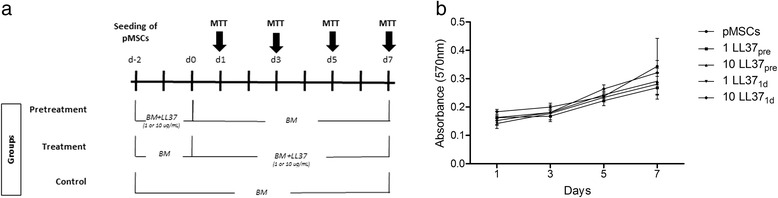
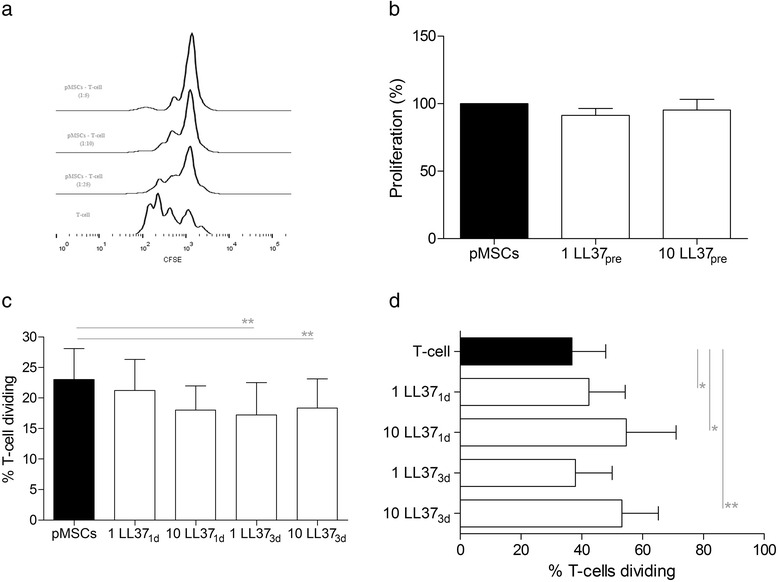
In the present study, the effects of LL-37 upon the proliferation and migratory capacity of human placenta-derived MSCs (pMSCs) were assessed by MTT and wound scratch assays. The influence of LL-37 over the immunosuppressive function of pMSCs was then investigated using CFSE cell division kit. Flow cytometry and real-time PCR were used to investigate the molecular mechanisms involved in the effects observed.
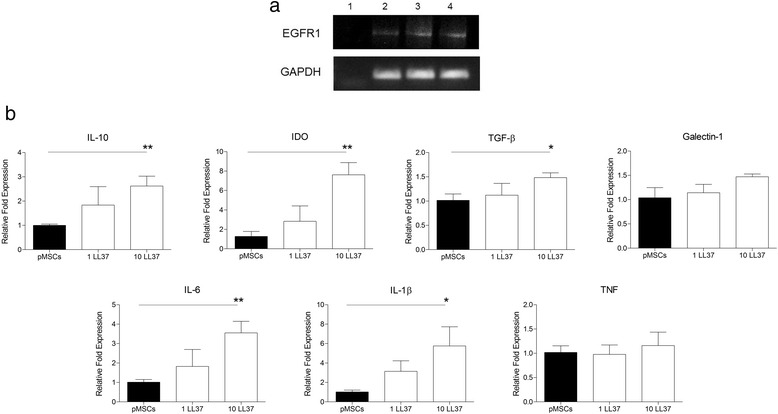
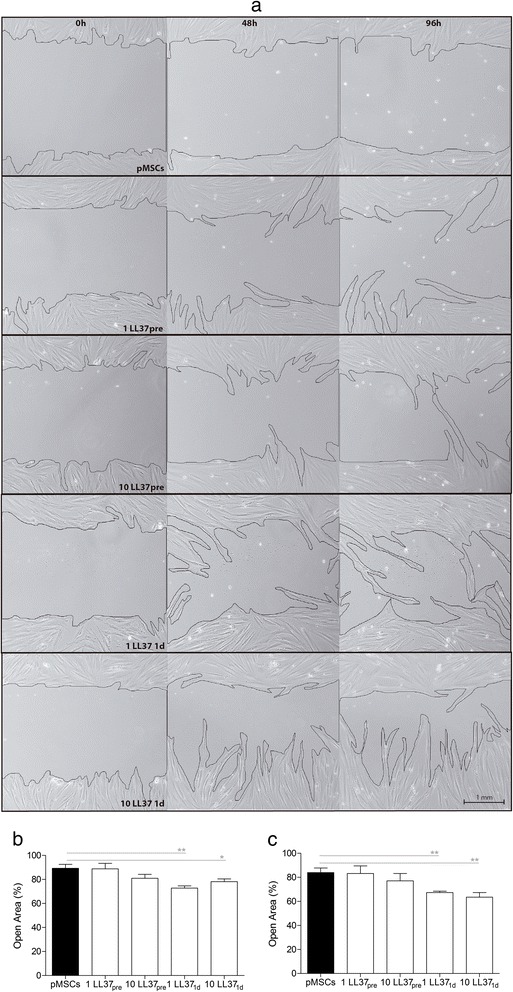
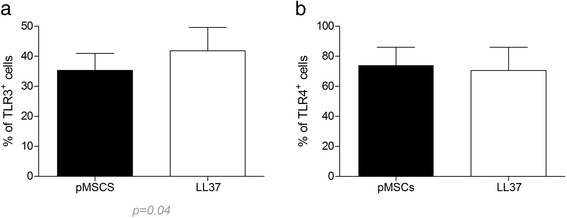
LL-37 had no detrimental effects over MSC proliferation and viability, as assessed by MTT assay. Moreover, the peptide promoted increased migratory behavior of pMSCs and enhanced their immunomodulatory function over activated human PBMCs. Strikingly, our data shows that LL-37 treatment leads to increased TLR3 levels, as shown by flow cytometry, and to an increased expression of factors classically related to immunosuppression, namely IDO, IL-10, TGF-β, IL-6, and IL-1β.
Taken together, our observations may serve as groundwork for the development of new therapeutic strategies based on the combined use of LL-37 and MSCs, which may provide patients not only with an enhanced immunosuppression regime, but also with an agent to prevent opportunistic infections.
尽管间充质干细胞(MSC)疗法在移植物抗宿主病(GvHD)治疗方面前景广阔,但仍面临重大挑战。例如,提高MSC的迁移能力以及增强免疫反应抑制作用备受关注。对于GvHD的管理,预防机会性感染也是一项有价值的策略,因为免疫功能低下的患者很容易受到感染。LL-37是一种宿主防御肽(HDP),由于其免疫调节功能而受到深入研究。在这种情况下,MSC与LL-37的联合使用可能会形成一种强大的组合,可供临床应用。
在本研究中,通过MTT和划痕实验评估LL-37对人胎盘来源的间充质干细胞(pMSC)增殖和迁移能力的影响。然后使用CFSE细胞分裂试剂盒研究LL-37对pMSC免疫抑制功能的影响。采用流式细胞术和实时定量PCR研究观察到的效应所涉及的分子机制。
MTT实验评估结果显示,LL-37对MSC的增殖和活力没有不利影响。此外,该肽促进了pMSC迁移行为的增加,并增强了其对活化的人外周血单个核细胞(PBMC)的免疫调节功能。引人注目的是,我们的数据表明,流式细胞术显示LL-37处理导致TLR3水平升高,并且与免疫抑制经典相关的因子(即吲哚胺2,3-双加氧酶(IDO)、白细胞介素-10(IL-10)、转化生长因子-β(TGF-β)、白细胞介素-6(IL-6)和白细胞介素-1β(IL-1β))的表达增加。
综上所述,我们的观察结果可为基于LL-37和MSC联合使用的新治疗策略的开发奠定基础,这不仅可以为患者提供增强的免疫抑制方案,还可以提供一种预防机会性感染的药物。