Centre for the Mathematical Modelling of Infectious Diseases, London School of Hygiene & Tropical Medicine, London, United Kingdom.
Centre for the Mathematical Modelling of Infectious Diseases, London School of Hygiene & Tropical Medicine, London, United Kingdom.
Epidemics. 2018 Mar;22:56-61. doi: 10.1016/j.epidem.2016.11.003. Epub 2016 Dec 16.
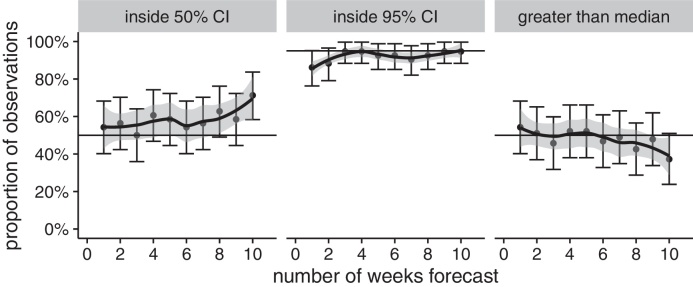
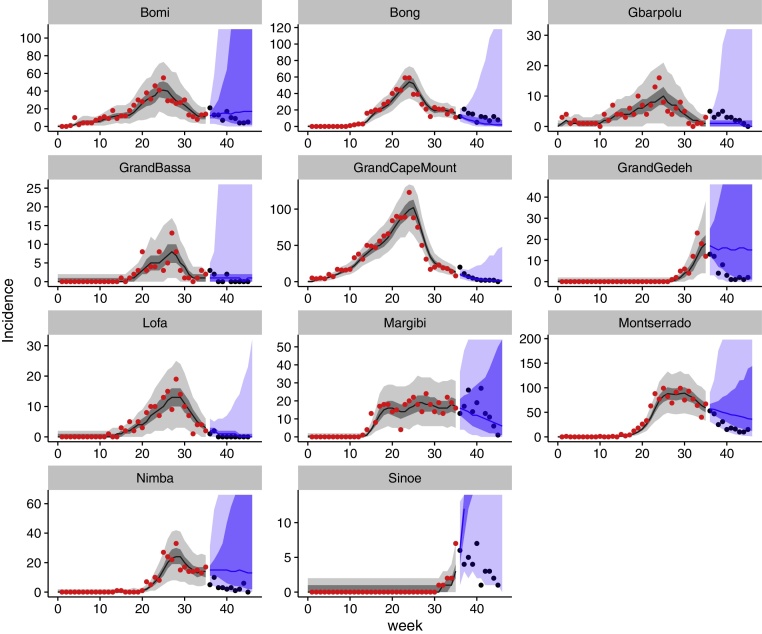
Real-time forecasts of infectious diseases can help public health planning, especially during outbreaks. If forecasts are generated from mechanistic models, they can be further used to target resources or to compare the impact of possible interventions. However, paremeterising such models is often difficult in real time, when information on behavioural changes, interventions and routes of transmission are not readily available. Here, we present a semi-mechanistic model of infectious disease dynamics that was used in real time during the 2013-2016 West African Ebola epidemic, and show fits to a Ebola Forecasting Challenge conducted in late 2015 with simulated data mimicking the true epidemic. We assess the performance of the model in different situations and identify strengths and shortcomings of our approach. Models such as the one presented here which combine the power of mechanistic models with the flexibility to include uncertainty about the precise outbreak dynamics may be an important tool in combating future outbreaks.
实时传染病预测有助于公共卫生规划,特别是在疫情爆发期间。如果预测是基于机械模型生成的,它们还可以进一步用于定位资源,或比较可能干预措施的影响。然而,当关于行为变化、干预措施和传播途径的信息不易获得时,实时参数化此类模型通常很困难。在这里,我们提出了一种传染病动力学的半机械模型,该模型在 2013-2016 年西非埃博拉疫情期间实时使用,并展示了对 2015 年末用模拟数据进行的埃博拉预测挑战赛的拟合情况,这些模拟数据模拟了真实的疫情。我们评估了该模型在不同情况下的性能,并确定了我们方法的优势和不足。这种将机械模型的优势与对精确疫情动态的不确定性的灵活性相结合的模型,例如本文提出的模型,可能是应对未来疫情的重要工具。