Dufour Florent, Rattier Thibault, Constantinescu Andrei Alexandru, Zischler Luciana, Morlé Aymeric, Ben Mabrouk Hazem, Humblin Etienne, Jacquemin Guillaume, Szegezdi Eva, Delacote Fabien, Marrakchi Naziha, Guichard Gilles, Pellat-Deceunynck Catherine, Vacher Pierre, Legembre Patrick, Garrido Carmen, Micheau Olivier
INSERM, UMR866, Equipe labellisée Ligue contre le Cancer and Laboratoire d'Excellence LipSTIC, Dijon, France.
Univ. Bourgogne Franche-Comté, Dijon, France.
Oncotarget. 2017 Feb 7;8(6):9974-9985. doi: 10.18632/oncotarget.14285.
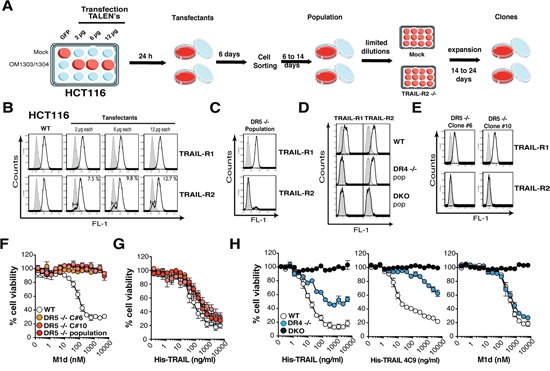
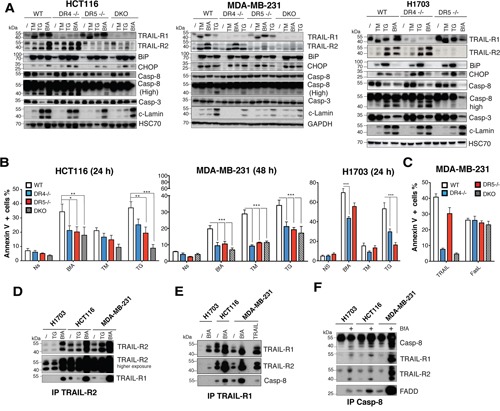
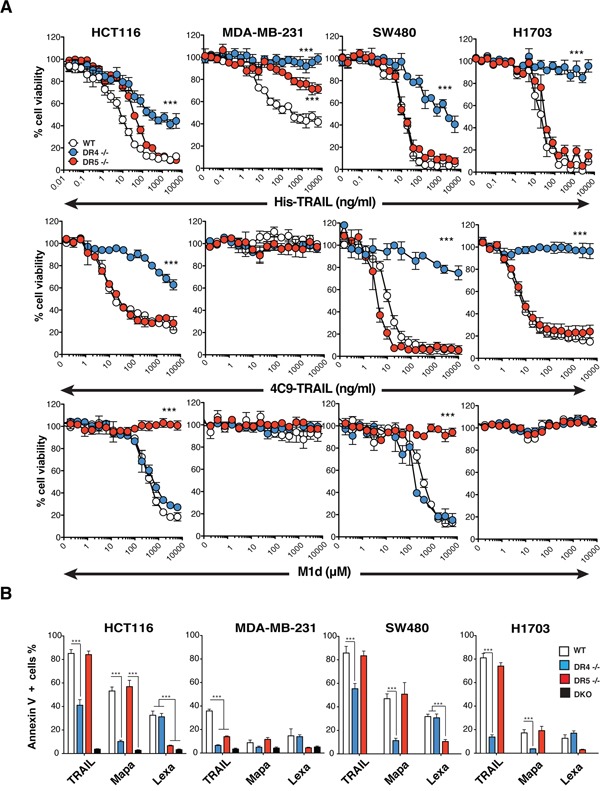
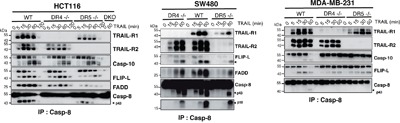
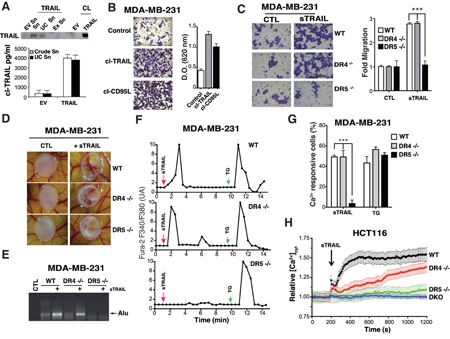
TRAIL induces selective tumor cell death through TRAIL-R1 and TRAIL-R2. Despite the fact that these receptors share high structural homologies, induction of apoptosis upon ER stress, cell autonomous motility and invasion have solely been described to occur through TRAIL-R2. Using the TALEN gene-editing approach, we show that TRAIL-R1 can also induce apoptosis during unresolved unfolded protein response (UPR). Likewise, TRAIL-R1 was found to co-immunoprecipitate with FADD and caspase-8 during ER stress. Its deficiency conferred resistance to apoptosis induced by thaspigargin, tunicamycin or brefeldin A. Our data also demonstrate that tumor cell motility and invasion-induced by TRAIL-R2 is not cell autonomous but induced in a TRAIL-dependant manner. TRAIL-R1, on the other hand, is unable to trigger cell migration owing to its inability to induce an increase in calcium flux. Importantly, all the isogenic cell lines generated in this study revealed that apoptosis induced TRAIL is preferentially induced by TRAIL-R1. Taken together, our results provide novel insights into the physiological functions of TRAIL-R1 and TRAIL-R2 and suggest that targeting TRAIL-R1 for anticancer therapy is likely to be more appropriate owing to its lack of pro-motile signaling capability.
肿瘤坏死因子相关凋亡诱导配体(TRAIL)通过TRAIL-R1和TRAIL-R2诱导选择性肿瘤细胞死亡。尽管这些受体具有高度的结构同源性,但内质网应激时的凋亡诱导、细胞自主运动和侵袭仅被描述为通过TRAIL-R2发生。使用转录激活因子样效应物核酸酶(TALEN)基因编辑方法,我们发现TRAIL-R1在未解决的未折叠蛋白反应(UPR)期间也能诱导凋亡。同样,在内质网应激期间,发现TRAIL-R1与FADD和半胱天冬酶-8共免疫沉淀。其缺陷赋予了对毒胡萝卜素、衣霉素或布雷菲德菌素A诱导的凋亡的抗性。我们的数据还表明,TRAIL-R2诱导的肿瘤细胞运动和侵袭不是细胞自主的,而是以TRAIL依赖的方式诱导的。另一方面,TRAIL-R1由于无法诱导钙通量增加而无法触发细胞迁移。重要的是,本研究中产生的所有同基因细胞系表明,TRAIL诱导的凋亡优先由TRAIL-R1诱导。综上所述,我们的结果为TRAIL-R1和TRAIL-R2的生理功能提供了新的见解,并表明由于其缺乏促运动信号能力,靶向TRAIL-R1进行抗癌治疗可能更合适。