Gan Jian, Weng Shih-Ming, Pernía-Andrade Alejandro J, Csicsvari Jozsef, Jonas Peter
IST Austria (Institute of Science and Technology Austria), Am Campus 1, A-3400 Klosterneuburg, Austria.
IST Austria (Institute of Science and Technology Austria), Am Campus 1, A-3400 Klosterneuburg, Austria.
Neuron. 2017 Jan 18;93(2):308-314. doi: 10.1016/j.neuron.2016.12.018. Epub 2016 Dec 29.
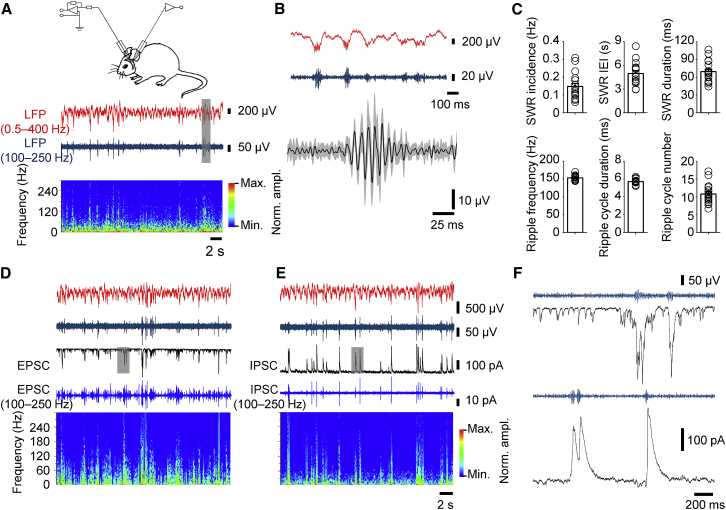
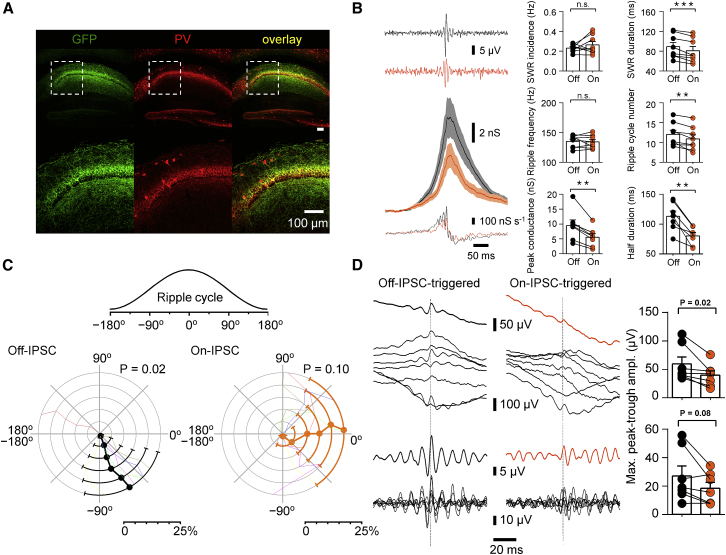
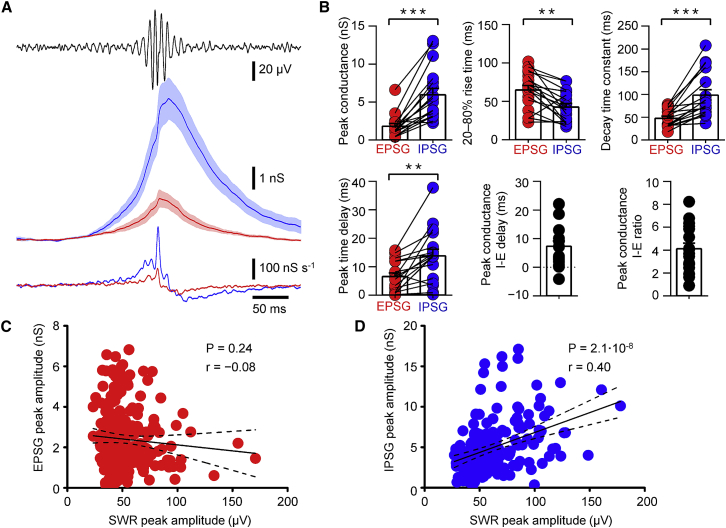
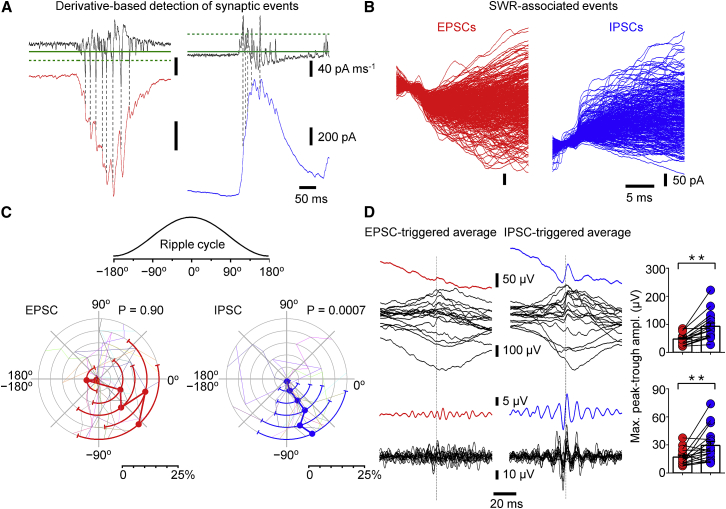
Sharp wave-ripple (SWR) oscillations play a key role in memory consolidation during non-rapid eye movement sleep, immobility, and consummatory behavior. However, whether temporally modulated synaptic excitation or inhibition underlies the ripples is controversial. To address this question, we performed simultaneous recordings of excitatory and inhibitory postsynaptic currents (EPSCs and IPSCs) and local field potentials (LFPs) in the CA1 region of awake mice in vivo. During SWRs, inhibition dominated over excitation, with a peak conductance ratio of 4.1 ± 0.5. Furthermore, the amplitude of SWR-associated IPSCs was positively correlated with SWR magnitude, whereas that of EPSCs was not. Finally, phase analysis indicated that IPSCs were phase-locked to individual ripple cycles, whereas EPSCs were uniformly distributed in phase space. Optogenetic inhibition indicated that PV interneurons provided a major contribution to SWR-associated IPSCs. Thus, phasic inhibition, but not excitation, shapes SWR oscillations in the hippocampal CA1 region in vivo.
尖锐波-涟漪(SWR)振荡在非快速眼动睡眠、静止不动和 consummatory 行为期间的记忆巩固中起着关键作用。然而,涟漪是由时间调制的突触兴奋还是抑制所驱动仍存在争议。为了解决这个问题,我们在清醒小鼠的海马体 CA1 区域进行了体内兴奋性和抑制性突触后电流(EPSC 和 IPSC)以及局部场电位(LFP)的同步记录。在 SWR 期间,抑制作用超过兴奋作用,峰值电导比为 4.1 ± 0.5。此外,与 SWR 相关的 IPSC 的幅度与 SWR 幅度呈正相关,而 EPSC 的幅度则不然。最后,相位分析表明,IPSC 与单个涟漪周期锁相,而 EPSC 在相空间中均匀分布。光遗传学抑制表明,PV 中间神经元对与 SWR 相关的 IPSC 起主要作用。因此,在体内,是相位抑制而非兴奋塑造了海马体 CA1 区域的 SWR 振荡。