Faculty of Science and Engineering, Waseda Univesity, Shinjuku, 162-8480, Japan.
Graduate School of Advanced Science and Engineering, Waseda Univesity, Shinjuku, 162-8480, Japan.
Sci Rep. 2017 Jan 3;7:39771. doi: 10.1038/srep39771.
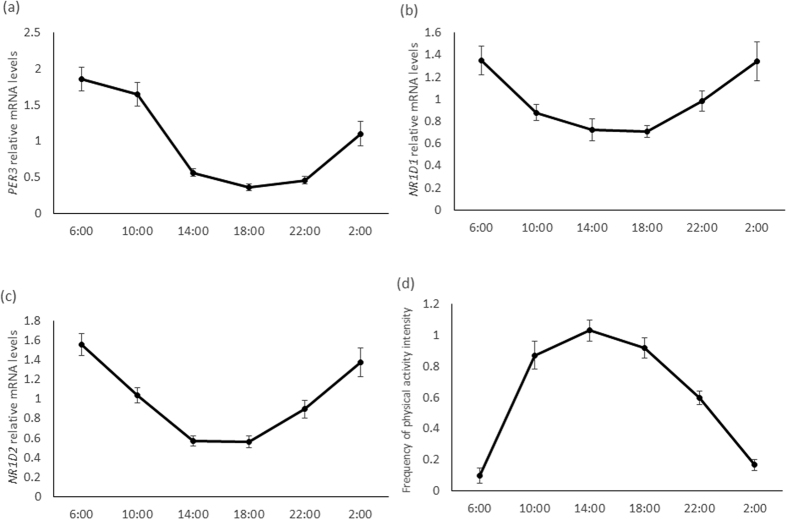
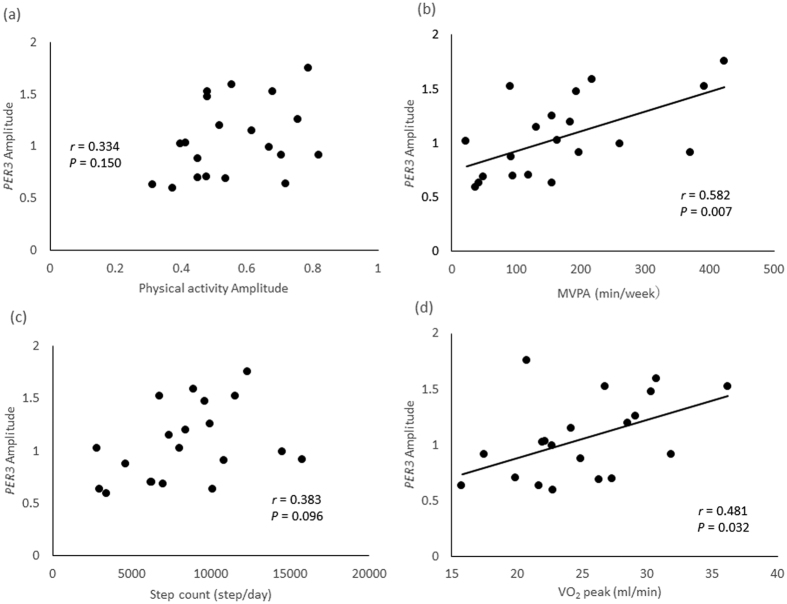
The circadian clock regulates many physiological functions including physical activity and feeding patterns. In addition, scheduled exercise and feeding themselves can affect the circadian clock. The purpose of the present study was to investigate the relationship between physical/feeding activity and expression of clock genes in hair follicle cells in older adults. Twenty adult men (age, 68 ± 7 years, mean ± SE) were examined in this cross-sectional study. Prior to hair follicle cell collection, the participants were asked to wear a uniaxial accelerometer for one week. The timings of breakfast, lunch, and dinner were also recorded. Hair follicle cells were then collected over a 24 h period at 4 h intervals. The amplitude of PER3 expression was positively correlated with moderate and vigorous physical activity (r = 0.582, p = 0.007) and peak oxygen uptake (r = 0.481, p = 0.032), but these correlations were not observed for NR1D1 or NR1D2. No association was noted between meal times and the amplitude or the acrophase for any of these three clock genes. These findings suggest that rhythmic expression of the circadian clock gene PER3 is associated with the amount of daily physical activity and physical fitness in older adults.
生物钟调节许多生理功能,包括体力活动和进食模式。此外,有规律的运动和进食本身也会影响生物钟。本研究的目的是调查老年人毛囊细胞中体力/进食活动与时钟基因表达之间的关系。在这项横断面研究中,对 20 名成年男性(年龄 68±7 岁,平均值±SE)进行了检查。在收集毛囊细胞之前,参与者被要求佩戴单轴加速度计一周。还记录了早餐、午餐和晚餐的时间。然后在 24 小时内每隔 4 小时收集一次毛囊细胞。PER3 表达的振幅与中等强度和剧烈体力活动(r=0.582,p=0.007)和峰值摄氧量(r=0.481,p=0.032)呈正相关,但 NR1D1 或 NR1D2 没有观察到这些相关性。这些时钟基因的振幅或高峰时间与用餐时间之间均无关联。这些发现表明,生物钟基因 PER3 的节律表达与老年人日常体力活动量和身体活动能力有关。