Slike Bonnie M, Creegan Matthew, Marovich Mary, Ngauy Viseth
U.S. Military HIV Research Program, Silver Spring, Maryland, United States of America.
The Henry M. Jackson for the Advancement of Military Medicine, Bethesda, Maryland, United States of America.
PLoS One. 2017 Jan 3;12(1):e0169247. doi: 10.1371/journal.pone.0169247. eCollection 2017.
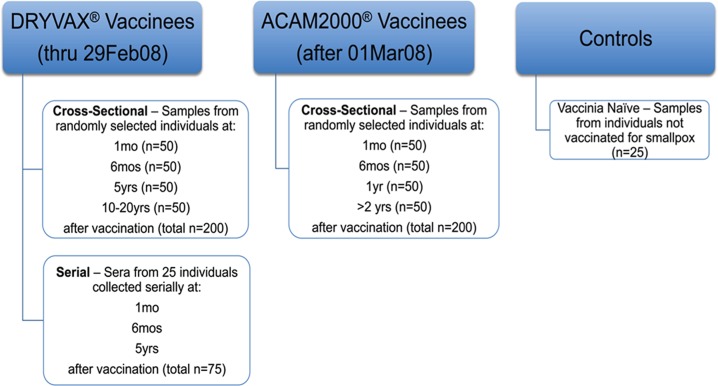
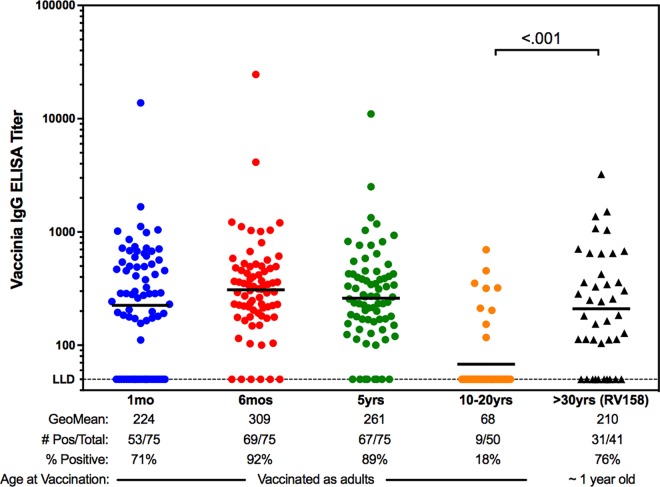
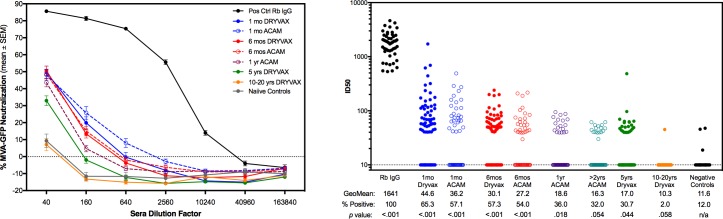
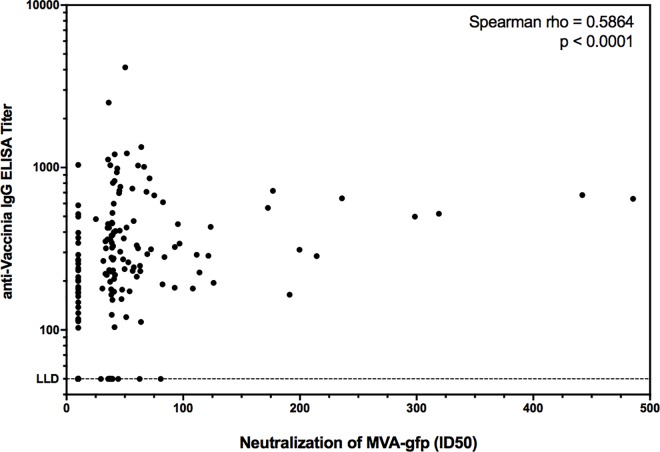
Modified Vaccinia virus has been shown to be a safe and immunogenic vector platform for delivery of HIV vaccines. Use of this vector is of particular importance to the military, with the implementation of a large scale smallpox vaccination campaign in 2002 in active duty and key civilian personnel in response to potential bioterrorist activities. Humoral immunity to smallpox vaccination was previously shown to be long lasting (up to 75 years) and protective. However, using vaccinia-vectored vaccine delivery for other diseases on a background of anti-vector antibodies (i.e. pre-existing immunity) may limit their use as a vaccine platform, especially in the military. In this pilot study, we examined the durability of vaccinia antibody responses in adult primary vaccinees in a healthy military population using a standard ELISA assay and a novel dendritic cell neutralization assay. We found binding and neutralizing antibody (NAb) responses to vaccinia waned after 5-10 years in a group of 475 active duty military, born after 1972, who were vaccinated as adults with Dryvax®. These responses decreased from a geometric mean titer (GMT) of 250 to baseline (<20) after 10-20 years post vaccination. This contrasted with a comparator group of adults, ages 35-49, who were vaccinated with Dryvax® as children. In the childhood vaccinees, titers persisted for >30 years with a GMT of 210 (range 112-3234). This data suggests limited durability of antibody responses in adult vaccinees compared to those vaccinated in childhood and further that adult vaccinia recipients may benefit similarly from receipt of a vaccinia based vaccine as those who are vaccinia naïve. Our findings may have implications for the smallpox vaccination schedule and support the ongoing development of this promising viral vector in a military vaccination program.
改良痘苗病毒已被证明是一种安全且具有免疫原性的载体平台,可用于递送HIV疫苗。随着2002年针对潜在生物恐怖活动对现役军人和关键文职人员开展大规模天花疫苗接种运动,该载体的使用对军队尤为重要。先前已证明,对天花疫苗接种的体液免疫具有持久性(长达75年)且具有保护作用。然而,在存在抗载体抗体(即预先存在的免疫力)的背景下,使用痘苗病毒载体疫苗递送其他疾病的疫苗可能会限制其作为疫苗平台的使用,尤其是在军队中。在这项初步研究中,我们使用标准酶联免疫吸附测定(ELISA)和一种新型树突状细胞中和测定,检测了健康军人成年初次接种疫苗者体内痘苗抗体反应的持久性。我们发现,在一组475名1972年以后出生、成年后接种Dryvax®疫苗的现役军人中,对痘苗的结合抗体和中和抗体(NAb)反应在5至10年后减弱。接种疫苗10至20年后,这些反应从几何平均滴度(GMT)250降至基线水平(<20)。这与一组35至49岁儿童时期接种Dryvax®疫苗的成年人对照组形成对比。在儿童时期接种疫苗者中,滴度持续超过30年,GMT为210(范围112 - 3234)。该数据表明,与儿童时期接种疫苗者相比,成年接种疫苗者抗体反应的持久性有限,进一步表明成年痘苗接种者可能与未接触过痘苗的人一样,从接种基于痘苗的疫苗中受益。我们的研究结果可能对天花疫苗接种计划有影响,并支持在军事疫苗接种计划中持续开发这种有前景的病毒载体。