Neubauer Vera, Djurdjevic Tanja, Griesmaier Elke, Biermayr Marlene, Gizewski Elke Ruth, Kiechl-Kohlendorfer Ursula
Department of Paediatrics II, Neonatology, Medical University of Innsbruck, Innsbruck, Austria.
Department of Neuroradiology, Medical University of Innsbruck, Innsbruck, Austria.
PLoS One. 2017 Jan 3;12(1):e0169442. doi: 10.1371/journal.pone.0169442. eCollection 2017.
In recent years, significant investigation has been undertaken by means of magnetic resonance imaging (MRI) in an attempt to identify preterm infants at risk for adverse outcome. The primary objective is to provide a comprehensive characterization of cerebral injury detected by conventional MRI at term-equivalent age in an unselected, consecutive, contemporary cohort of preterm infants born <32 gestational weeks. Secondly, this study aims to identify risk factors for the different injury types in this population.
Data for all preterm infants born <32 gestational weeks and admitted to Innsbruck Medical University Hospital were prospectively collected (October 2010 to December 2015). Cerebral MRI was evaluated retrospectively using a validated scoring system that incorporates intraventricular haemorrhage (IVH), white matter disease (WMD) and cerebellar haemorrhage (CBH).
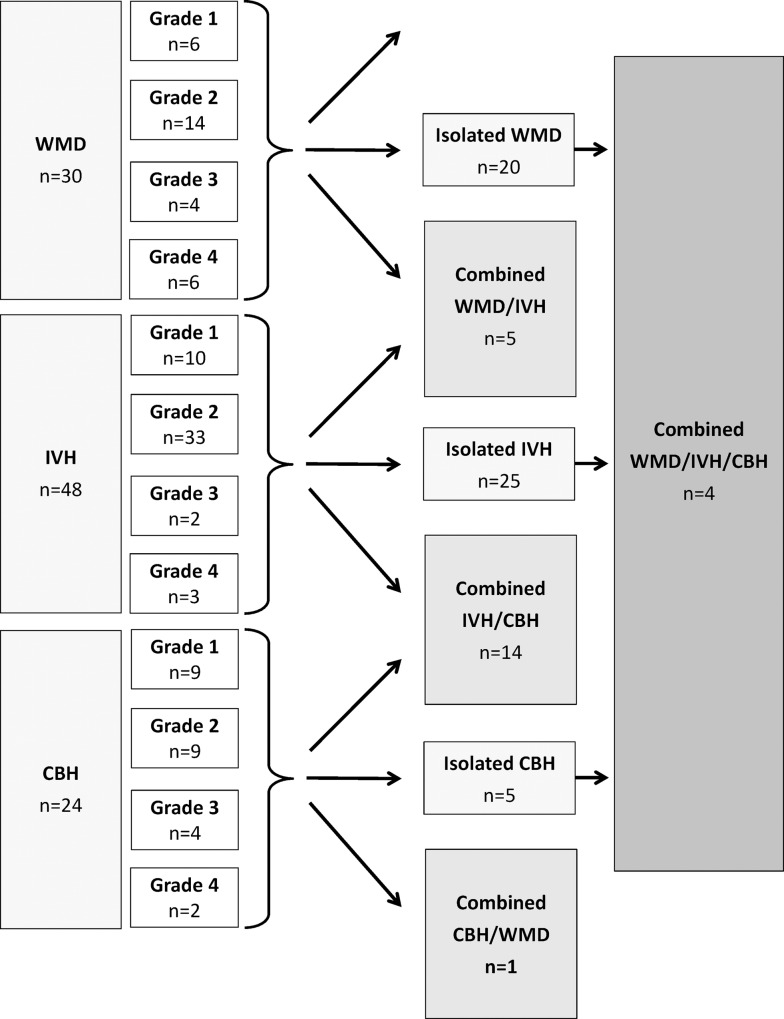
300 infants were included in the study. MRI showed 24.7% of all infants to have some form of brain injury. The most common injury type was IVH (16.0%). WMD and CBH were seen in 10.0% and 8.0%. The prevalence of common neonatal risk factors was greater within the group of infants with CBH. In particular indicators for respiratory disease were observed more often: longer ventilation duration, more frequent need for supplemental oxygen at day 28, higher rates of hydrocortisone treatment. Catecholamine treatment was the only neonatal risk factor that was overrepresented in infants with WMD.
Cerebral MRI at term-equivalent age, as addition to cranial ultrasound, detected brain injury in 25% of preterm survivors. The diagnosis of IVH was already made by neonatal ultrasound in most cases. In contrast, only a minority of the CBH and none of the non-cystic WMD have been detected prior to MRI. Decreasing gestational age and neonatal complications involved with immaturity have been identified as risk factors for CBH, whereas WMD was found in relatively mature infants with circulatory disturbances.
近年来,人们通过磁共振成像(MRI)进行了大量研究,试图识别有不良结局风险的早产儿。主要目的是在一个未经选择、连续的当代孕周小于32周的早产儿队列中,全面描述在足月等效年龄时通过传统MRI检测到的脑损伤情况。其次,本研究旨在确定该人群中不同损伤类型的风险因素。
前瞻性收集了2010年10月至2015年12月在因斯布鲁克医科大学医院收治的所有孕周小于32周的早产儿的数据。使用一种经过验证的评分系统对脑MRI进行回顾性评估,该系统纳入了脑室内出血(IVH)、白质疾病(WMD)和小脑出血(CBH)。
300名婴儿纳入研究。MRI显示24.7%的婴儿有某种形式的脑损伤。最常见的损伤类型是IVH(16.0%)。WMD和CBH分别为10.0%和8.0%。CBH婴儿组中常见新生儿风险因素的发生率更高。特别是呼吸系统疾病的指标更常被观察到:通气时间更长、出生后28天补充氧气的需求更频繁、氢化可的松治疗率更高。儿茶酚胺治疗是WMD婴儿中唯一占比过高的新生儿风险因素。
在足月等效年龄时进行的脑MRI,作为头颅超声的补充检查,在25%的早产幸存者中检测到脑损伤。大多数情况下,IVH已通过新生儿超声诊断。相比之下,在MRI之前仅检测到少数CBH,且未检测到非囊性WMD。孕周减小和与不成熟相关的新生儿并发症已被确定为CBH的风险因素,而WMD则见于相对成熟但有循环障碍的婴儿。