Berres Mark E, Garic Ana, Flentke George R, Smith Susan M
Department of Nutritional Sciences, University of Wisconsin-Madison, Madison, Wisconsin, United States of America.
PLoS One. 2017 Jan 3;12(1):e0169351. doi: 10.1371/journal.pone.0169351. eCollection 2017.
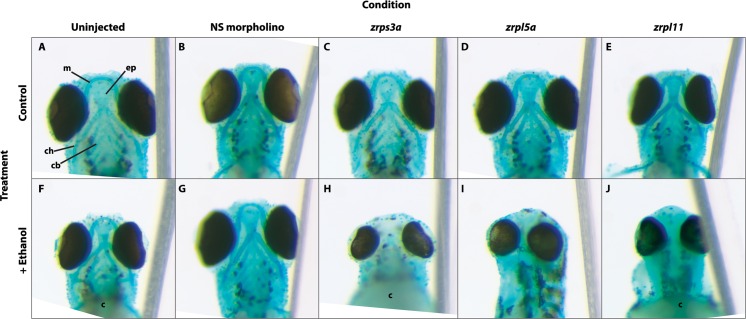
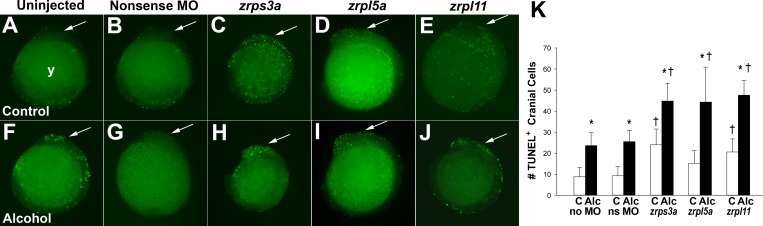
Fetal alcohol spectrum disorder (FASD) is a leading cause of neurodevelopmental disability. Individuals with FASD may exhibit a characteristic facial appearance that has diagnostic utility. The mechanism by which alcohol disrupts craniofacial development is incompletely understood, as are the genetic factors that can modify individual alcohol vulnerability. Using an established avian model, we characterized the cranial transcriptome in response to alcohol to inform the mechanism underlying these cells' vulnerability. Gallus gallus embryos having 3-6 somites were exposed to 52 mM alcohol and the cranial transcriptomes were sequenced thereafter. A total of 3422 genes had significantly differential expression. The KEGG pathways with the greatest enrichment of differentially expressed gene clusters were Ribosome (P = 1.2 x 10⁻¹⁷, 67 genes), Oxidative Phosphorylation (P = 4.8 x 10⁻¹², 60 genes), RNA Polymerase (P = 2.2 x 10⁻³, 15 genes) and Spliceosome (P = 2.6 x 10⁻², 39 genes). The preponderance of transcripts in these pathways were repressed in response to alcohol. These same gene clusters also had the greatest altered representation in our previous comparison of neural crest populations having differential vulnerability to alcohol-induced apoptosis. Comparison of differentially expressed genes in alcohol-exposed (3422) and untreated, alcohol-vulnerable (1201) transcriptomes identified 525 overlapping genes of which 257 have the same direction of transcriptional change. These included 36 ribosomal, 25 oxidative phosphorylation and 7 spliceosome genes. Using a functional approach in zebrafish, partial knockdown of ribosomal proteins zrpl11, zrpl5a, and zrps3a individually heightened vulnerability to alcohol-induced craniofacial deficits and increased apoptosis. In humans, haploinsufficiency of several of the identified ribosomal proteins are causative in craniofacial dysmorphologies such as Treacher Collins Syndrome and Diamond-Blackfan Anemia. This work suggests ribosome biogenesis may be a novel target mediating alcohol's damage to developing neural crest. Our findings are consistent with observations that gene-environment interactions contribute to vulnerability in FASD.
胎儿酒精谱系障碍(FASD)是神经发育障碍的主要原因。患有FASD的个体可能表现出具有诊断价值的特征性面部外观。酒精破坏颅面发育的机制尚未完全明了,能够改变个体对酒精易感性的遗传因素也是如此。我们使用已建立的禽类模型,对酒精作用下的颅转录组进行了表征,以了解这些细胞易感性背后的机制。将具有3至6个体节的原鸡胚胎暴露于52 mM酒精中,随后对颅转录组进行测序。共有3422个基因具有显著差异表达。差异表达基因簇富集程度最高的KEGG通路是核糖体(P = 1.2×10 -17,67个基因)、氧化磷酸化(P = 4.8×10 -12,60个基因)、RNA聚合酶(P = 2.2×10 -3,15个基因)和剪接体(P = 2.6×10 -2,39个基因)。这些通路中的转录本大多因酒精作用而受到抑制。在我们之前对酒精诱导凋亡易感性不同的神经嵴群体的比较中,这些相同的基因簇也有最大的表达变化。对酒精暴露组(3422个)和未处理的酒精易感组(1201个)转录组中的差异表达基因进行比较,鉴定出525个重叠基因,其中257个基因的转录变化方向相同。这些基因包括36个核糖体基因、25个氧化磷酸化基因和7个剪接体基因。在斑马鱼中采用功能学方法,分别部分敲低核糖体蛋白zrpl11、zrpl5a和zrps3a会增加对酒精诱导的颅面缺陷的易感性并增加细胞凋亡。在人类中,几种已鉴定的核糖体蛋白单倍剂量不足是导致颅面畸形的原因,如特雷彻·柯林斯综合征和钻石黑范贫血。这项研究表明核糖体生物合成可能是介导酒精对发育中的神经嵴造成损害的新靶点。我们的研究结果与基因 - 环境相互作用导致FASD易感性增加的观察结果一致。