Hwang Ji Hyen, Lim Chang Hoon, Kim Dong Ho, Eun Byung Wook, Jo Dae Sun, Song Young Hwan, Kim Yun Kyung
Department of Pediatrics, Korea University Ansan Hospital, Ansan, Korea.
Department of Pediatrics, Korea Institute of Radiological and Medical Sciences, Seoul, Korea.
J Korean Med Sci. 2017 Feb;32(2):204-211. doi: 10.3346/jkms.2017.32.2.204.
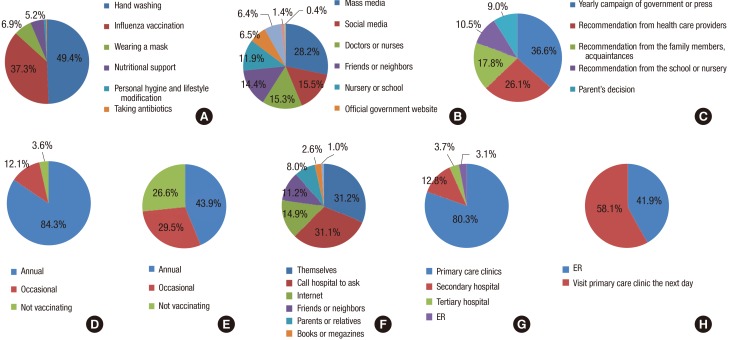
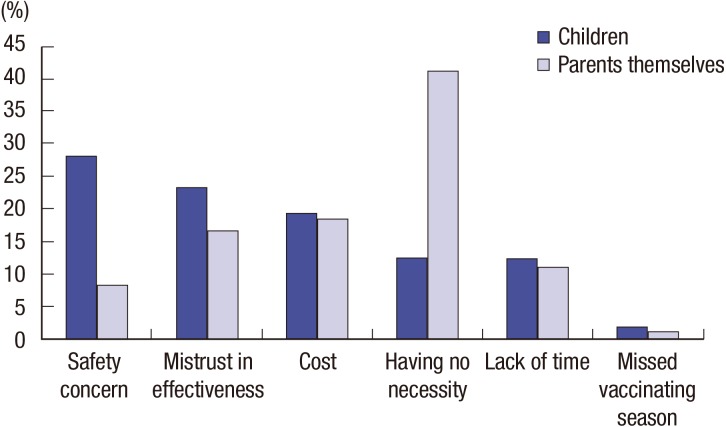
Seasonal influenza is a significant cause of morbidity and mortality of children in Korea. However, few data are available on parental perception and action toward childhood influenza. This study aimed to characterize parental perception and patterns of action in response to influenza and influenza-like illnesses (ILIs), including vaccination and healthcare use. This prospective study involved a random survey of parents whose children were aged 6-59 months. The survey was conducted in October 2014. The study included 638 parents of 824 children younger than 6 years. Most parental information of influenza came from mass media (28.2%) and social media (15.5%). The factor that most often motivated parents to vaccinate their children against influenza was promotion of the government or mass media (36.6%). Negative predictors of immunization included safety concerns about influenza vaccination (28.1%) and mistrust in the vaccine's effectiveness (23.3%). Therefore, correct information about influenza and vaccination from mass media will be one of the cornerstones for implementing a successful childhood immunization program and reducing morbidity and mortality in Korea. Furthermore, to enroll younger children in vaccination programs, and to minimize coverage gaps, public concerns about vaccine safety should be resolved. The demographic data in the present study will be used to provide a deeper insight into a parental perception and will help health care providers increase influenza immunization rate.
季节性流感是韩国儿童发病和死亡的一个重要原因。然而,关于父母对儿童流感的认知和行动的数据却很少。本研究旨在描述父母对流感和流感样疾病(ILI)的认知及应对模式,包括疫苗接种和医疗保健利用情况。这项前瞻性研究对6至59个月大儿童的父母进行了随机调查。调查于2014年10月进行。该研究纳入了824名6岁以下儿童的638名家长。大多数家长关于流感的信息来自大众媒体(28.2%)和社交媒体(15.5%)。最常促使父母为孩子接种流感疫苗的因素是政府或大众媒体的宣传(36.6%)。免疫接种的负面预测因素包括对流感疫苗安全性的担忧(28.1%)和对疫苗有效性的不信任(23.3%)。因此,来自大众媒体的关于流感和疫苗接种的正确信息将是在韩国实施成功的儿童免疫计划以及降低发病率和死亡率 的基石之一。此外,为了让更小的儿童加入疫苗接种计划,并尽量减少覆盖差距,公众对疫苗安全性的担忧应该得到解决。本研究中的人口统计学数据将用于更深入地了解父母的认知,并有助于医疗保健提供者提高流感免疫接种率。