Koller Emily J, Brooks Mieu M T, Golde Todd E, Giasson Benoit I, Chakrabarty Paramita
Department of Neuroscience, University of Florida, Gainesville, Florida, 32610, USA.
Center for Translational Research in Neurodegenerative Disease, University of Florida, Gainesville, Florida, 32610, USA.
Mol Neurodegener. 2017 Jan 3;12(1):1. doi: 10.1186/s13024-016-0142-z.
Cell-to-cell transmission of α-synuclein (αSyn) is hypothesized to play an important role in disease progression in synucleinopathies. This process involves cellular uptake of extracellular amyloidogenic αSyn seeds followed by seeding of endogenous αSyn. Though it is well known that αSyn is an immunogenic protein that can interact with immune receptors, the role of innate immunity in regulating induction of αSyn pathology in vivo is unknown. Herein, we explored whether altering innate immune activation affects induction of αSyn pathology in wild type mice.
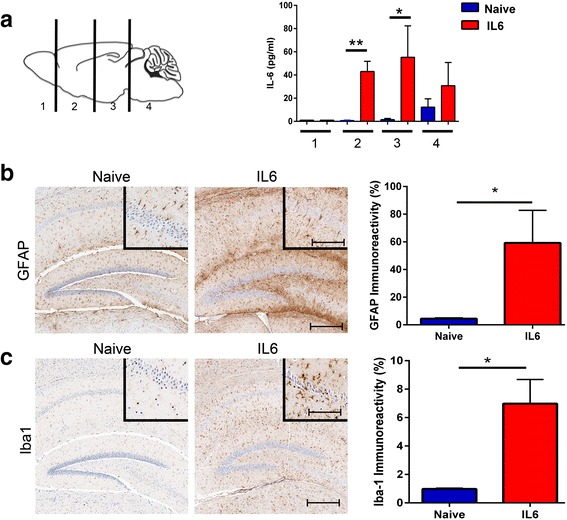
We have previously demonstrated that recombinant adeno-associated virus (AAV) mediated expression of the inflammatory cytokine, Interleukin (IL)-6, in neonatal wild type mice brains leads to widespread immune activation in the brain without overt neurodegeneration. To investigate how IL-6 expression affects induction of αSyn pathology, we injected mouse wild type αSyn fibrils in the hippocampus of AAV-IL-6 expressing mice. Control mice received AAV containing an Empty vector (EV) construct. Two separate cohorts of AAV-IL-6 and AAV-EV mice were analyzed in this study: 4 months or 2 months following intrahippocampal αSyn seeding.
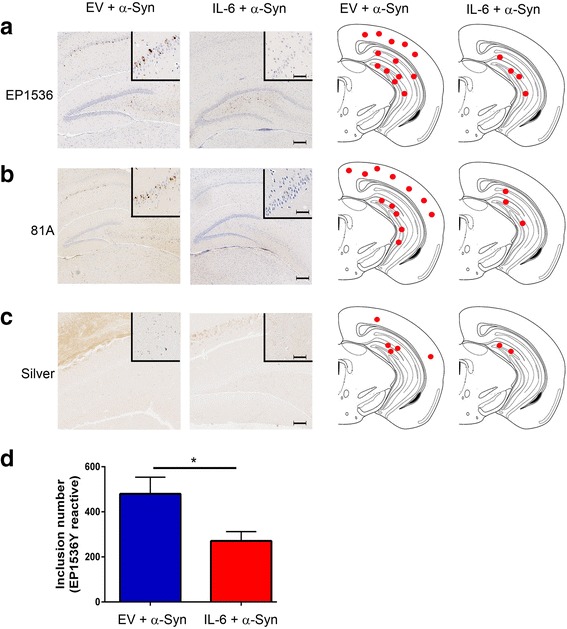
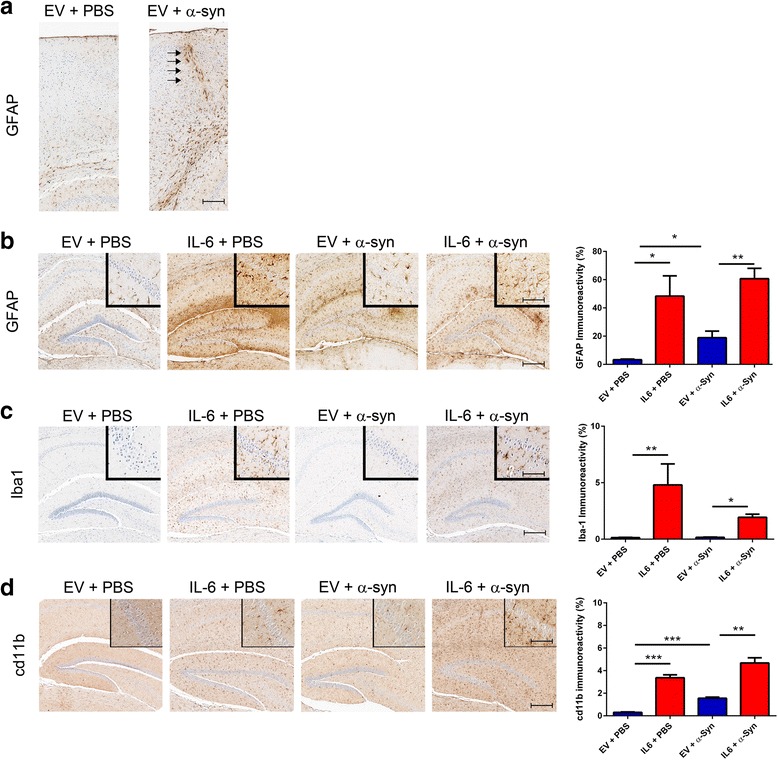
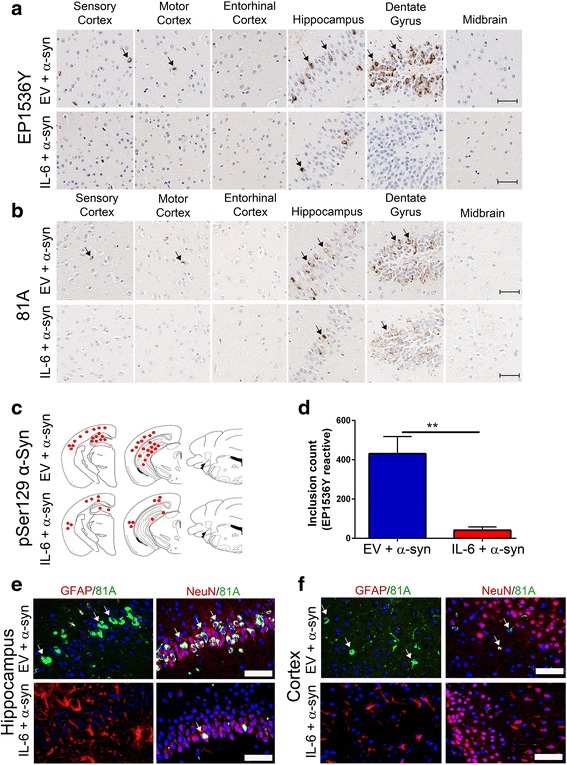
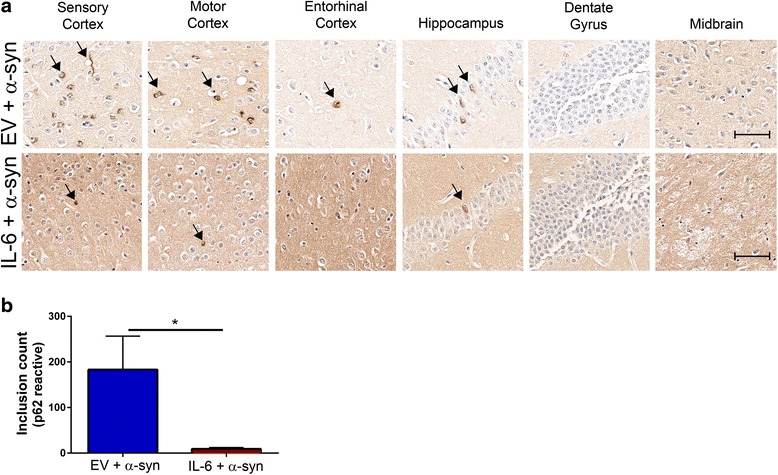
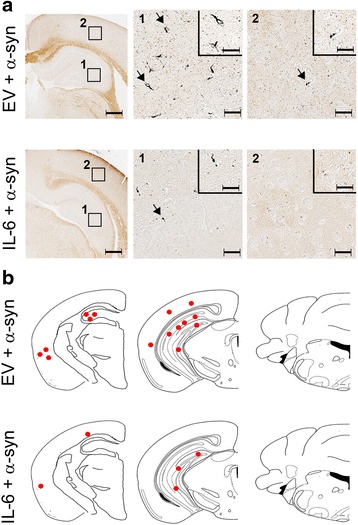
Here, we show that IL-6 expression resulted in widespread gliosis and concurrently reduced αSyn inclusion pathology induced by a single intra-hippocampal injection of exogenous amyloidogenic αSyn. The reduction in αSyn inclusion pathology in IL-6 expressing mice was time-dependent. Suppression of αSyn pathology was accompanied by reductions in both argyrophilic and p62 immunoreactive inclusions.
Our data supports a beneficial role of inflammatory priming of the CNS in wild type mice challenged with exogenous αSyn. A likely mechanism is efficient astroglial scavenging of exogenous αSyn, at least early in the disease process, and in the absence of human αSyn transgene overexpression. Given evidence that a pro-inflammatory environment may restrict seeding of αSyn pathology, this can be used to design anti-αSyn immunobiotherapies by harnessing innate immune function.
α-突触核蛋白(αSyn)的细胞间传递被认为在突触核蛋白病的疾病进展中起重要作用。这一过程涉及细胞摄取细胞外淀粉样αSyn种子,随后内源性αSyn的播种。虽然众所周知αSyn是一种可与免疫受体相互作用的免疫原性蛋白,但先天免疫在体内调节αSyn病理诱导中的作用尚不清楚。在此,我们探讨了改变先天免疫激活是否会影响野生型小鼠中αSyn病理的诱导。
我们之前已经证明,重组腺相关病毒(AAV)介导的炎性细胞因子白细胞介素(IL)-6在新生野生型小鼠脑中的表达会导致脑内广泛的免疫激活,而无明显的神经变性。为了研究IL-6表达如何影响αSyn病理的诱导,我们将小鼠野生型αSyn原纤维注射到表达AAV-IL-6的小鼠海马中。对照小鼠接受含有空载体(EV)构建体的AAV。在本研究中分析了两个独立的AAV-IL-6和AAV-EV小鼠队列:海马内αSyn接种后4个月或2个月。
在此,我们表明IL-6表达导致广泛的胶质增生,同时减少了单次海马内注射外源性淀粉样αSyn诱导的αSyn包涵体病理。表达IL-6的小鼠中αSyn包涵体病理的减少是时间依赖性的。αSyn病理的抑制伴随着嗜银性和p62免疫反应性包涵体的减少。
我们的数据支持在受到外源性αSyn攻击的野生型小鼠中,中枢神经系统的炎性启动具有有益作用。一种可能的机制是至少在疾病过程早期且在不存在人αSyn转基因过表达的情况下,星形胶质细胞对外源性αSyn的有效清除。鉴于有证据表明促炎环境可能限制αSyn病理的播种,这可用于通过利用先天免疫功能来设计抗αSyn免疫生物疗法。