Hegemann Nina-Sophie, Schlesinger-Raab Anne, Ganswindt Ute, Hörl Claudia, Combs Stephanie E, Hölzel Dieter, Gschwend Jürgen E, Stief Christian, Belka Claus, Engel Jutta
Department of Radiation Oncology, Klinikum der Universität, Ludwig-Maximilians-University, LMU Munich, Marchioninistr 15, 81377, Munich, Germany.
Munich Cancer Registry (MCR) of the Munich Cancer Centre (MCC) at the Department of Medical Informatics, Biometry and Epidemiology (IBE), University of Munich, Marchioninistr 15, 81377, Munich, Germany.
Radiat Oncol. 2017 Jan 3;12(1):2. doi: 10.1186/s13014-016-0738-z.
To investigate the risk of second cancer and radiation induced second cancer following prostate cancer radiotherapy.
We compared men with radiotherapy only with those treated with radical prostatectomy only and those with radiotherapy after radical prostatectomy. Cumulative incidences of second cancers were calculated. Cox analyses were performed to identify determinants influencing second cancer incidence.
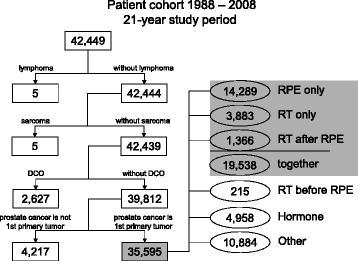
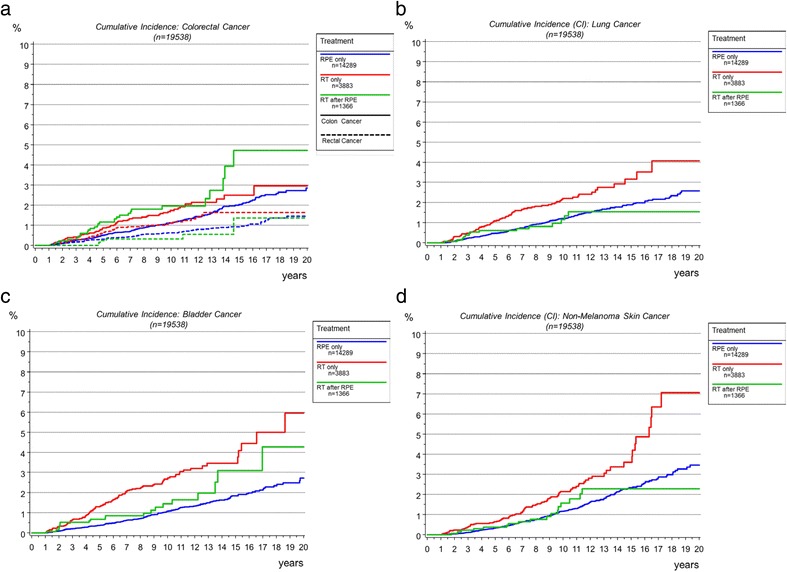
Nineteen thousand five hundred thirty eight patients were analyzed. Age and median follow-up differed significantly with radiotherapy only patients having the highest median age (70.3 years) and radical prostatectomy only patients the longest median follow-up (10.2 years). Ten-year cumulative incidence of second cancer was 15.9%, 13.2% and 10.5% for patients with radiotherapy only, radiotherapy after radical prostatectomy and radical prostatectomy only (p <0.0001). Increasing age and belonging to the radiotherapy only group were associated with a higher risk of second cancer-no significant increase was seen in radiotherapy after radical prostatectomy patients. A significantly higher rate of smoking related malignancies, like lung, bladder and non-melanoma skin cancer, was seen in radiotherapy only patients.
No clear increase in radiation induced second cancer was found in patients after radiotherapy for prostate cancer. Whereas the rate of second cancer was increased in radiotherapy only patients, no such increase was seen in patients with radiotherapy after radical prostatectomy. The increase of second cancer following radiotherapy only is highly likely to reflect advanced age and lifestyle habits and comorbidities.
研究前列腺癌放疗后发生第二原发癌及放射诱导第二原发癌的风险。
我们将仅接受放疗的男性患者与仅接受根治性前列腺切除术的患者以及根治性前列腺切除术后接受放疗的患者进行比较。计算第二原发癌的累积发病率。进行Cox分析以确定影响第二原发癌发病率的决定因素。
分析了19538例患者。年龄和中位随访时间有显著差异,仅接受放疗的患者中位年龄最高(70.3岁),仅接受根治性前列腺切除术的患者中位随访时间最长(10.2年)。仅接受放疗、根治性前列腺切除术后放疗和仅接受根治性前列腺切除术的患者,其第二原发癌的10年累积发病率分别为15.9%、13.2%和10.5%(p<0.0001)。年龄增加以及属于仅接受放疗组与第二原发癌风险较高相关,根治性前列腺切除术后放疗的患者未观察到显著增加。仅接受放疗的患者中,吸烟相关恶性肿瘤(如肺癌、膀胱癌和非黑色素瘤皮肤癌)的发生率显著更高。
前列腺癌放疗患者未发现放射诱导第二原发癌有明显增加。仅接受放疗的患者第二原发癌发生率增加,而根治性前列腺切除术后放疗的患者未出现这种增加。仅接受放疗后第二原发癌的增加很可能反映了高龄、生活方式习惯和合并症。