Cancer Epidemiology and Population Health Research Group, Allied Health and Human Performance, University of South Australia, North Terrace, SAHMRI Building, Adelaide, 5001, Australia.
Public Health Department, Debre Markos University, Debre Markos, Ethiopia.
Sci Rep. 2023 Nov 16;13(1):20083. doi: 10.1038/s41598-023-45856-z.
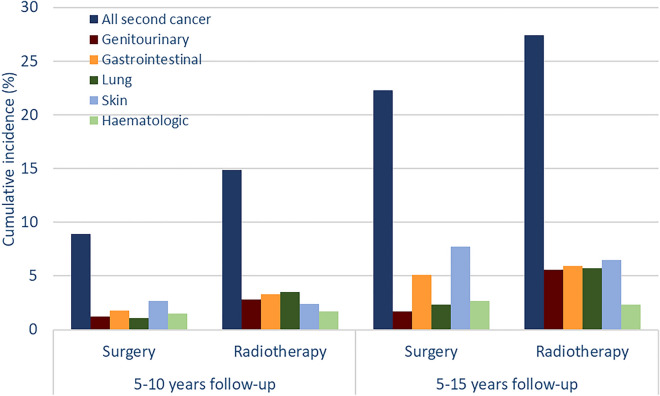
We investigated whether prostate cancer patients treated with external beam radiation therapy (EBRT) have a higher cumulative incidence of secondary cancer compared with patients treated with radical prostatectomy (RP). We used state-wide linked data from South Australia to follow men with prostate cancer diagnosed from 2002 to 2019. The cumulative incidence of overall and site-specific secondary cancers between 5 and 15 years after treatment was estimated. Fine-Gray competing risk analyses were performed with additional sensitivity analyses to test different scenarios. A total of 7625 patients were included (54% underwent RP and 46% EBRT). Characteristics of the two groups differed significantly, with the EBRT group being older (71 vs. 64 years), having higher comorbidity burden and being more likely to die during follow-up than the RP group. Fifteen-year cumulative incidence for all secondary cancers was 27.4% and 22.3% in EBRT and RP groups, respectively. In the adjusted models, patients in the EBRT group had a significantly higher risk of genitourinary (adjusted subhazard ratio (aSHR), 2.29; 95%CI 1.16-4.51) and lung (aSHR, 1.93; 95%CI 1.05-3.56) cancers compared with patients in the RP group. However, there was no statistically significant difference between the two groups for risk of any secondary cancer, gastro-intestinal, skin or haematologic cancers. No statistically significant differences in overall risk of secondary cancer were observed in any of the sensitivity analyses and patterns for risk at specific cancer sites were relatively consistent across different age restriction and latency/time-lag scenarios. In conclusion, the increased risk of genitourinary and lung cancers among men undergoing EBRT may relate partly to treatment effects and partly to unmeasured residual confounding.
我们研究了接受外部束放射治疗(EBRT)的前列腺癌患者与接受根治性前列腺切除术(RP)的患者相比,是否具有更高的继发癌症累积发生率。我们使用来自南澳大利亚州的全州连锁数据,对 2002 年至 2019 年诊断出患有前列腺癌的男性进行了随访。在治疗后 5 至 15 年内,估计了整体和特定部位继发性癌症的累积发生率。使用 Fine-Gray 竞争风险分析进行了额外的敏感性分析,以测试不同的情况。共纳入 7625 例患者(54%接受 RP,46%接受 EBRT)。两组的特征差异显著,EBRT 组年龄较大(71 岁 vs. 64 岁),合并症负担较高,且在随访期间死亡的可能性高于 RP 组。所有继发性癌症的 15 年累积发生率分别为 EBRT 和 RP 组的 27.4%和 22.3%。在调整模型中,EBRT 组患者发生泌尿生殖系统(调整后的亚危险比(aSHR),2.29;95%CI 1.16-4.51)和肺部(aSHR,1.93;95%CI 1.05-3.56)癌症的风险明显高于 RP 组患者。然而,两组之间任何继发性癌症、胃肠道、皮肤或血液系统癌症的风险无统计学显著差异。在任何敏感性分析中,都没有观察到继发性癌症总体风险的统计学显著差异,特定癌症部位的风险模式在不同的年龄限制和潜伏期/延迟时间场景下相对一致。总之,接受 EBRT 的男性发生泌尿生殖系统和肺癌的风险增加可能部分与治疗效果有关,部分与未测量的残余混杂因素有关。