Morales Amilcar L, Junga Zachary, Singla Manish B, Sjogren Maria, Torres Dawn
Amilcar L Morales, Hepatology Service, San Antonio Military Medical Center, San Antonio, TX 78234, United States.
World J Hepatol. 2016 Dec 18;8(35):1557-1563. doi: 10.4254/wjh.v8.i35.1557.
To assess the effect of sofosbuvir (SOF) based regimens on glycemic and lipid control.
This is a retrospective analysis of hepatitis C virus (HCV)-infected patients treated and cured with a SOF regimen [SOF/ribavirin/interferon, SOF/simeprevir, or SOF/ledipasvir (LDV) ± ribavirin] from January 2014 to March 2015. Patients with hemoglobin A1C (HbA1C) and lipid panels within six months before and six months after therapy were identified and included in our study. Due to the known hemolytic effect of ribavirin, HbA1C was obtained a minimum of three months post-treatment for the patients treated with a ribavirin regimen. Medical history, demographics, HCV genotype, pre-therapy RNA, and liver biopsies were included in our analysis. The patients who started a new medication or had an adjustment of baseline medical management for hyperlipidemia or diabetes mellitus (DM) were excluded from our analysis.
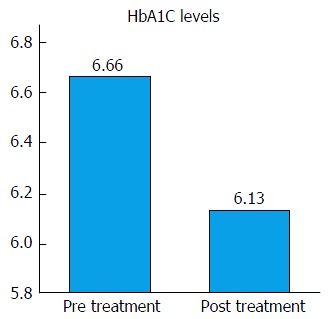
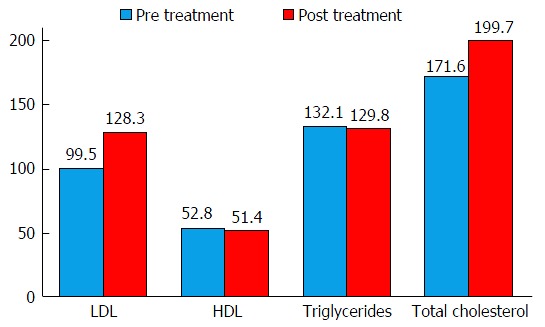
Two hundred and thirty-four patients were reviewed, of which 60 patients met inclusion criteria. Sixty-three point three percent were male, 26.7% were Caucasian, 41.7% were African American and 91.7% were infected with hepatitis C genotype 1. Mean age was 60.6 ± 6.7 years. Thirty-nine patients had HbA1C checked before and after treatment, of which 22 had the diagnosis of DM type 2. HbA1C significantly decreased with treatment of HCV (pretreatment 6.66% ± 0.95% post-treatment 6.14% ± 0.65%, < 0.005). Those treated with SOF/LDV had a lower HbA1C response than those treated with other regimens (0.26% ± 0.53% 0.71% ± 0.83%, = 0.070). Fifty-two patients had pre- and post-treatment lipid panels; there was a significant increase in low-density lipoprotein (LDL) and total cholesterol (TC) after treatment (LDL: 99.5 ± 28.9 mg/dL 128.3 ± 34.9 mg/dL, < 0.001; TC: 171.6 ± 32.5 mg/dL 199.7 ± 40.0 mg/dL, < 0.001). Pre-treatment body-mass index (BMI) did not differ from post-treatment BMI ( = 0.684).
Eradication of HCV with a SOF regimen resulted in a significant drop in HbA1C and an increase in LDL and TC post therapy.
评估基于索磷布韦(SOF)的治疗方案对血糖和血脂控制的影响。
这是一项对2014年1月至2015年3月期间接受索磷布韦治疗方案[索磷布韦/利巴韦林/干扰素、索磷布韦/西米普明或索磷布韦/来迪帕司韦(LDV)±利巴韦林]治疗并治愈的丙型肝炎病毒(HCV)感染患者的回顾性分析。确定并纳入在治疗前六个月和治疗后六个月内进行过糖化血红蛋白(HbA1C)和血脂检查的患者。由于已知利巴韦林的溶血作用,对于接受利巴韦林治疗方案的患者,在治疗后至少三个月获取HbA1C。我们的分析纳入了病史、人口统计学、HCV基因型、治疗前RNA和肝活检。开始使用新药物或对高脂血症或糖尿病(DM)的基线医疗管理进行调整的患者被排除在我们的分析之外。
共审查了234例患者,其中60例符合纳入标准。63.3%为男性,26.7%为白种人,41.7%为非裔美国人,91.7%感染丙型肝炎1型。平均年龄为60.6±6.7岁。39例患者在治疗前后进行了HbA1C检查,其中22例诊断为2型糖尿病。HCV治疗后HbA1C显著下降(治疗前6.66%±0.95%,治疗后6.14%±0.65%,P<0.005)。接受索磷布韦/来迪帕司韦治疗的患者HbA1C反应低于接受其他治疗方案的患者(0.26%±0.53%对0.71%±0.83%,P=0.070)。52例患者进行了治疗前后的血脂检查;治疗后低密度脂蛋白(LDL)和总胆固醇(TC)显著升高(LDL:99.5±28.9mg/dL对128.3±34.9mg/dL,P<0.001;TC:171.6±32.5mg/dL对199.7±40.0mg/dL, P<0.001)。治疗前体重指数(BMI)与治疗后BMI无差异(P=0.684)。
采用索磷布韦治疗方案根除HCV后,HbA1C显著下降,治疗后LDL和TC升高。