Park Hee-Jung, Lee Jun Hyup, Park Sujin, Kim Tae-Il
Department of Health Policy and Management, Korea University College of Health Sciences, Seoul, Korea .
Department of Health Policy and Management, Korea University College of Health Sciences, Seoul, Korea.; BK21 PLUS Program in Embodiment: Health-Society Interaction, Department of Public Health Sciences, Korea University Graduate School, Seoul, Korea.
J Periodontal Implant Sci. 2016 Dec;46(6):405-414. doi: 10.5051/jpis.2016.46.6.405. Epub 2016 Dec 27.
This study aimed to evaluate the effects of a policy change to expand Korean National Health Insurance (KNHI) benefit coverage to include scaling on access to dental care at the national level.
A nationally representative sample of 12,794 adults aged 20 to 64 years from Korea National Health and Nutritional Examination Survey (2010-2014) was analyzed. To examine the effect of the policy on the outcomes of interest (unmet dental care needs and preventive dental care utilization in the past year), an estimates-based probit model was used, incorporating marginal effects with a complex sampling structure. The effect of the policy on individuals depending on their income and education level was also assessed.
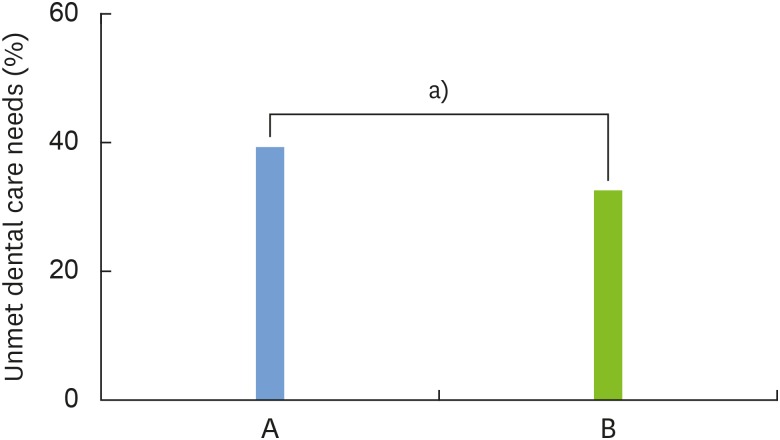
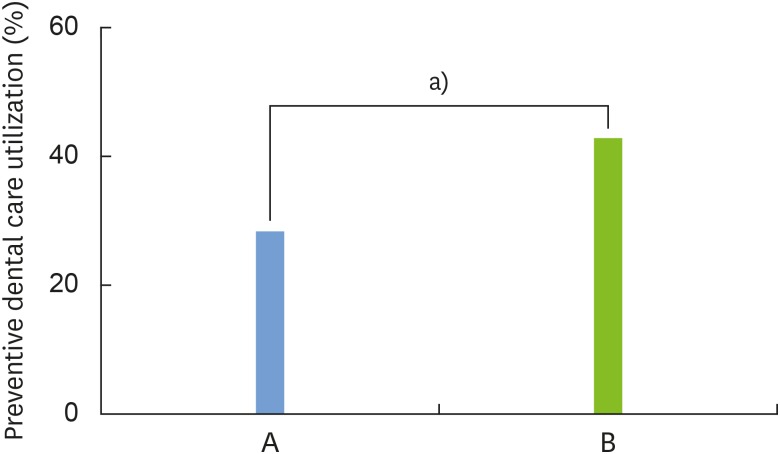
Adjusting for potential covariates, the probability of having unmet needs for dental care decreased by 6.1% and preventative dental care utilization increased by 14% in the post-policy period compared to those in the pre-policy period (2010, 2012). High income and higher education levels were associated with fewer unmet dental care needs and more preventive dental visits.
The expansion of coverage to include scaling demonstrated to have a significant association with decreasing unmet dental care needs and increasing preventive dental care utilization. However, the policy disproportionately benefited certain groups, in contrast with the objective of the policy to benefit all participants in the KNHI system.
本研究旨在评估一项政策变化的效果,该政策变化是将韩国国民健康保险(KNHI)的福利覆盖范围扩大至包括洗牙,以在国家层面评估其对获得牙科护理的影响。
对来自韩国国民健康与营养检查调查(2010 - 2014年)的12794名年龄在20至64岁的成年人的全国代表性样本进行了分析。为了检验该政策对感兴趣的结果(过去一年中未满足的牙科护理需求和预防性牙科护理的使用情况)的影响,使用了基于估计的概率模型,并纳入了具有复杂抽样结构的边际效应。还评估了该政策对不同收入和教育水平个人的影响。
在调整潜在协变量后,与政策实施前时期(2010年、2012年)相比,政策实施后时期未满足牙科护理需求的概率降低了6.1%,预防性牙科护理的使用率提高了14%。高收入和较高教育水平与较少的未满足牙科护理需求以及更多的预防性牙科就诊相关。
将覆盖范围扩大至包括洗牙被证明与减少未满足的牙科护理需求以及增加预防性牙科护理的使用有显著关联。然而,与该政策使KNHI系统所有参与者受益的目标相反,该政策使某些群体受益过多。