He Xiao-Li, Liao Xue-Lian, Xie Zhi-Chao, Han Li, Yang Xiao-Lei, Kang Yan
Department of Critical Care Medicine, West China Hospital, Sichuan University, Chengdu, China.
Biomed Res Int. 2016;2016:4213712. doi: 10.1155/2016/4213712. Epub 2016 Dec 5.
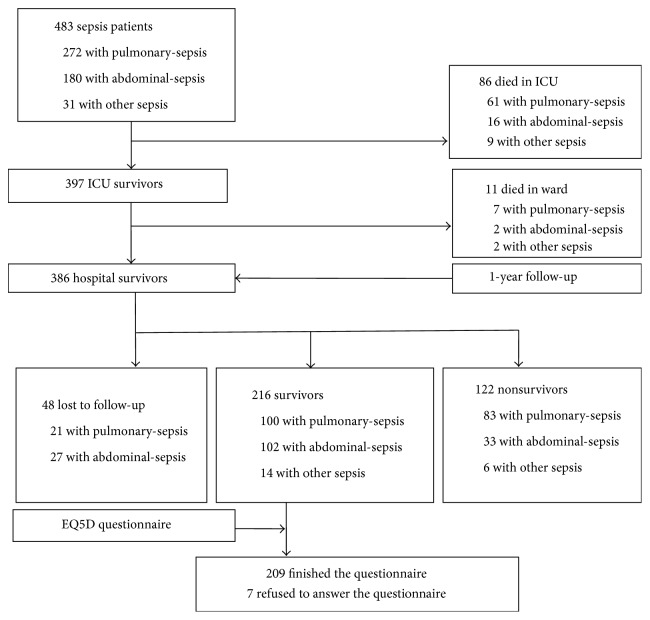
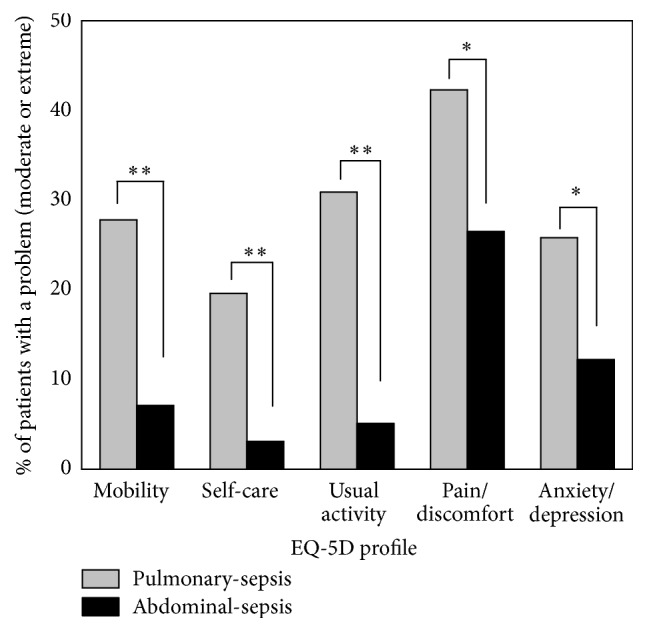
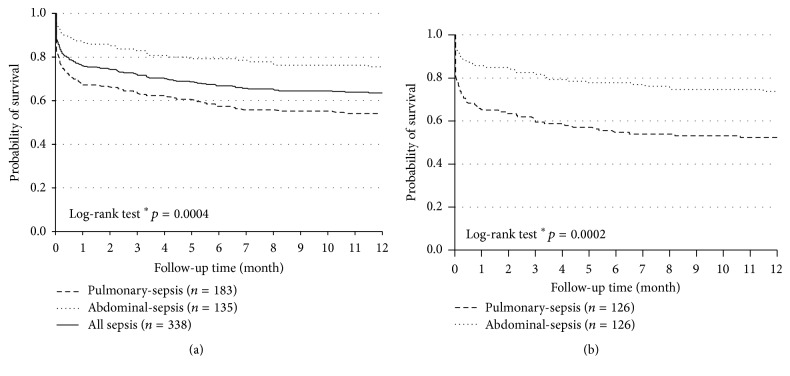
Long-term outcomes (mortality and health-related quality of life) of sepsis have risen as important indicators for health care. Pulmonary infection and abdominal infection are the leading causes of sepsis. However, few researches about long-term outcomes focused on the origin of sepsis. Here we aim to study the clinical differences between pulmonary-sepsis and abdominal-sepsis and to investigate whether different infection foci were associated with long-term outcomes. Patients who survived after hospital discharge were followed up by telephone interview. Quality of life (QoL) was assessed using the EuroQol 5-dimension (EQ5D) questionnaire. Four hundred and eighty-three sepsis patients were included, 272 (56.3%) had pulmonary-sepsis, and 180 (37.3%) had abdominal-sepsis. The overall ICU and one-year mortality rates of the cohort were 17.8% and 36.1%, respectively. Compared with abdominal-sepsis, pulmonary-sepsis patients had older age, higher APACHE II, higher ICU mortality (31.7% versus 12.6%), and one-year mortality (45.4% versus 24.4%), together with worse QoL. Age, septic shock, acute renal failure, fungus infection, anion gap, and pulmonary infection were predictors for one-year mortality and pulmonary infection was a risk factor for poor QoL. Pulmonary-sepsis showed worse outcome than abdominal-sepsis. Pulmonary infection is a risk factor for one-year mortality and QoL after sepsis.
脓毒症的长期预后(死亡率和健康相关生活质量)已成为医疗保健的重要指标。肺部感染和腹部感染是脓毒症的主要原因。然而,很少有关于长期预后的研究关注脓毒症的起源。在此,我们旨在研究肺部脓毒症和腹部脓毒症之间的临床差异,并调查不同的感染灶是否与长期预后相关。对出院后存活的患者进行电话随访。使用欧洲五维健康量表(EQ5D)问卷评估生活质量(QoL)。纳入483例脓毒症患者,其中272例(56.3%)患有肺部脓毒症,180例(37.3%)患有腹部脓毒症。该队列的总体重症监护病房(ICU)死亡率和一年死亡率分别为17.8%和36.1%。与腹部脓毒症相比,肺部脓毒症患者年龄更大,急性生理与慢性健康状况评分系统(APACHE II)更高,ICU死亡率更高(31.7%对12.6%),一年死亡率更高(45.4%对24.4%),生活质量更差。年龄、感染性休克、急性肾衰竭、真菌感染、阴离子间隙和肺部感染是一年死亡率的预测因素,而肺部感染是生活质量差的危险因素。肺部脓毒症的预后比腹部脓毒症更差。肺部感染是脓毒症后一年死亡率和生活质量的危险因素。