Sundh Josefin, Johansson Gunnar, Larsson Kjell, Lindén Anders, Löfdahl Claes-Göran, Janson Christer, Sandström Thomas
Department of Respiratory Medicine, Örebro University, Örebro, Sweden.
Department of Public Health and Caring Science, Family Medicine and Preventive Medicine, Uppsala University, Uppsala, Sweden.
Int J Chron Obstruct Pulmon Dis. 2015 Jan 22;10:173-83. doi: 10.2147/COPD.S74645. eCollection 2015.
Our understanding of how comorbid diseases influence health-related quality of life (HRQL) in patients with chronic obstructive pulmonary disease (COPD) is limited and in need of improvement. The aim of this study was to examine the associations between comorbidities and HRQL as measured by the instruments EuroQol-5 dimension (EQ-5D) and the COPD Assessment Test (CAT).
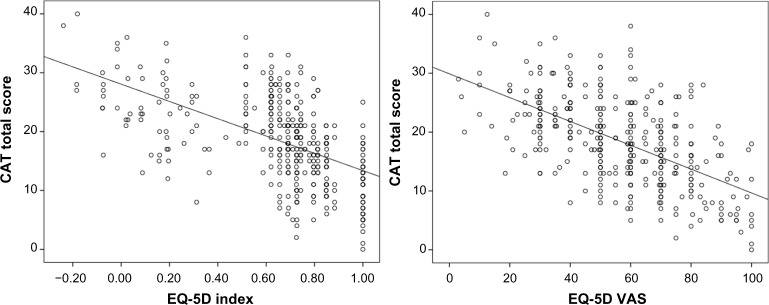
Information on patient characteristics, chronic bronchitis, cardiovascular disease, diabetes, renal impairment, musculoskeletal symptoms, osteoporosis, depression, and EQ-5D and CAT questionnaire results was collected from 373 patients with Forced Expiratory Volume in one second (FEV1) <50% of predicted value from 27 secondary care respiratory units in Sweden. Correlation analyses and multiple linear regression models were performed using EQ-5D index, EQ-5D visual analog scale (VAS), and CAT scores as response variables.
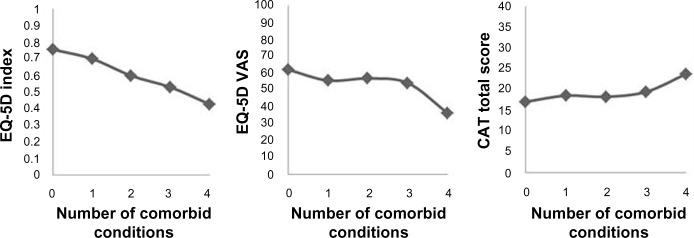
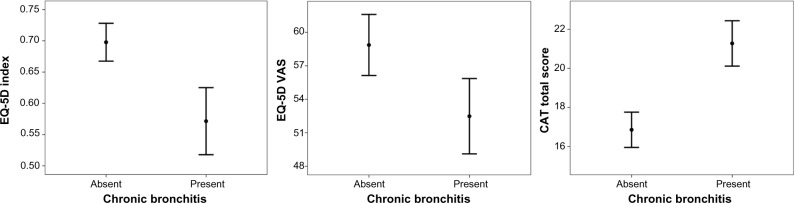
Having more comorbid conditions was associated with a worse HRQL as assessed by all instruments. Chronic bronchitis was significantly associated with a worse HRQL as assessed by EQ-5D index (adjusted regression coefficient [95% confidence interval] -0.07 [-0.13 to -0.02]), EQ-5D VAS (-5.17 [-9.42 to -0.92]), and CAT (3.78 [2.35 to 5.20]). Musculoskeletal symptoms were significantly associated with worse EQ-5D index (-0.08 [-0.14 to -0.02]), osteoporosis with worse EQ-5D VAS (-4.65 [-9.27 to -0.03]), and depression with worse EQ-5D index (-0.10 [-0.17 to -0.04]). In stratification analyses, the associations of musculoskeletal symptoms, osteoporosis, and depression with HRQL were limited to female patients.
The instruments EQ-5D and CAT complement each other and emerge as useful for assessing HRQL in patients with COPD. Chronic bronchitis, musculoskeletal symptoms, osteoporosis, and depression were associated with worse HRQL. We conclude that comorbid conditions, in particular chronic bronchitis, depression, osteoporosis, and musculoskeletal symptoms, should be taken into account in the clinical management of patients with severe COPD.
我们对合并症如何影响慢性阻塞性肺疾病(COPD)患者健康相关生活质量(HRQL)的理解有限,需要改进。本研究的目的是通过欧洲五维健康量表(EQ-5D)和慢性阻塞性肺疾病评估测试(CAT)这两种工具来检验合并症与HRQL之间的关联。
从瑞典27个二级护理呼吸科收集了373例一秒用力呼气量(FEV1)<预测值50%的患者的以下信息:患者特征、慢性支气管炎、心血管疾病、糖尿病、肾功能损害、肌肉骨骼症状、骨质疏松症、抑郁症以及EQ-5D和CAT问卷结果。使用EQ-5D指数、EQ-5D视觉模拟量表(VAS)和CAT评分作为反应变量进行相关性分析和多元线性回归模型分析。
所有工具评估结果均显示,合并症越多,HRQL越差。慢性支气管炎与较差的HRQL显著相关,EQ-5D指数(调整回归系数[95%置信区间]-0.07[-0.13至-0.02])、EQ-5D VAS(-5.17[-9.42至-0.92])和CAT(3.78[2.35至5.20])均可证明。肌肉骨骼症状与较差的EQ-5D指数显著相关(-0.08[-0.14至-0.02]),骨质疏松症与较差的EQ-5D VAS显著相关(-4.65[-9.27至-0.03]),抑郁症与较差的EQ-5D指数显著相关(-0.10[-0.17至-0.04])。分层分析中,肌肉骨骼症状、骨质疏松症和抑郁症与HRQL的关联仅限于女性患者。
EQ-5D和CAT这两种工具相互补充,是评估COPD患者HRQL的有用工具。慢性支气管炎、肌肉骨骼症状、骨质疏松症和抑郁症与较差的HRQL相关。我们得出结论,在重度COPD患者的临床管理中应考虑合并症,尤其是慢性支气管炎、抑郁症、骨质疏松症和肌肉骨骼症状。