Bollschweiler Daniel, Schaffer Miroslava, Lawrence C Martin, Engelhardt Harald
Max-Planck-Institut für Biochemie, Am Klopferspitz 18, 82152, Martinsried, Germany.
Department of Biochemistry, University of Cambridge, Cambridge, UK.
Extremophiles. 2017 Mar;21(2):393-398. doi: 10.1007/s00792-016-0912-0. Epub 2017 Jan 3.
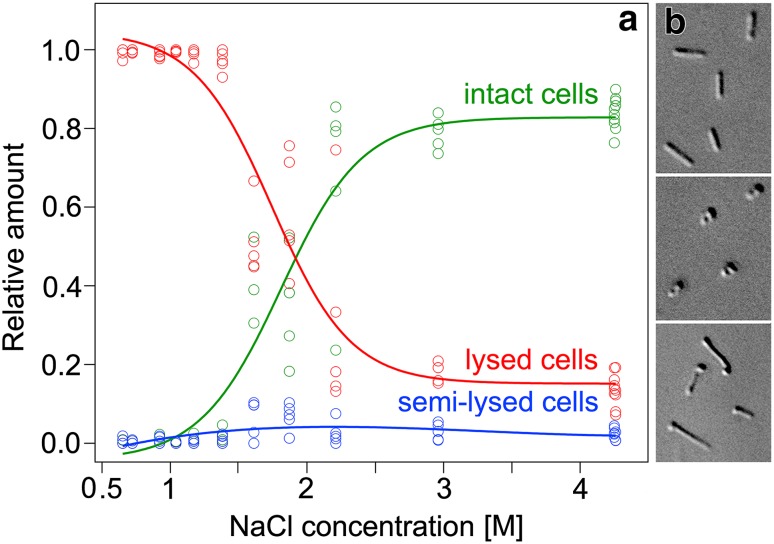
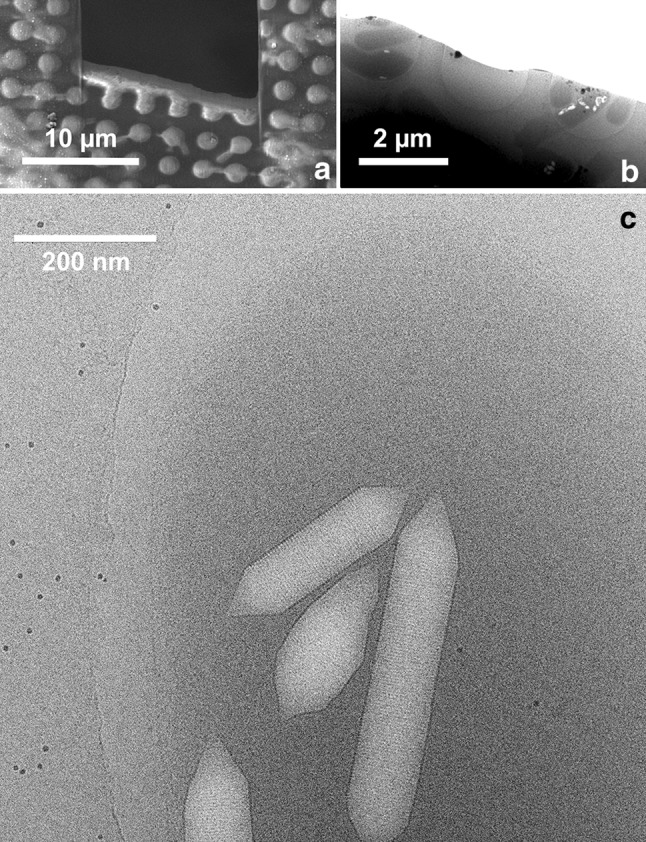
Most halophilic Archaea of the class Halobacteriaceae depend on the presence of several molar sodium chloride for growth and cell integrity. This poses problems for structural studies, particularly for electron microscopy, where the high salt concentration results in diminished contrast. Since cryo-electron microscopy of intact cells provides new insights into the cellular and molecular organization under close-to-live conditions, we evaluated strategies and conditions to make halophilic microbes available for investigations in situ. Halobacterium salinarum, the test organism for this study, usually grows at 4.3 M NaCl. Adaptation to lower concentrations and subsequent NaCl reduction via dialysis led to still vital cells at 3 M salt. A comprehensive evaluation of vitrification parameters, thinning of frozen cells by focused-ion-beam micromachining, and cryo-electron microscopy revealed that structural studies under high salt conditions are possible in situ.
盐杆菌科的大多数嗜盐古菌依赖数摩尔浓度的氯化钠来生长和维持细胞完整性。这给结构研究带来了问题,特别是对于电子显微镜而言,高盐浓度会导致对比度降低。由于完整细胞的冷冻电子显微镜能够在接近活细胞的条件下为细胞和分子组织提供新的见解,因此我们评估了使嗜盐微生物能够用于原位研究的策略和条件。本研究的受试生物盐沼盐杆菌通常在4.3M氯化钠浓度下生长。通过适应较低浓度并随后通过透析降低氯化钠浓度,可使细胞在3M盐浓度下仍保持活力。对玻璃化参数、聚焦离子束微加工使冷冻细胞变薄以及冷冻电子显微镜进行的全面评估表明,在高盐条件下进行原位结构研究是可行的。