Rigaud Vagner Oliveira-Carvalho, Ferreira Ludmila R P, Ayub-Ferreira Silvia M, Ávila Mônica S, Brandão Sara M G, Cruz Fátima D, Santos Marília H H, Cruz Cecilia B B V, Alves Marco S L, Issa Victor S, Guimarães Guilherme V, Cunha-Neto Edécio, Bocchi Edimar A
Heart Failure Unit, Heart Institute (InCor), Hospital das Clínicas da Faculdade de Medicina da Universidade de São Paulo (HC-FMUSP), São Paulo, Brazil.
Laboratory of Immunology, Heart Institute (InCor), Hospital das Clínicas da Faculdade de Medicina da Universidade de São Paulo (HC-FMUSP), São Paulo, Brazil.
Oncotarget. 2017 Jan 24;8(4):6994-7002. doi: 10.18632/oncotarget.14355.
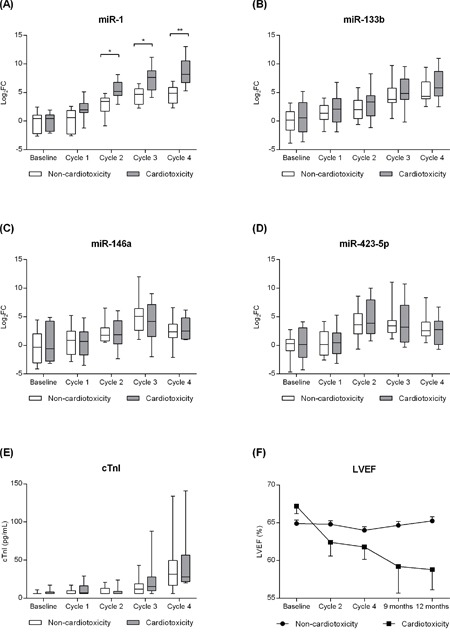
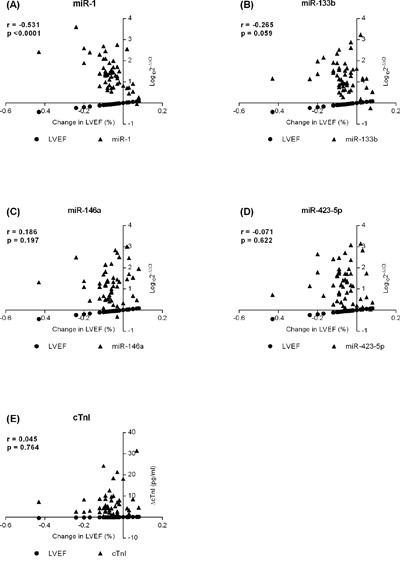
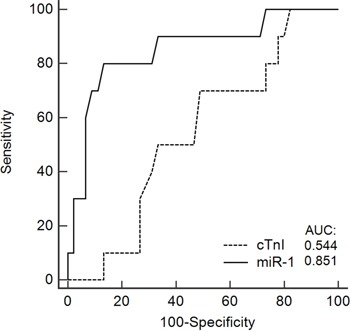
Cardiotoxicity is associated with the chronic use of doxorubicin leading to cardiomyopathy and heart failure. Identification of cardiotoxicity-specific miRNA biomarkers could provide clinicians with a valuable prognostic tool. The aim of the study was to evaluate circulating levels of miRNAs in breast cancer patients receiving doxorubicin treatment and to correlate with cardiac function. This is an ancillary study from "Carvedilol Effect on Chemotherapy-induced Cardiotoxicity" (CECCY trial), which included 56 female patients (49.9±3.3 years of age) from the placebo arm. Enrolled patients were treated with doxorubicin followed by taxanes. cTnI, LVEF, and miRNAs were measured periodically. Circulating levels of miR-1, -133b, -146a, and -423-5p increased during the treatment whereas miR-208a and -208b were undetectable. cTnI increased from 6.6±0.3 to 46.7±5.5 pg/mL (p<0.001), while overall LVEF tended to decrease from 65.3±0.5 to 63.8±0.9 (p=0.053) over 12 months. Ten patients (17.9%) developed cardiotoxicity showing a decrease in LVEF from 67.2±1.0 to 58.8±2.7 (p=0.005). miR-1 was associated with changes in LVEF (r=-0.531, p<0.001). In a ROC curve analysis miR-1 showed an AUC greater than cTnI to discriminate between patients who did and did not develop cardiotoxicity (AUC = 0.851 and 0.544, p= 0.0016). Our data suggest that circulating miR-1 might be a potential new biomarker of doxorubicin-induced cardiotoxicity in breast cancer patients.
心脏毒性与长期使用阿霉素导致的心肌病和心力衰竭有关。识别心脏毒性特异性miRNA生物标志物可为临床医生提供有价值的预后工具。本研究的目的是评估接受阿霉素治疗的乳腺癌患者循环miRNA水平,并与心脏功能进行关联。这是一项来自“卡维地洛对化疗诱导心脏毒性的影响”(CECCY试验)的辅助研究,该试验纳入了安慰剂组的56名女性患者(年龄49.9±3.3岁)。入选患者先接受阿霉素治疗,随后接受紫杉烷治疗。定期测量肌钙蛋白I(cTnI)、左心室射血分数(LVEF)和miRNA。治疗期间,循环miR-1、-133b、-146a和-423-5p水平升高,而miR-208a和-208b未检测到。cTnI从6.6±0.3 pg/mL升高至46.7±5.5 pg/mL(p<0.001),而在12个月内,总体LVEF倾向于从65.3±0.5降至63.8±0.9(p=0.053)。10名患者(17.9%)发生心脏毒性,LVEF从67.2±1.0降至58.8±2.7(p=0.005)。miR-1与LVEF变化相关(r=-0.531,p<0.001)。在ROC曲线分析中,miR-1在区分发生和未发生心脏毒性的患者方面,其曲线下面积(AUC)大于cTnI(AUC分别为0.851和0.544,p=0.0016)。我们的数据表明,循环miR-1可能是乳腺癌患者阿霉素诱导心脏毒性的一种潜在新生物标志物。