Burden Sorrel T, Gibson Debra J, Lal Simon, Hill James, Pilling Mark, Soop Mattias, Ramesh Aswatha, Todd Chris
School of Health Sciences, The University of Manchester, Manchester, UK.
Salford Royal NHS Foundation Trust, Salford, UK.
J Cachexia Sarcopenia Muscle. 2017 Jun;8(3):437-446. doi: 10.1002/jcsm.12170. Epub 2017 Jan 3.
Pre-operative weight loss has been consistently associated with increased post-operative morbidity. The study aims to determine if pre-operative oral nutritional supplements (ONSs) with dietary advice reduce post-operative complications.
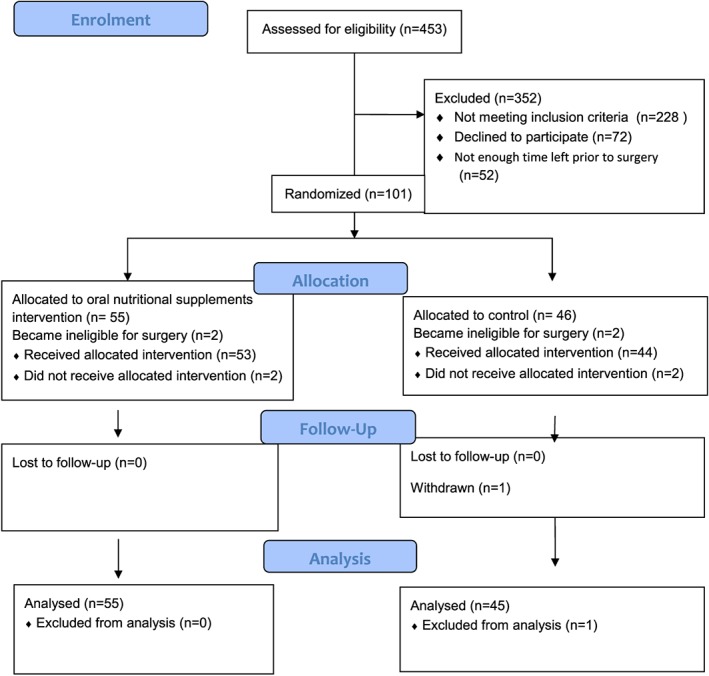
Single-blinded randomized controlled trial. People with colorectal cancer scheduled for surgery with pre-operative weight loss >1 kg/3-6 months were randomized by using stratified blocks (1:1 ratio) in six hospitals (1 November 2013-28 February 2015). Intervention group was given 250 mL/day ONS (10.1 KJ and 0.096 g protein per mL) and dietary advice. Control group received dietary advice alone. Oral nutritional supplements were administered from diagnosis to the day preceding surgery. Research team was masked to group allocation. Primary outcome was patients with one or more surgical site infection (SSI) or chest infection; secondary outcomes included percentage weight loss, total complications, and body composition measurements. Intention-to-treat analysis was performed with both unadjusted and adjusted analyses. A sample size of 88 was required.
Of 101 participants, (55 ONS, 46 controls) 97 had surgery. In intention-to-treat analysis, there were 21/45 (47%) patients with an infection-either an SSI or chest infection in the control group vs. 17/55 (30%) in the ONS group. The odds ratio of a patient incurring either an SSI or chest infection was 0.532 (P = 0.135 confidence interval 0.232 to 1.218) in the unadjusted analysis and when adjusted for random differences at baseline (age, gender, percentage weight loss, and cancer staging) was 0.341 (P = 0.031, confidence interval 0.128 to 0.909). Pre-operative percentage weight loss at the first time point after randomization was 4.1% [interquartile range (IQR) 1.7-7.0] in ONS group vs. 6.7% (IQR 2.6-10.8) in controls (Mann-Whitney U P = 0.021) and post-operatively was 7.4% (IQR 4.3-10.0) in ONS group vs. 10.2% (IQR 5.1-18.5) in controls (P = 0.016).
Compared with dietary advice alone, ONS resulted in patients having fewer infections and less weight loss following surgery for colorectal cancer. We have demonstrated that pre-operative oral nutritional supplementation can improve clinical outcome in weight losing patients with colorectal cancer.
术前体重减轻一直与术后发病率增加相关。本研究旨在确定术前口服营养补充剂(ONS)结合饮食建议是否能减少术后并发症。
单盲随机对照试验。在六家医院(2013年11月1日至2015年2月28日),将计划接受手术且术前体重减轻>1 kg/3 - 6个月的结直肠癌患者按分层区组(1:1比例)随机分组。干预组每天给予250 mL ONS(每毫升含10.1千焦能量和0.096克蛋白质)及饮食建议。对照组仅接受饮食建议。口服营养补充剂从诊断开始至手术前一天给予。研究团队对分组情况不知情。主要结局是发生一种或多种手术部位感染(SSI)或肺部感染的患者;次要结局包括体重减轻百分比、总并发症及身体成分测量。采用未调整和调整分析进行意向性分析。所需样本量为88例。
101名参与者中(55例ONS组,46例对照组)97例接受了手术。在意向性分析中,对照组有21/45(47%)的患者发生感染(SSI或肺部感染),ONS组为17/55(30%)。在未调整分析中,发生SSI或肺部感染的患者的比值比为0.532(P = 0.135,置信区间0.232至1.218),在对基线随机差异(年龄、性别、体重减轻百分比和癌症分期)进行调整后为0.341(P = 0.031,置信区间0.128至0.909)。随机分组后第一个时间点的术前体重减轻百分比,ONS组为4.1% [四分位间距(IQR)1.7 - 7.0],对照组为6.7%(IQR 2.6 - 10.8)(曼 - 惠特尼U检验P = 0.021),术后ONS组为7.4%(IQR 4.3 - 10.0),对照组为10.2%(IQR 5.1 - 18.5)(P = 0.016)。
与单纯饮食建议相比,ONS可使结直肠癌手术后患者感染减少且体重减轻幅度更小。我们已证明术前口服营养补充可改善体重减轻的结直肠癌患者的临床结局。