Sremanakova Jana, Knight Stephen R, Lapitan Marie Carmela M, Yenli Edwin, Tabiri Stephen, Ghosh Dhruva, Kingsley Pamela A, Valparaiso Apple, Harrison Ewen M, Thomas Maria, Haque Parvez D, Veetil Sreejith K, Suroy Atul, Choudhrie Ashish, Mittal Rohin, Kottayasamy Seenivasagam Rajkumar, Roy Bipradas, Jones Debra, Burden Sorrel T
Faculty of Medicine, Biology and Health, Manchester Academic Health Science Centre, University of Manchester, Manchester, United Kingdom.
Centre for Medical Informatics, Usher Institute, University of Edinburgh, Edinburgh, United Kingdom.
Front Nutr. 2025 Jun 5;12:1576916. doi: 10.3389/fnut.2025.1576916. eCollection 2025.
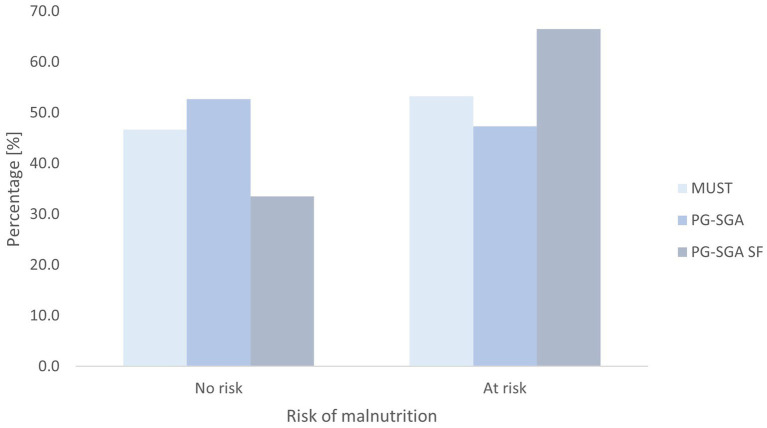
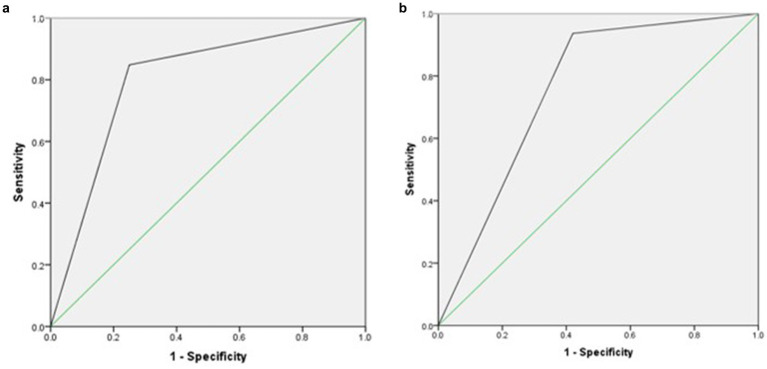
Approximately one-third of patients are severely malnourished prior to surgery in low- and middle-income countries (LMICs). Identifying the most appropriate tool for detecting malnutrition is a critical first step toward enabling effective treatment interventions. Therefore, this study aimed to assess the validity and reliability of nutritional screening tools in patients with cancer scheduled for surgery in LMICs. Participants included adults undergoing either curative elective or palliative surgeries in Ghana, India, and the Philippines. Nutritional status was assessed using anthropometric measurements, the Malnutrition Universal Screening Tool (MUST), and the Patient-Generated Subjective Global Assessment (PG-SGA). Data were analysed using Bland-Altman plots with confidence intervals (CIs) and intra-class correlation coefficients (ICCs) to assess inter-rater reliability. Sensitivity and specificity tests were conducted using the Area Under the Receiver Operating Characteristics Curve (AUROC). A total of 167 participants were recruited, with a mean age of 53.3 years (SD 14.7) and a mean body mass index (BMI) of 23.0 kg/m (SD 4.9). The proportion of participants identified as at risk of malnutrition was 53.3% using MUST, 47.3% using PG-SGA SF, and 66% using the full PG-SGA. When compared to the PG-SGA, MUST and PG-SGA SF had AUROCs of 0.78 (95% CI: 0.73-0.87) and 0.76 (95% CI: 0.68-0.83), respectively. MUST demonstrated a sensitivity of 85% and a specificity of 25%, while PG-SGA SF showed a sensitivity of 93% and a specificity of 42%. Excellent inter-rater agreement was observed for anthropometric measurements, with ICC values >0.9 across all assessments. Both MUST and PG-SGA SF demonstrated good sensitivity when compared to PG-SGA. However, PG-SGA SF demonstrated slightly greater specificity than MUST. Based on these findings, PG-SGA SF is recommended for preoperative nutritional screening in LMICs.
在低收入和中等收入国家(LMICs),约三分之一的患者在手术前存在严重营养不良。确定最适合检测营养不良的工具是实现有效治疗干预的关键第一步。因此,本研究旨在评估LMICs中计划接受手术的癌症患者营养筛查工具的有效性和可靠性。参与者包括在加纳、印度和菲律宾接受根治性择期手术或姑息性手术的成年人。使用人体测量、营养不良通用筛查工具(MUST)和患者主观整体评定法(PG-SGA)评估营养状况。使用带有置信区间(CIs)的Bland-Altman图和组内相关系数(ICCs)分析数据,以评估评分者间的可靠性。使用受试者工作特征曲线下面积(AUROC)进行敏感性和特异性测试。共招募了167名参与者,平均年龄为53.3岁(标准差14.7),平均体重指数(BMI)为23.0kg/m²(标准差4.9)。使用MUST确定为营养不良风险患者的比例为53.3%,使用PG-SGA简表为47.3%,使用完整PG-SGA为66%。与PG-SGA相比,MUST和PG-SGA简表的AUROC分别为0.78(95%CI:0.73-0.87)和0.76(95%CI:0.68-0.83)。MUST的敏感性为85%,特异性为25%,而PG-SGA简表的敏感性为93%,特异性为42%。人体测量显示出极好的评分者间一致性,所有评估的ICC值均>0.9。与PG-SGA相比,MUST和PG-SGA简表均显示出良好的敏感性。然而,PG-SGA简表的特异性略高于MUST。基于这些发现,建议在LMICs中使用PG-SGA简表进行术前营养筛查。