Kassaye Seble G, Ong'ech John, Sirengo Martin, Kose Judith, Matu Lucy, McOdida Peter, Simiyu Rogers, Syengo Titus, Muthama David, Machekano Rhoderick
Department of Medicine, Georgetown University, Washington, DC, USA.
Kenyatta National Hospital, Nairobi, Kenya.
AIDS Res Treat. 2016;2016:1289328. doi: 10.1155/2016/1289328. Epub 2016 Dec 8.
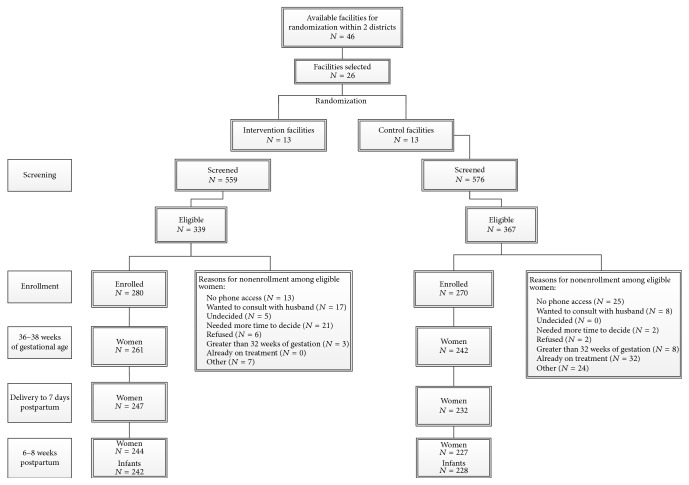
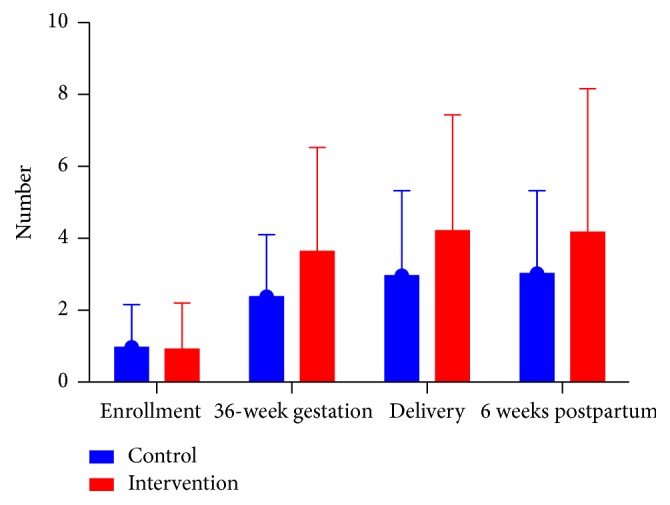
. Antiretroviral medications are key for prevention of mother-to-child transmission (PMTCT) of HIV, and transmission mitigation is affected by service delivery, adherence, and retention. . We conducted a cluster-randomized controlled study in 26 facilities in Nyanza, Kenya, to determine the efficacy of SMS text messages on PMTCT outcomes. The relative risk and confidence intervals were estimated at the facility level using STATA. . 550 women were enrolled, from June 2012 to July 2013. The median age was 25.6 years, and 85.3% received ARVs. Maternal ARV use was similar between the intervention and control arms: 254/261 (97.3%) versus 241/242 (99.6%) at 34-36 weeks of gestation and 234/247 (94.7%) versus 229/229 (100%) at delivery. Among infants, 199/246 (80.9%) and 209/232 (90.1%) received ARVs (RR: 0.91; 95% CI: 0.77-1.14); 88% versus 88.6% were tested for HIV at 6 weeks, with 1/243 (0.4%) and 3/217 (1.4%) positive results in the intervention and control arms, respectively. Communication increased in both the intervention and control arms, with the mean number of 7.5 (SD: 5.70) compared with 6 (SD: 9.96), < 0.0001. . We identified high ARV uptake and infant HIV testing, with very low HIV transmission. Increased communication may influence health-seeking behaviors irrespective of technology. The long-term effectiveness of facilitated communication on PMTCT outcomes needs to be tested. The study has been registered on ClinicalTrials.gov under the identifier NCT01645865.
抗逆转录病毒药物是预防艾滋病毒母婴传播(PMTCT)的关键,而传播的减轻受服务提供、依从性和保留率的影响。我们在肯尼亚尼扬扎的26个机构中进行了一项整群随机对照研究,以确定短信对PMTCT结果的疗效。使用STATA在机构层面估计相对风险和置信区间。2012年6月至2013年7月,招募了550名妇女。中位年龄为25.6岁,85.3%接受了抗逆转录病毒药物治疗。干预组和对照组的孕产妇抗逆转录病毒药物使用情况相似:妊娠34 - 36周时分别为254/261(97.3%)对241/242(99.6%),分娩时分别为234/247(94.7%)对229/229(100%)。在婴儿中,199/246(80.9%)和209/232(90.1%)接受了抗逆转录病毒药物治疗(相对风险:0.91;95%置信区间:0.77 - 1.14);6周时接受艾滋病毒检测的比例分别为88%对88.6%,干预组和对照组的阳性结果分别为1/243(0.4%)和3/217(1.4%)。干预组和对照组的沟通都有所增加,干预组的平均沟通次数为7.5(标准差:5.70),对照组为6(标准差:9.96),P < 0.0001。我们发现抗逆转录病毒药物的高使用率和婴儿艾滋病毒检测率,艾滋病毒传播率非常低。沟通的增加可能会影响就医行为,而与技术无关。促进沟通对PMTCT结果的长期有效性需要进行测试。该研究已在ClinicalTrials.gov上注册,标识符为NCT01645865。