Hong Sung-Soo, Son Sang-Yong, Shin Ho-Jung, Cui Long-Hai, Hur Hoon, Han Sang-Uk
Department of Surgery, Ajou University School of Medicine, Suwon, Korea.
J Gastric Cancer. 2016 Dec;16(4):240-246. doi: 10.5230/jgc.2016.16.4.240. Epub 2016 Dec 20.
It is hypothesized that robotic gastrectomy may surpass laparoscopic gastrectomy after the operators acquire long-term experience and skills in the manipulation of robotic arms. This study aimed to evaluate the long-term learning curve of robotic distal gastrectomy (RDG) for gastric cancer compared with laparoscopic distal gastrectomy (LDG).
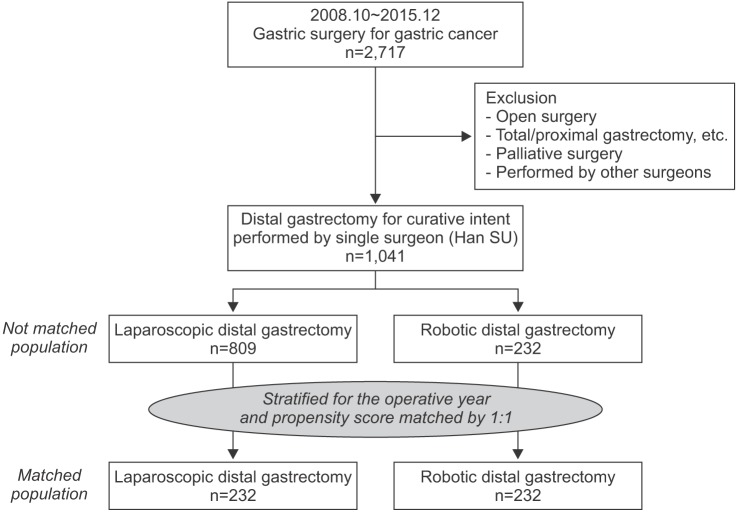
From October 2008 to December 2015, patients who underwent LDG (n=809) were matched to patients who underwent RDG (n=232) at a 1:1 ratio, by using a propensity score matching method after stratification for the operative year. The surgical outcomes, such as trends of operative time, blood loss, and complication rate, were compared between the two groups.
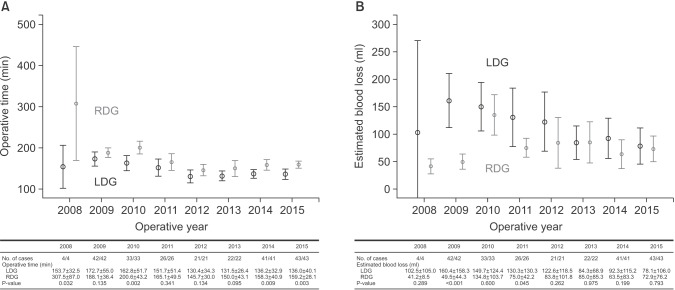
The RDG group showed a longer operative time (171.3 minutes vs. 147.6 minutes, P<0.001) but less estimated blood loss (77.6 ml vs. 116.6 ml, P<0.001). The complication rate and postoperative recovery did not differ between the two groups. The RDG group showed a longer operative time and similar estimated blood loss compared with the LDG group after 5 years of experience (operative time: 159.2 minutes vs. 136.0 minutes in 2015, P=0.003; estimated blood loss: 72.9 ml vs. 78.1 ml in 2015, P=0.793).
In terms of short-term surgical outcomes, RDG may not surpass LDG after a long-term experience with the technique.
据推测,在操作者获得机器人手臂操作的长期经验和技能后,机器人胃癌切除术可能会超过腹腔镜胃癌切除术。本研究旨在评估与腹腔镜远端胃癌切除术(LDG)相比,机器人远端胃癌切除术(RDG)的长期学习曲线。
从2008年10月至2015年12月,对接受LDG(n = 809)的患者与接受RDG(n = 232)的患者按1:1比例进行匹配,采用倾向评分匹配法,按手术年份分层。比较两组的手术结果,如手术时间趋势、失血量和并发症发生率。
RDG组手术时间较长(171.3分钟对147.6分钟,P<0.001),但估计失血量较少(77.6毫升对116.6毫升,P<0.001)。两组的并发症发生率和术后恢复情况无差异。在有5年经验后,RDG组与LDG组相比,手术时间较长,估计失血量相似(2015年手术时间:159.2分钟对136.0分钟,P = 0.003;估计失血量:2015年72.9毫升对78.1毫升,P = 0.793)。
就短期手术结果而言,在长期掌握该技术后,RDG可能不会超过LDG。