Mannino Robert G, Santiago-Miranda Adriana N, Pradhan Pallab, Qiu Yongzhi, Mejias Joscelyn C, Neelapu Sattva S, Roy Krishnendu, Lam Wilbur A
The Wallace H. Coulter Department of Biomedical Engineering at Georgia Tech and Emory University, Atlanta, GA, USA.
Department of Lymphoma and Myeloma, Division of Cancer Medicine, The University of Texas MD Anderson Cancer Center, Houston, TX, USA.
Lab Chip. 2017 Jan 31;17(3):407-414. doi: 10.1039/c6lc01204c.
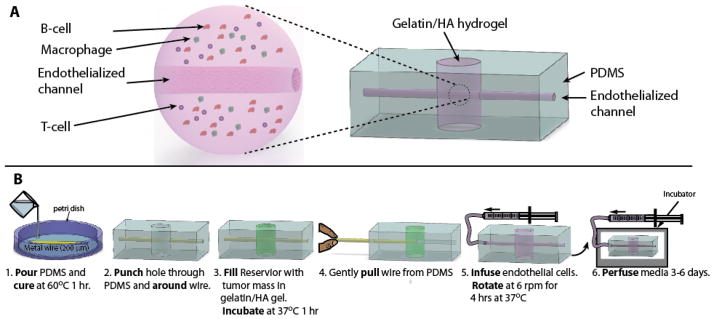
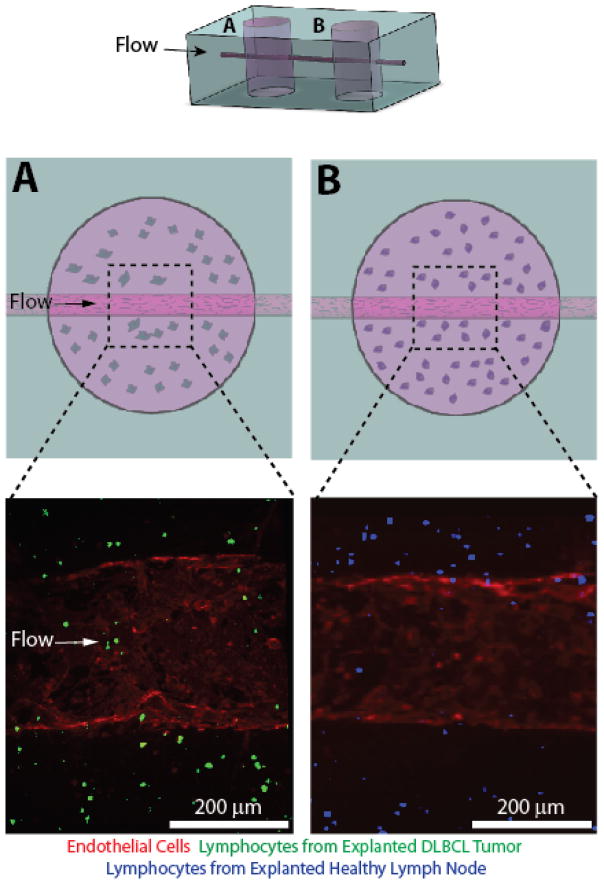
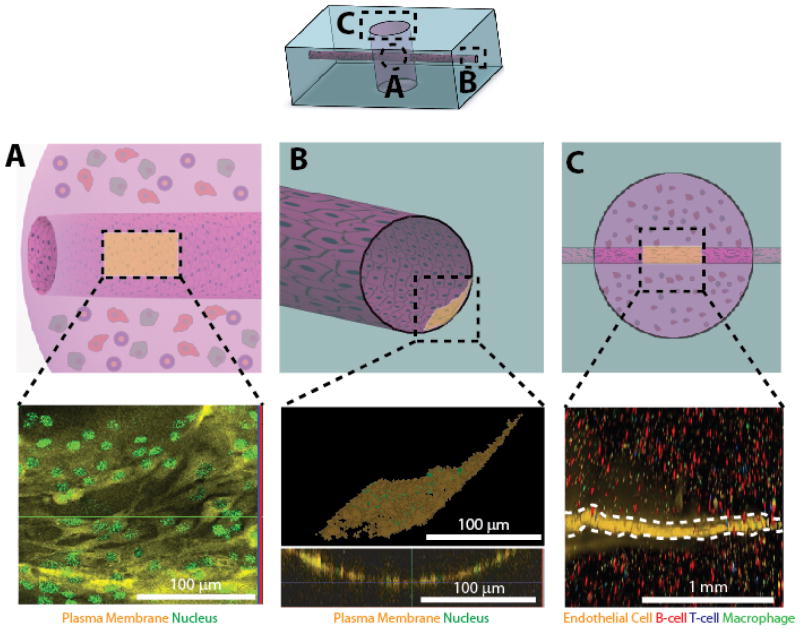
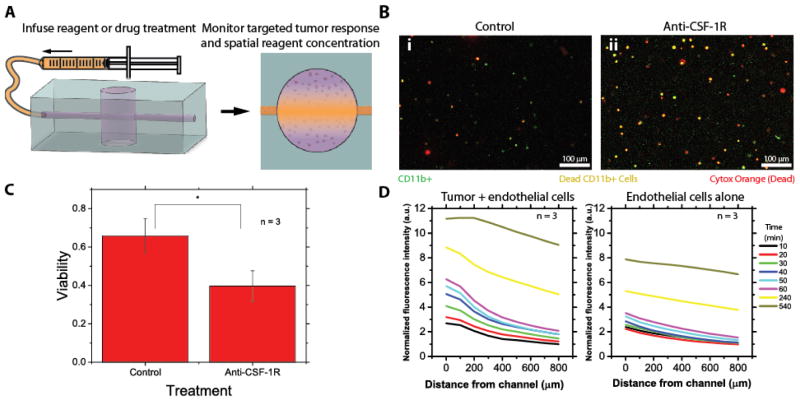
Diffuse large B-cell lymphoma (DLBCL) is an aggressive cancer that affects ∼22 000 people in the United States yearly. Understanding the complex cellular interactions of the tumor microenvironment is critical to the success and development of DLBCL treatment strategies. In vitro platforms that successfully model the complex tumor microenvironment without introducing the variability of in vivo systems are vital for understanding these interactions. To date, no such in vitro model exists that can accurately recapitulate the interactions that occur between immune cells, cancer cells, and endothelial cells in the tumor microenvironment of DLBCL. To that end, we developed a lymphoma-on-chip model consisting of a hydrogel based tumor model traversed by a vascularized, perfusable, round microchannel that successfully recapitulates key complexities and interactions of the in vivo tumor microenvironment in vitro. We have shown that the perfusion capabilities of this technique allow us to study targeted treatment strategies, as well as to model the diffusion of infused reagents spatiotemporally. Furthermore, this model employs a novel fabrication technique that utilizes common laboratory materials, and allows for the microfabrication of multiplex microvascular environments without the need for advanced microfabrication facilities. Through our facile microfabrication process, we are able to achieve micro vessels within a tumor model that are highly reliable and precise over the length of the vessel. Overall, we have developed a tool that enables researchers from many diverse disciplines to study previously inaccessible aspects of the DLBCL tumor microenvironment, with profound implications for drug delivery and design.
弥漫性大B细胞淋巴瘤(DLBCL)是一种侵袭性癌症,在美国每年影响约22000人。了解肿瘤微环境中复杂的细胞相互作用对于DLBCL治疗策略的成功与发展至关重要。能够成功模拟复杂肿瘤微环境而不引入体内系统变异性的体外平台对于理解这些相互作用至关重要。迄今为止,还不存在这样一种体外模型,能够准确再现DLBCL肿瘤微环境中免疫细胞、癌细胞和内皮细胞之间发生的相互作用。为此,我们开发了一种芯片上淋巴瘤模型,该模型由一个基于水凝胶的肿瘤模型组成,该模型被一个血管化、可灌注的圆形微通道穿过,成功地在体外再现了体内肿瘤微环境的关键复杂性和相互作用。我们已经表明,该技术的灌注能力使我们能够研究靶向治疗策略,并对注入试剂的时空扩散进行建模。此外,该模型采用了一种新颖的制造技术,该技术利用常见的实验室材料,并且无需先进的微制造设备即可实现多重微血管环境的微制造。通过我们简便的微制造工艺,我们能够在肿瘤模型中实现高度可靠且在血管长度上精确的微血管。总体而言,我们开发了一种工具,使来自许多不同学科的研究人员能够研究DLBCL肿瘤微环境中以前无法触及的方面,这对药物递送和设计具有深远影响。